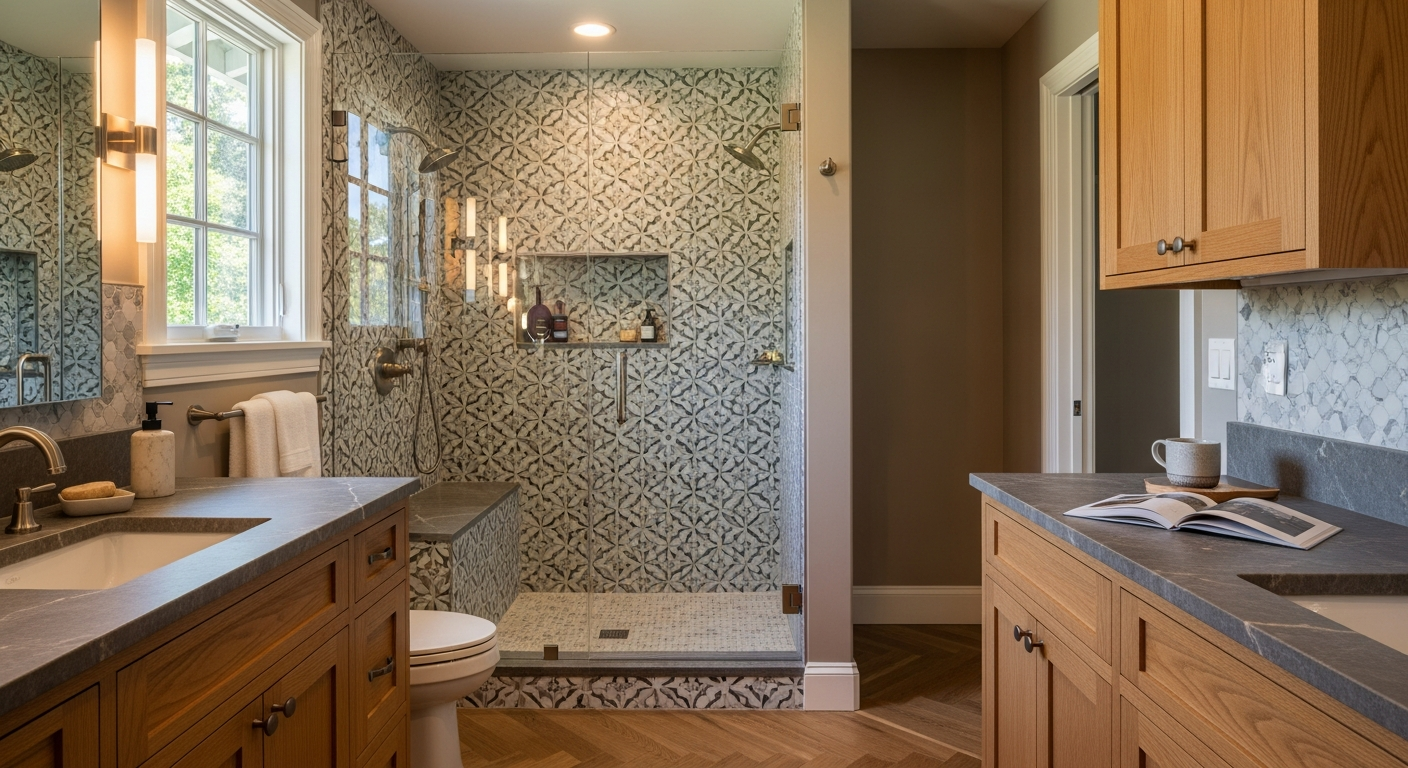
What Are the Best Walk-In Shower Ideas for Bay Area Homes in 2026?
Here's what's driving walk-in shower design decisions in the South Bay and Peninsula this year:
- Zellige tile — Handmade Moroccan clay tile with an imperfect, light-catching glaze. We're installing it in every color from warm white to sage green to terracotta.
- Calacatta Viola marble and quartzite slabs — Book-matched floor-to-ceiling slabs that eliminate grout lines and create a dramatic focal wall.
- Frameless glass panels — Fixed panels or minimal pivot doors with brushed brass or matte black hardware, replacing bulky framed enclosures.
- Curbless (zero-threshold) entries — Barrier-free showers with linear drains that create a seamless transition from bathroom floor to shower floor.
- Built-in niches with accent materials — Unlacquered brass trim around recessed niches lined in contrasting stone or tile.
- Microcement and hand-applied plaster walls — Tadelakt-style waterproof plaster for a monolithic, spa-like look with zero grout.
How Much Does a Walk-In Shower Remodel Cost in the Bay Area?
A walk-in shower remodel in the Bay Area costs between $15,000 and $55,000+ in 2026, depending on the size of the shower, the tile or stone you select, the type of glass enclosure, and whether you're reconfiguring plumbing or structural walls. Our 2026 project data from Santa Clara and San Mateo counties breaks down like this:
| Scope | Typical Bay Area Cost (2026) | Timeline | What's Included |
|---|---|---|---|
| Cosmetic Refresh (tile swap + new fixtures) | $15,000–$25,000 | 2–3 weeks | New tile over existing walls, new showerhead/valve, glass door replacement |
| Mid-Range Walk-In Shower Build | $25,000–$40,000 | 3–5 weeks | Full demo, waterproofing, zellige or porcelain tile, frameless glass, niche, linear drain |
| Luxury Walk-In Shower (slab stone or book-matched marble) | $40,000–$55,000+ | 5–8 weeks | Calacatta or quartzite slabs, curbless entry, body sprays, steam unit, heated floor |
| Full Bathroom Remodel Including Walk-In Shower | $65,000–$150,000+ | 8–14 weeks | Complete gut, new layout, walk-in shower + freestanding tub, vanity, lighting, tile floors |
A few important Bay Area-specific cost factors that homeowners in Los Altos, Menlo Park, and surrounding cities should understand:
- Waterproofing is non-negotiable. We use Schluter DITRA or Laticrete HydroBan sheet membranes in every shower. This adds $1,500–$3,000 to material costs, but it's the single most critical step in preventing water damage behind your walls.
- Permit costs vary by city. A bathroom remodel permit in Los Gatos runs $800–$1,500; in San Jose, it's $600–$1,200. Permit approval in Santa Clara County currently takes 4–8 weeks, so plan accordingly.
- Material lead times. Zellige tile imported from Morocco can take 4–6 weeks to arrive. Italian marble slabs from local stone yards (we frequently source from Arizona Tile and European Bath Kitchen Tile & Stone in San Jose) can take 2–4 weeks for fabrication after templating.
- Labor rates. Experienced tile setters in the Bay Area charge $12–$22 per square foot for installation in 2026, with zellige and natural stone on the higher end due to the precision required.
Zellige Tile Walk-In Showers: Why Bay Area Homeowners Love Handcrafted Tile
What makes zellige perfect for walk-in showers is the way its undulating surface catches and diffuses natural light. In a shower that receives morning light through a window — something common in hillside homes in Saratoga and Los Gatos — zellige transforms the entire space into something that feels alive, almost like water itself.
Here are the zellige colors and layouts we're installing most in 2026:
- Warm white / natural — The most popular. Not bright white; more of an aged linen tone with natural variation. Installed in a stacked vertical bond for a modern look.
- Sage green — A muted, organic green that pairs beautifully with unlacquered brass fixtures and rift-cut white oak vanities.
- Terracotta / clay — Earthy, warm, and unexpected. We've used this in a primary shower in Willow Glen paired with Dekton Kreta countertops in the adjacent vanity.
- Deep blue / midnight — A dramatic choice for powder-room-adjacent showers or guest baths where homeowners want to make a statement.
Cost data: Zellige tile itself costs $15–$35 per square foot for the material, with premium sources like Clé Tile or Mosaic House running $25–$45 per square foot. Installation runs $14–$22 per square foot in the Bay Area because each tile must be hand-set individually and the variation requires an experienced setter who can read the tones and maintain consistent grout lines. For a typical 50-square-foot walk-in shower (walls only), expect to spend $2,500–$4,500 on tile and $1,500–$2,500 on setting labor.
One important note: zellige is porous. We always seal it with a penetrating stone sealer after installation and recommend resealing every 12–18 months. Some clients prefer the patina that develops over time; others want it to stay pristine. We discuss this upfront during our 3D design rendering phase so clients can see exactly what their zellige shower will look like before we break ground.
Walk-In Shower Tile Options: Zellige vs. Marble vs. Porcelain vs. Microcement
Choosing the right wall and floor material is the most impactful decision in any walk-in shower project. Here's a side-by-side comparison of the four most popular walk-in shower tile options we install across Silicon Valley in 2026, with real cost and maintenance data from our projects:
| Material | Material Cost/SF | Install Cost/SF (Bay Area) | Maintenance | Look & Feel | Best For |
|---|---|---|---|---|---|
| Zellige Tile | $15–$45 | $14–$22 | Seal every 12–18 months; porous | Handmade, luminous, organic texture | Primary shower focal wall, spa-like aesthetics |
| Calacatta Marble Slab | $40–$120 | $18–$30 (fabrication + install) | Seal annually; can etch from acidic products | Dramatic veining, luxurious, timeless | Book-matched feature walls, luxury primary baths |
| Large-Format Porcelain (Dekton, Neolith) | $8–$25 | $10–$18 | Virtually maintenance-free; non-porous | Clean, uniform; can mimic stone | Low-maintenance showers, rental properties, guest baths |
| Microcement / Tadelakt Plaster | $12–$30 | $20–$35 (specialist required) | Seal every 1–2 years; repair chips promptly | Monolithic, seamless, spa-like, zero grout lines | Contemporary/minimalist designs, European-style baths |
A few insights from our project experience:
- Marble slab showers look extraordinary but require commitment. The Calacatta Viola marble we installed in a recent primary bathroom in Atherton had dramatic purple veining that the homeowner fell in love with at the stone yard. We book-matched two slabs across the back wall for a symmetrical, butterfly-wing pattern. Material cost for those slabs alone was $8,500.
- Microcement is rising fast. We've completed six microcement shower installations in the past 12 months. The seamless, grout-free look is stunning, but it requires a specialist applicator — there are only a handful of qualified ones in the Bay Area, which extends timelines by 1–2 weeks.
For shower floors specifically, I almost always recommend natural stone mosaic (honed marble penny rounds or pebble) or textured porcelain for grip. Never use polished marble on a shower floor — it becomes dangerously slippery when wet. Honed or tumbled finishes with proper slope to the drain (we target 1/4" per foot to a linear drain) are essential.
Frameless Glass Walk-In Showers: Fixed Panels, Pivot Doors, and Curbless Designs
Frameless glass enclosures are the standard for any walk-in shower we build in 2026 — framed shower doors feel dated and visually heavy. A frameless glass panel or door uses 3/8" to 1/2" tempered glass with minimal hardware, letting the tile or stone be the star while making the bathroom feel significantly larger.
Here are the three most popular frameless configurations we install:
- Fixed glass panel (no door): A single stationary panel of tempered glass, typically 30"–36" wide, positioned to contain most water spray while allowing an open entry. This works best with curbless showers and is our most requested configuration in 2026. Cost: $1,200–$2,500 installed.
- Frameless pivot door: A single glass door that pivots open and closed, typically with a small fixed panel. Ideal for enclosed shower niches. Cost: $2,000–$4,000 installed, depending on glass thickness and hardware finish.
- Inline panel + door combo: For larger showers (60"+ opening), a fixed panel and a swinging door create a seamless glass wall. Cost: $3,000–$5,500 installed.
Hardware finish matters. In 2026, brushed brass (sometimes called satin brass or champagne bronze) dominates hardware selections across our Bay Area projects — appearing in about 60% of bathroom remodels. Matte black remains popular at around 25%, and polished chrome/nickel has dropped to about 15%. Unlacquered brass is a premium choice that develops a living patina over time; it costs 20–30% more than standard finishes but adds incredible character.
Curbless (zero-threshold) walk-in showers deserve special attention. Removing the shower curb creates a seamless floor plane that is both visually stunning and practically beneficial for aging in place. However, curbless showers in Bay Area homes require careful structural work:
- The subfloor must be recessed to accommodate the slope-to-drain within the shower area while keeping the bathroom floor level.
- In homes with raised foundations (common in older Los Gatos and Palo Alto neighborhoods), this is straightforward. In slab-on-grade construction, it may require cutting into the concrete slab — adding $2,000–$4,000 to the project.
- We use linear drains from brands like Schluter Kerdi-Line or Infinity Drain, positioned at the shower entry point so water never reaches the bathroom floor.
The result is worth the effort. A curbless walk-in shower with a fixed glass panel, zellige walls, and a honed marble floor is the signature feature of probably 40% of the bathroom renovations we've completed in the past year. It's the single detail that gets the most compliments from homeowners after move-in.
Walk-In Shower Features That Add Luxury: Steam, Body Sprays, Heated Floors, and Niches
1. Steam shower systems ($3,500–$7,000 installed)
Steam generators from brands like Mr. Steam or ThermaSol turn any enclosed walk-in shower into a personal steam room. The generator installs in a nearby closet or vanity cabinet, and a small steam head mounts low on the shower wall. Requirements: the shower must be fully enclosed (no open-entry designs) and the ceiling should be sloped slightly to prevent condensation dripping. We install approximately 15–20 steam showers per year, mostly in primary bathrooms in Los Gatos and Saratoga.
2. Body spray systems ($2,000–$5,000 for hardware + installation)
Multiple wall-mounted body sprays create an immersive, spa-like water experience. We typically install 4–6 body jets in two vertical columns, controlled by a thermostatic diverter valve. Brand recommendations: Hansgrohe Raindance, Kohler Hydrorail, or Brizo Litze. Important note: body sprays require a 3/4" water supply line — most homes have 1/2" lines to the shower, so your contractor must upsize the supply during rough-in.
3. Radiant heated shower floors ($800–$1,500 installed)
Electric radiant heat mats from Schluter DITRA-HEAT or NuHeat install beneath the shower floor tile. Stepping onto a warm floor on a cool Bay Area morning — even in July when the marine layer rolls in — is a small luxury that every client tells me they'd never give up. It adds minimal cost relative to the daily comfort.
4. Recessed shower niches ($400–$1,200 per niche, built-in)
Built-in niches eliminate the need for hanging caddies and corner shelves. We typically recommend one large niche (12" x 24") at chest height and a smaller one (6" x 12") lower for items used while seated or shaving. Lining the niche interior with a contrasting material — say, a strip of Calacatta marble inside a zellige shower, or unlacquered brass trim on the edges — adds a designer detail that elevates the entire shower.
5. Rainhead showerheads ($300–$2,000 for the fixture)
6. LED shower lighting and integrated speakers
How Long Does a Walk-In Shower Remodel Take in Silicon Valley?
- Tile-only shower refresh (no layout changes): 2–3 weeks of on-site work
- Full walk-in shower build (new waterproofing, tile, glass, fixtures): 3–5 weeks of on-site work
- Complete bathroom remodel including walk-in shower: 8–14 weeks of on-site work
However, the total project timeline from design kickoff to completion is longer than just the construction phase. Here's how the full process breaks down for a mid-range to luxury walk-in shower project:
- Design and material selection: 2–4 weeks. Our team uses 3D design renderings to visualize every detail before ordering materials.
- Permitting: 4–8 weeks in Santa Clara County; 3–6 weeks in San Mateo County. Note: a simple tile replacement may not require a permit, but any plumbing relocation, electrical changes, or structural modifications will.
- Material procurement: 2–6 weeks. Stock porcelain tiles can arrive in days; imported zellige from Morocco takes 4–6 weeks; custom-fabricated stone slabs take 2–4 weeks after templating.
- Construction: 3–8 weeks depending on scope.
The most common delay I see? Material changes mid-project. When a homeowner selects a tile, then switches to a different option after demolition has started, it can add 2–4 weeks to the timeline while we wait for the new material. This is exactly why we invest heavily in the design phase with photorealistic 3D renderings — so there are no surprises once hammers start swinging.
For homeowners planning a whole-house remodel that includes multiple bathrooms, we sequence the shower work so that you always have at least one functioning bathroom throughout construction. It's a logistical detail that matters enormously to families living in the home during renovation.
Frequently Asked Questions
How much does it cost to build a walk-in shower in the Bay Area in 2026?
Is zellige tile good for showers or does it stain?
Zellige tile is excellent for showers when properly sealed and maintained. It's been used in wet environments for centuries in Moroccan hammams. The key is applying a penetrating sealer (we use products from StoneTech or Miracle Sealants) after installation and resealing every 12–18 months. Zellige is porous, so without sealing it can absorb water and develop staining from colored products like hair dye or certain shampoos. Most of our Bay Area clients find the slight patina that develops over time adds character, but if you prefer zero maintenance, large-format porcelain tiles that mimic handmade looks (like those from Cle Tile's porcelain line) are a practical alternative.
What is the best tile for a walk-in shower in 2026?
How big does a walk-in shower need to be?
The minimum recommended size for a comfortable walk-in shower is 36" x 48" (12 square feet), but most Bay Area homeowners building new walk-in showers go larger. Our most common size in 2026 is 42" x 60" to 48" x 72", which provides room for a built-in bench, comfortable movement, and proper water containment with a fixed glass panel. For curbless/open-entry designs, we recommend at least 48" x 60" so the open side has enough distance from the showerhead to prevent water from reaching the bathroom floor. If you're converting a tub-shower combo, the existing 60" x 30" alcove is workable but tight; many of our clients in Los Gatos and Saratoga choose to expand the footprint by borrowing space from an adjacent closet.
Do walk-in showers increase home value in Silicon Valley?
What is the difference between a curbless shower and a regular walk-in shower?
Do I need a permit for a walk-in shower remodel in Los Gatos or Santa Clara County?
It depends on the scope. A simple tile replacement with no changes to plumbing, electrical, or structural elements typically does not require a permit. However, if you're moving plumbing (relocating the showerhead or drain), adding electrical (heated floors, steam units, new lighting circuits), or modifying walls or subfloor structure, you will need a building permit from the Town of Los Gatos Building Department or the Santa Clara County Planning and Development Department. Permit approval currently takes 4–8 weeks in Santa Clara County and costs $800–$1,500 for a bathroom remodel in Los Gatos. At Barcci Builders (CA License #1086047), we handle all permitting and inspections as part of our design-build process.
Can I convert a bathtub to a walk-in shower in my Bay Area home?
Absolutely — tub-to-shower conversions are one of our most common projects. The existing 60" x 30" tub alcove provides a ready-made space for a walk-in shower. The process involves removing the tub, capping or rerouting the tub drain and supply lines to shower configuration, installing new waterproofing membrane, setting tile, and adding a frameless glass enclosure. Total cost for a tub-to-walk-in-shower conversion in the Bay Area runs $18,000–$35,000 in 2026, depending on materials. Timeline is typically 3–4 weeks. One consideration: if this is the only bathtub in the home, we usually recommend keeping it or adding a freestanding tub elsewhere — especially for resale value in family-oriented neighborhoods like Willow Glen or Downtown Los Gatos.