How Do You Remodel a Small Kitchen to Maximize Space?
You maximize space in a small kitchen remodel by rethinking the layout, choosing space-efficient cabinetry, and selecting materials that visually expand the room — not by tearing down every wall. Based on our 116+ completed Bay Area projects, the most impactful small kitchen remodel ideas combine smart storage solutions (pull-out pantries, integrated appliance garages, drawer-within-drawer systems) with design tricks that make a compact footprint feel open and functional.
I'm Bar Benbenisty, founder of Barcci Builders (CA Contractor License #1086047), and my team has remodeled kitchens across Los Gatos, Saratoga, Palo Alto, and throughout Silicon Valley. Many of the homes we work on — especially mid-century ranches in Willow Glen, Eichlers in Sunnyvale, and bungalows in Old Mountain View — have kitchens under 120 square feet. These are homes where every single inch matters.
Here's what I've learned after doing this for years: a small kitchen doesn't need to feel small. The homeowners who end up happiest aren't the ones who spent the most — they're the ones who planned the smartest. This guide walks you through the exact strategies, materials, costs, and timelines that work in real Bay Area kitchens in 2026.
What Are the Best Small Kitchen Layout Ideas for Bay Area Homes?
The best small kitchen layout for Bay Area homes depends on your square footage and how the kitchen connects to adjacent rooms, but galley kitchens, L-shaped layouts, and single-wall kitchens with an island consistently deliver the highest efficiency per square foot. Our 2026 project data shows that galley-to-open-concept conversions are the most requested small kitchen layout change across Los Gatos, Cupertino, and Campbell.
Here are the layouts we recommend most often for compact Bay Area kitchens:
Galley Kitchen (Two-Wall Parallel)
Ideal for kitchens between 60 and 100 square feet. We keep the corridor at 42–48 inches wide — enough for two people to pass comfortably. In a recent Campbell project, we transformed a cramped 75-square-foot galley by removing upper cabinets on one side, replacing them with open shelving in unlacquered brass brackets, and installing a full-height window. The kitchen felt twice its actual size.
L-Shaped With Peninsula
This is the sweet spot for kitchens between 100 and 150 square feet. The peninsula replaces a standalone island (which rarely fits in a small kitchen) and doubles as a breakfast bar. We typically spec 12-inch overhangs on the seating side with integrated finger-pull cabinetry below for seamless storage.
Single-Wall Kitchen With Compact Island
For open-concept conversions — especially in Eichler homes throughout Sunnyvale and Mountain View — consolidating everything to one wall with a movable or slim island (24 inches deep instead of the standard 36) works beautifully. This layout maximizes floor area while preserving the mid-century open flow.
| Layout Type | Best For (Sq Ft) | Avg. Remodel Cost (Bay Area 2026) | Timeline |
|---|---|---|---|
| Galley Kitchen | 60–100 sq ft | $65,000–$110,000 | 8–11 weeks |
| L-Shaped with Peninsula | 100–150 sq ft | $85,000–$145,000 | 10–14 weeks |
| Single-Wall + Island | 80–130 sq ft | $75,000–$130,000 | 9–12 weeks |
| U-Shaped (Compact) | 90–140 sq ft | $90,000–$155,000 | 10–14 weeks |
As someone who's completed over 116 remodels across the Bay Area, the single biggest mistake I see homeowners make with small kitchen layouts is trying to force a large island into a space that can't support it. If you don't have at least 36 inches of clearance on all four sides of an island, skip it and use a peninsula instead. You'll gain storage, seating, and sanity.
How Much Does a Small Kitchen Remodel Cost in the Bay Area in 2026?
A small kitchen remodel in the Bay Area costs between $55,000 and $160,000 in 2026, depending on scope, material selections, and whether structural changes or permit work are involved. Based on our 2026 project data from homes in Los Gatos, Saratoga, Los Altos, and across Santa Clara County, the average small kitchen remodel (under 150 square feet) lands around $95,000–$120,000 for a mid-range to high-end finish.
Here's how costs typically break down:
| Cost Category | Cosmetic Refresh | Mid-Range Remodel | High-End Remodel |
|---|---|---|---|
| Cabinetry | $8,000–$15,000 (reface) | $18,000–$35,000 | $35,000–$65,000 (custom) |
| Countertops | $3,500–$6,000 | $6,000–$14,000 | $14,000–$28,000 |
| Appliances | $4,000–$8,000 | $10,000–$22,000 | $22,000–$50,000+ |
| Flooring | $2,500–$5,000 | $5,000–$10,000 | $10,000–$18,000 |
| Plumbing + Fixtures | $2,000–$4,000 | $5,000–$12,000 | $12,000–$25,000 |
| Electrical + Lighting | $1,500–$3,500 | $4,000–$10,000 | $10,000–$20,000 |
| Demolition + Labor | $3,000–$6,000 | $12,000–$25,000 | $25,000–$45,000 |
| Permits + Design | $0–$2,000 | $3,000–$8,000 | $8,000–$18,000 |
| Total Range | $25,000–$50,000 | $63,000–$136,000 | $136,000–$269,000 |
A few cost factors that are specific to the Bay Area in 2026:
- Permit fees in Santa Clara County currently run $1,200–$3,500 for kitchen remodels involving electrical, plumbing, or structural changes. Permit approval takes 4–8 weeks through the Santa Clara County Planning office or your local city building department.
- Bay Area labor rates are 25–40% higher than the national average. Skilled finish carpenters, licensed plumbers, and electricians in Silicon Valley command premium rates, and rightfully so — the quality of work here is exceptional.
- Material lead times for imported surfaces like Calacatta Viola marble or Dekton Kreta can add 3–6 weeks. We always advise clients to finalize material selections before demolition day.
For a detailed consultation on your specific space, our kitchen remodeling service starts with a complimentary site assessment where we walk through the space and give you realistic numbers — not generic online estimates.
What Are the Best Storage Solutions for a Small Kitchen Remodel?
The best storage solutions for a small kitchen remodel are full-height cabinetry to the ceiling, pull-out pantry systems, corner carousel drawers, and integrated appliance garages that hide countertop clutter. In our experience across 116+ Bay Area projects, upgrading to ceiling-height cabinets alone adds 25–30% more storage to a small kitchen without expanding the footprint.
Here are the specific storage strategies our team installs most often in compact kitchens across Los Altos, Cupertino, and the greater South Bay:
1. Floor-to-Ceiling Cabinetry
Standard upper cabinets stop at 84–90 inches. In homes with 9-foot ceilings (common in newer Bay Area construction), that leaves 18–24 inches of dead space. We extend cabinets to 96–108 inches with a dedicated top shelf for rarely used items — holiday platters, oversize serving bowls, backup small appliances. The visual effect is dramatic: the room looks taller and more streamlined.
2. Pull-Out Pantry Towers
A 12-inch-wide pull-out pantry tower holds more than you'd expect — spices, oils, canned goods, baking supplies. We use Blum Legrabox or Hafele systems for smooth soft-close action. In a recent 95-square-foot kitchen remodel in Downtown Los Gatos, we installed two pull-out pantry columns flanking the refrigerator and eliminated the need for a separate pantry closet entirely.
3. Deep Drawer Systems Instead of Lower Cabinets
Lower cabinets with shelves waste space because you can't see or reach items in the back. Deep drawers with custom dividers — especially 24-inch-deep pot drawers and 30-inch-deep peg-board dish drawers — increase usable lower storage by roughly 40%. Pair these with integrated finger pulls (a major 2026 design trend) for a clean, hardware-free look that doesn't catch hips in tight galley kitchens.
4. Corner Solutions That Actually Work
Lazy Susans are outdated. In 2026, we're installing LeMans corner pull-out systems (by Kesseböhmer) and blind-corner optimizer trays. These systems pull everything forward in an arc motion, making the entire corner accessible. The cost premium over a standard lazy Susan is about $400–$800, but the usability gain is enormous.
5. Integrated Appliance Garages
Tambour-door or lift-up appliance garages built into the backsplash zone keep stand mixers, toasters, and coffee machines hidden but accessible. This reclaims 4–6 square feet of visual counter space — a significant gain when your total counter space is only 20–30 square feet.
What Materials and Finishes Make a Small Kitchen Look Bigger in 2026?
Light-toned but warm materials, reflective surfaces, continuous slab backsplashes, and streamlined cabinetry with minimal hardware make a small kitchen look significantly bigger. The 2026 design trend in the Bay Area has moved decisively away from sterile all-white kitchens toward warm earthy tones, textured natural materials, and organic shapes that feel spacious without feeling cold.
Here's what's working in our small kitchen projects right now:
Cabinetry: Rift-Cut White Oak and Warm Neutrals
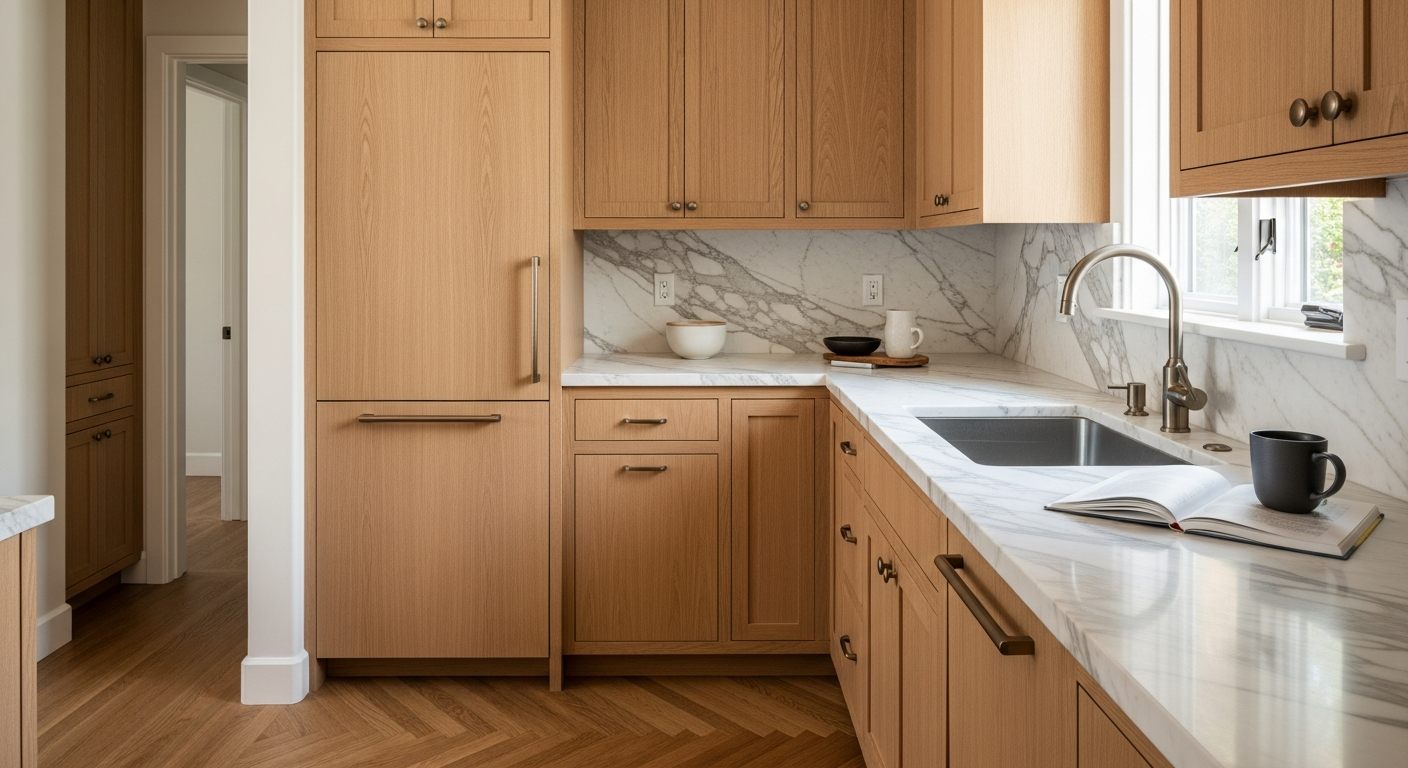
Rift-cut white oak is the dominant cabinet material in premium Bay Area kitchens in 2026. Its tight, linear grain reads clean and modern, and the warm honey tone adds depth without darkening the room. For painted cabinets, our clients are choosing warm greiges, soft sage greens, and creamy off-whites (Benjamin Moore White Dove, Sherwin-Williams Accessible Beige) instead of stark bright white.
Countertops: Dekton, Quartzite, and Statement Marble
78% of our Bay Area clients choose engineered surfaces over natural granite in 2026. Dekton Kreta and Dekton Eter are extremely popular for small kitchens because the ultracompact material can be fabricated at 12mm thickness — visually lighter than a standard 3cm slab — while being virtually indestructible. For clients who want natural stone, Calacatta Viola marble with its soft purple veining creates a stunning focal point. Quartzite options like Taj Mahal and Mont Blanc deliver the marble aesthetic with better durability.
Backsplashes: Full-Height Slabs and Zellige Tile
In small kitchens, a continuous slab backsplash — using the same countertop material running up to the upper cabinets — eliminates visual breaks and makes the space feel larger. Zellige tile, with its handmade irregularity and subtle color variation, is the other trending choice for Bay Area kitchens in 2026. Its reflective glaze bounces light beautifully in compact spaces.
Flooring: Herringbone Patterns and Microcement
Herringbone wood floors in European white oak create visual movement that tricks the eye into perceiving more space. For a seamless, grout-free look, microcement flooring is gaining traction — especially in open-concept conversions where the kitchen flows into living areas in homes across Menlo Park and Professorville in Palo Alto.
Range Hoods: Plaster and Organic Shapes
Plaster range hoods with curved, organic shapes are replacing boxy stainless steel hoods in 2026. In a small kitchen, a custom plaster hood in the same tone as the walls creates visual continuity — the hood disappears into the architecture rather than dominating the room. Our team builds these on-site using a steel frame with hand-applied plaster finish, typically costing $3,500–$7,500 installed.
Hardware and Fixtures: Unlacquered Brass and Integrated Pulls
Unlacquered brass fixtures and faucets (we frequently spec Waterworks, Brizo Litze, and Kohler Purist in brass) add warmth and develop a living patina over time. For cabinet hardware, integrated finger pulls routed directly into the cabinet door edge are the cleanest option for small kitchens — no protruding handles to catch on in tight spaces.
Which Appliances Are Best for Small Kitchens in the Bay Area?
The best appliances for small Bay Area kitchens are counter-depth refrigerators, 30-inch or 24-inch ranges, single-drawer dishwashers, and induction cooktops — which are rapidly becoming the default in Silicon Valley due to California's building electrification codes and their superior performance in compact spaces. Our 2026 project data shows that 65% of our Bay Area kitchen clients now choose induction over gas.
Here are specific appliance recommendations by size:
For Kitchens Under 100 Square Feet
- Refrigerator: 24-inch column units from Thermador, Bosch, or Fisher & Paykel. Panel-ready models integrate seamlessly with cabinetry.
- Range/Cooktop: 24-inch Miele induction range or a 30-inch Bosch 800 Series induction cooktop with separate wall oven.
- Dishwasher: Fisher & Paykel DishDrawer single drawer (24-inch) — uses less water and fits perfectly in compact layouts. Or a standard 18-inch dishwasher from Bosch.
- Ventilation: Downdraft vent or recirculating hood to eliminate overhead ductwork bulk.
For Kitchens 100–150 Square Feet
- Refrigerator: 30-inch counter-depth from Thermador, Bosch Benchmark, or Sub-Zero. Counter-depth models sit flush with 24-inch cabinets, reclaiming 4–6 inches of floor space versus standard-depth units.
- Range: 30-inch Thermador Pro Harmony or Wolf Induction Range. Both offer serious cooking performance in a compact package.
- Dishwasher: Standard 24-inch Miele G7000 series — the quietest dishwashers on the market at 38 dBA, which matters in open-concept small kitchens where the living room is ten feet away.
One tip from our field experience: don't cheap out on the range hood. Underpowered ventilation in a small kitchen means grease buildup on your beautiful new cabinets within months. We spec a minimum of 400 CFM for any kitchen, and 600+ CFM if you're doing serious wok cooking — common in many Bay Area households.
How Long Does a Small Kitchen Remodel Take in Silicon Valley?
A small kitchen remodel in Silicon Valley takes 8 to 14 weeks from demolition to final walkthrough, with an additional 4–10 weeks of pre-construction for design, permitting, and material procurement. Based on our 2026 project data, the total timeline from signing a contract to cooking in your new kitchen is typically 14–24 weeks.
Here's a realistic week-by-week breakdown:
Pre-Construction Phase (4–10 Weeks)
- Weeks 1–2: Design development, material selections, and 3D design renderings so you can visualize the finished space before anything is demolished.
- Weeks 2–4: Permit submission. In Santa Clara County, kitchen remodel permits that involve electrical, plumbing, or structural modifications currently take 4–8 weeks for plan-check approval. San Mateo County Building Department timelines are similar at 3–6 weeks.
- Weeks 3–8: Material ordering. Custom cabinetry takes 6–10 weeks to fabricate. Countertop templating and fabrication adds 2–3 weeks. We advise clients to finalize all material selections before permits are even submitted — this is the number one way to compress your timeline.
Construction Phase (8–14 Weeks)
- Week 1: Demolition (1–3 days for a small kitchen)
- Weeks 2–3: Rough plumbing, electrical, and any structural work (headers for wall removals, floor leveling)
- Week 4: Inspections — Santa Clara County requires rough mechanical inspections before walls are closed
- Weeks 4–5: Drywall, patching, and prep
- Weeks 5–7: Cabinet installation, followed by countertop templating (2–3 day wait for fabrication)
- Weeks 7–9: Countertop installation, tile backsplash, flooring
- Weeks 9–11: Appliance installation, plumbing trim, electrical trim, painting
- Weeks 11–14: Punch list, final inspections, touch-ups, and walkthrough
The most common cause of delays in Bay Area kitchen remodels? Changing material selections mid-project. Every change order after demolition adds 1–3 weeks and increases costs by 5–15%. This is why our process at Barcci Builders front-loads all decision-making with detailed 3D renderings and material boards before we ever pick up a sledgehammer.
Frequently Asked Questions
How much does it cost to remodel a small kitchen in Los Gatos?
A small kitchen remodel in Los Gatos costs between $65,000 and $160,000 in 2026, depending on the scope of work. A cosmetic refresh (new countertops, cabinet refacing, updated fixtures) starts around $25,000–$50,000, while a full gut renovation with custom cabinetry, premium countertops like Calacatta Viola marble or Dekton, and high-end appliances from Thermador or Miele typically runs $95,000–$160,000. Based on our project data from 116+ completed Bay Area remodels, the average Los Gatos small kitchen remodel costs approximately $110,000 with mid-range to high-end finishes.
Can you remodel a small kitchen without a permit in the Bay Area?
You can do cosmetic work — painting cabinets, replacing countertops with the same footprint, swapping hardware, and updating light fixtures on existing circuits — without a permit in most Bay Area jurisdictions. However, any work that moves plumbing, adds or moves electrical circuits, removes or modifies walls (even non-load-bearing), or changes the kitchen footprint requires permits from your local building department. In Santa Clara County, unpermitted work can result in fines and complications when you sell your home. Permit fees for a small kitchen remodel typically run $1,200–$3,500 in 2026, and approval takes 4–8 weeks.
What is the best countertop for a small kitchen in 2026?
The best countertop for a small kitchen in 2026 depends on your priorities. For durability and low maintenance, Dekton (an ultracompact sintered surface by Cosentino) in options like Kreta or Eter is our top recommendation — it can be fabricated at a slim 12mm thickness that looks light and modern in compact spaces. For natural beauty, quartzite varieties like Taj Mahal or Mont Blanc deliver a marble look with significantly better stain resistance. If budget allows, Calacatta Viola marble is the current statement stone of choice in the Bay Area. 78% of our Bay Area clients choose quartz or engineered surfaces over natural granite in 2026.
How do you make a galley kitchen look bigger?
To make a galley kitchen look bigger: remove upper cabinets on one side and replace with open shelving or a window, use a continuous slab backsplash in a light material, install under-cabinet LED lighting to eliminate shadows, choose light-toned rift-cut white oak or painted cabinets in warm off-whites, use the same flooring material (herringbone pattern adds visual length) as the adjacent room, and install integrated finger-pull hardware instead of protruding handles. Keeping the corridor width between 42 and 48 inches ensures the space feels open while remaining ergonomic for cooking.
Is it worth remodeling a small kitchen before selling a home in Silicon Valley?
Yes. According to our experience working with Bay Area homeowners and local real estate data, a well-executed kitchen remodel in Silicon Valley returns approximately 70–85% of the investment at resale in 2026. In competitive markets like Los Gatos, Saratoga, Los Altos, and Palo Alto, an updated kitchen can be the deciding factor between multiple offers. We recommend focusing your budget on quality cabinetry, premium countertops, and modern appliances rather than overly personalized design choices. A $90,000–$120,000 kitchen remodel on a home valued at $2.5M–$4M is a proportionally smart investment.
Induction cooktop vs gas range for a small kitchen — which is better?
For small Bay Area kitchens in 2026, induction cooktops are generally the better choice. They're faster (boiling water in under 90 seconds), more energy-efficient, generate significantly less ambient heat (critical in a small kitchen without great ventilation), and are now required in many new Bay Area construction projects under California's building electrification codes. Brands like Thermador, Bosch, Wolf, and Miele all make excellent 30-inch induction cooktops. The main trade-off is that your cookware must be magnetic (cast iron and most stainless steel work; aluminum and copper do not). 65% of our Bay Area kitchen clients now choose induction over gas.
What are the best kitchen cabinet colors for small spaces in 2026?
The best kitchen cabinet colors for small spaces in 2026 are warm off-whites (Benjamin Moore White Dove, Simply White), warm greiges (Sherwin-Williams Accessible Beige, Benjamin Moore Edgecomb Gray), and soft sage greens. Natural wood tones — especially rift-cut white oak with a clear or light stain — are the dominant premium choice in Bay Area kitchens. The trend has moved decisively away from bright, stark white and cool gray toward warm, earthy tones with organic texture. Two-tone combinations (lighter uppers with a wood or darker lower) can add depth to a small kitchen without making it feel closed-in.
How much kitchen storage can you add in a small kitchen remodel?
A well-planned small kitchen remodel can increase usable storage by 30–50% without changing the kitchen's footprint. The biggest gains come from extending cabinets to the ceiling (adds 25–30% more cubic storage), replacing lower shelved cabinets with deep drawer systems (increases usable lower storage by roughly 40%), adding pull-out pantry towers in 12-inch-wide spaces next to appliances, and incorporating corner optimizer systems instead of dead corner cabinets. Based on our projects across Los Gatos, Campbell, and Cupertino, these strategies combined can transform a kitchen from frustratingly inadequate to more than sufficient for a family of four.