Should You Remodel or Tear Down and Rebuild Your Bay Area Home?
For most Bay Area homeowners, a major remodel costs between $250,000 and $700,000 in 2026, while a full tear-down and rebuild typically runs $800,000 to $1.5 million or more — but the right choice depends on your home's existing condition, your long-term goals, and local zoning constraints. There is no universal answer, and anyone who gives you one before evaluating your property is skipping the most important step.
I'm Bar Benbenisty, founder of Barcci Builders (CA Contractor License #1086047), and over the past decade our team has completed 116+ residential projects across Los Gatos, Saratoga, Palo Alto, and throughout Silicon Valley. Roughly 30% of those projects started as remodel inquiries and ended up as tear-down-and-rebuild conversations — or vice versa. The decision is rarely as clear-cut as people expect.
This guide walks you through the real numbers, timelines, permit realities, and hidden costs for both paths in 2026. I'll share the framework our team uses with every client, including the specific scenarios where remodeling saves six figures and the scenarios where tearing down and starting fresh is actually the smarter financial move.
How Much Does a Whole-House Remodel Cost vs a New Build in the Bay Area in 2026?
| Category | Major Whole-House Remodel | Tear Down and Rebuild |
|---|---|---|
| Cost per sq ft (construction only) | $200–$450/sq ft | $400–$700/sq ft |
| Typical total project cost | $250,000–$700,000+ | $800,000–$1,500,000+ |
| Demolition costs | $5,000–$25,000 (selective) | $25,000–$60,000 (full) |
| Architecture and engineering | $20,000–$60,000 | $60,000–$150,000 |
| Permit fees (Santa Clara County) | $8,000–$25,000 | $30,000–$80,000+ |
| Temporary housing (if needed) | $0–$30,000 (3–5 months) | $36,000–$84,000 (12–18 months) |
| Timeline (permit to move-in) | 4–8 months | 12–20 months |
| Typical ROI at resale | 60–80% cost recovery | 70–90% cost recovery (new home premium) |
These ranges reflect projects in Los Altos, Menlo Park, Los Gatos, and other South Bay and Peninsula communities where land values are high and construction labor is at a premium. A whole-house remodel in Cupertino will cost significantly more per square foot than one in Milpitas or Fremont, because local labor demand, soil conditions, and municipal requirements vary widely.
When Does It Make More Sense to Remodel Instead of Tearing Down?
Remodeling makes more financial sense when your home's foundation, framing, and roof are structurally sound, and your desired changes don't require expanding the footprint by more than 30–40%. In our experience, homeowners who remodel rather than rebuild save an average of $400,000–$700,000 in total project costs across Silicon Valley in 2026.
Here are the specific scenarios where our team at Barcci Builders consistently recommends remodeling over tearing down:
- Sound structural bones: If your foundation passes a structural engineer's inspection (typically $1,500–$3,000 in the Bay Area), your home is a strong remodel candidate. Many 1950s–1970s ranch homes in Campbell, Willow Glen, and Old Mountain View have excellent post-and-pier or slab foundations that need only minor seismic retrofitting ($15,000–$40,000).
- You love your lot position and setbacks: Current zoning may actually give you less buildable area than your existing footprint. In Los Gatos, many older homes were built before current setback requirements — tearing down means the new build must comply with today's rules, potentially shrinking your livable square footage by 10–20%.
- You want to stay under the 50% rule: Most Bay Area municipalities (including Santa Clara County and San Mateo County jurisdictions) allow renovations that don't exceed 50% of the home's assessed structural value without triggering a full code upgrade to current standards. Staying below this threshold can save $80,000–$200,000 in mandatory upgrades.
- Budget is under $600,000: For this investment, a skilled kitchen remodel, full bathroom renovations, new flooring, updated electrical and plumbing, and even a modest addition deliver far more value than a bare-bones tear-down and rebuild.
- Historic or architecturally significant homes: Neighborhoods like Professorville in Palo Alto, parts of Downtown Los Gatos, and older Saratoga estates have homes with character and craftsmanship that would cost three to four times as much to replicate from scratch.
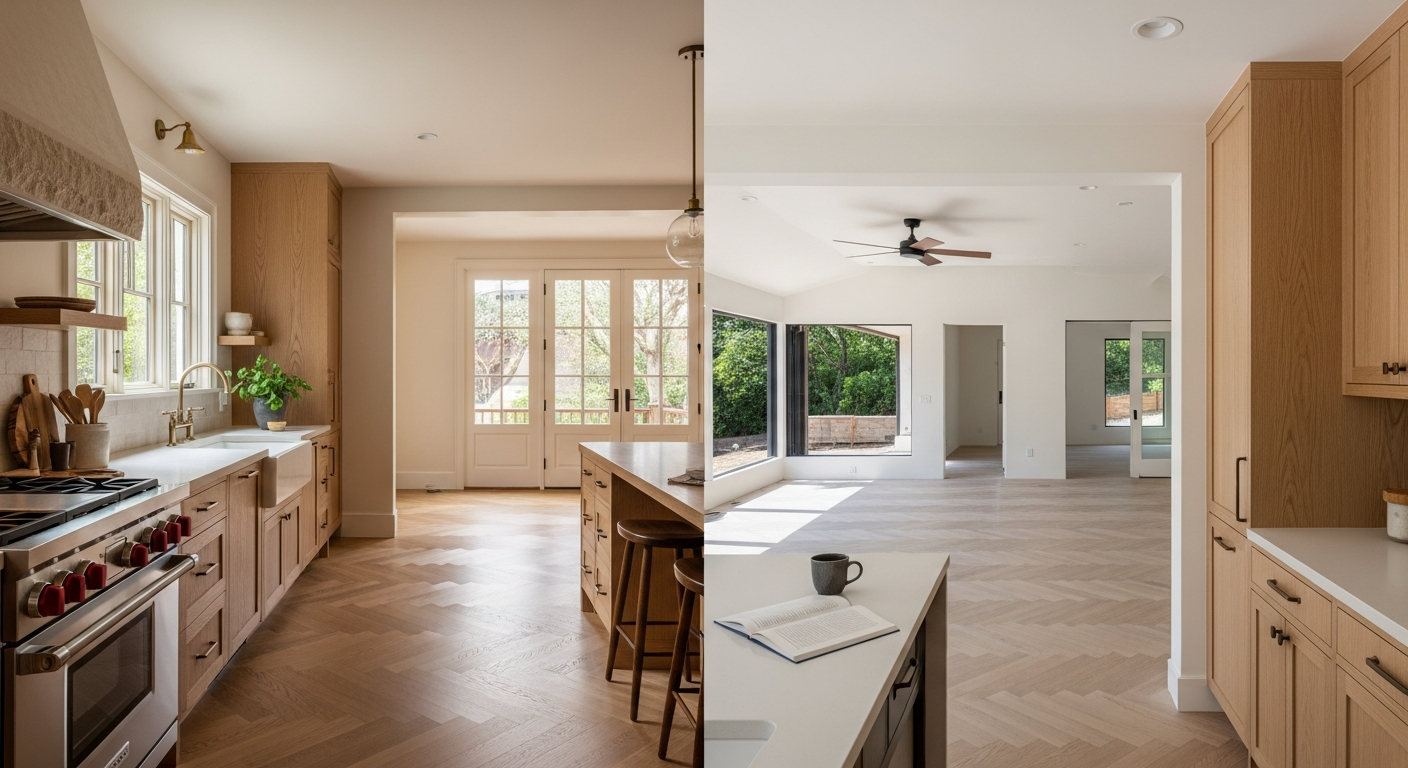
One project I frequently reference: a 1960s ranch in Saratoga where the homeowners were convinced they needed to tear down. After our 3D design rendering showed what a $480,000 remodel with a 400-square-foot addition could achieve — rift-cut white oak herringbone floors, a plaster range hood over a Thermador 48" induction range, hand-applied plaster walls, and a complete reconfiguration of the main living area — they chose to remodel. The home appraised for $650,000 more than their pre-remodel value. A tear-down and rebuild on the same lot would have cost $1.2 million and taken over 16 months.
When Should You Tear Down and Rebuild Your Silicon Valley Home?
Here are the clear signals that a tear-down-and-rebuild is the smarter path:
- Foundation failure or severe damage: If your structural engineer identifies widespread cracking, settling greater than 2 inches, or a failing post-and-beam system, foundation replacement alone can cost $100,000–$250,000 in the Bay Area — at which point you're spending new-construction money on old framing.
- Asbestos, lead, and mold remediation exceeds $50,000: Many pre-1978 homes in Sunnyvale, Mountain View, and San Jose contain asbestos in popcorn ceilings, vinyl flooring, insulation, and ductwork. When remediation costs cross the $50,000 threshold, the economics tilt toward demolition.
- You want to more than double the square footage: Going from a 1,400-square-foot ranch to a 3,200-square-foot two-story home is technically possible as a remodel with an addition, but the engineering complexity, mismatched ceiling heights, and structural gymnastics often make a clean-sheet design 15–20% more cost-efficient per square foot.
- The floor plan is fundamentally broken: Load-bearing walls in positions that block every reasonable open-concept layout, a home oriented wrong on the lot, a roofline that can't accommodate a second story without full re-engineering — these are cases where working around existing constraints costs more than starting over.
- Your lot value dwarfs the structure value: In Atherton, Los Altos Hills, and parts of Woodside, the land may be worth $3–8 million while the existing structure is assessed at $200,000–$400,000. Pouring $700,000 into remodeling a structure worth a fraction of the land rarely makes financial sense.
One important note about 2026 Bay Area zoning: cities like Cupertino, Palo Alto, and Los Gatos have increasingly strict lot coverage and FAR (floor area ratio) limits. Before committing to a tear-down, always verify your maximum buildable square footage with the local planning department. I've seen homeowners tear down a 2,800-square-foot home only to discover that current zoning limits their rebuild to 2,400 square feet.
How Long Does a Remodel Take vs a Tear Down and Rebuild in 2026?
A major whole-house remodel in the Bay Area takes 4 to 8 months of construction in 2026, while a complete tear-down and new build takes 12 to 20 months — and that's after permits are approved. Permit approval timelines are the variable most homeowners underestimate.
| Phase | Major Remodel Timeline | Tear Down and Rebuild Timeline |
|---|---|---|
| Architecture and design | 4–8 weeks | 8–16 weeks |
| Engineering (structural, civil, MEP) | 2–4 weeks | 4–8 weeks |
| Permit review and approval | 4–10 weeks | 8–20 weeks |
| Demolition | 1–2 weeks (selective) | 1–3 weeks (full) |
| Construction | 12–28 weeks | 36–60 weeks |
| Final inspections and punch list | 1–3 weeks | 2–4 weeks |
| Total (design through move-in) | 6–13 months | 14–26 months |
Permit approval in Santa Clara County currently takes 4–10 weeks for a remodel and 8–20 weeks for new construction, depending on the municipality. San Mateo County jurisdictions like Hillsborough and Woodside can take significantly longer due to design review boards and environmental review requirements. Palo Alto's planning review for new construction regularly exceeds 16 weeks.
This timeline gap matters enormously for your budget. If you're renting during a rebuild, 18 months of temporary housing in Silicon Valley at $5,000–$7,000 per month adds $90,000–$126,000 to your total project cost. With a remodel, you may be able to live in the home during portions of the work, or your rental period may be as short as 3–5 months.
Our 2026 project data shows that the average Los Gatos kitchen remodel takes 10 to 14 weeks from demolition to final walkthrough, while a complete tear-down and rebuild of a 3,000-square-foot custom home takes 14 to 18 months. The time value of that difference — in rental costs, disruption, and opportunity cost — should be a central part of your calculation.
What Are the Hidden Costs of Tearing Down a House in the Bay Area?
The hidden costs of tearing down and rebuilding a Bay Area home can add $150,000–$350,000+ beyond the base construction bid. These are the expenses that don't show up in the initial estimate but consistently appear in our 2026 project data across Silicon Valley:
- Demolition and haul-away: $25,000–$60,000 depending on home size, asbestos abatement requirements, and dump fees. Bay Area landfill rates have increased 12% since 2023.
- New utility connections: $15,000–$50,000. When you demolish a home, you typically need to reconnect or upgrade water, sewer, gas, and electrical service. PG&E panel upgrades for a new 400-amp service in 2026 run $8,000–$15,000, and trenching for new connections can add $10,000–$25,000.
- Soil and geotechnical reports: $5,000–$15,000. Required for new construction in many Bay Area jurisdictions, especially in hillside areas of Los Gatos, Saratoga, and Woodside.
- School impact fees: In some Santa Clara County jurisdictions, new construction triggers school impact fees of $4.79–$5.85 per square foot. On a 3,000-square-foot home, that's $14,370–$17,550.
- Tree protection and replacement: $5,000–$40,000. Los Gatos, Palo Alto, and Saratoga have strict heritage tree ordinances. Removing a protected oak or redwood can require a $10,000–$25,000 replacement bond, and arborist root-protection plans during construction add $3,000–$8,000.
- Temporary housing: $60,000–$126,000 for 12–18 months at Bay Area rental rates. This is the single largest hidden cost.
- Complete landscape replacement: $50,000–$200,000+. When heavy equipment demolishes a home, existing landscaping is typically destroyed. A full landscaping and exterior redesign with mature plantings, hardscaping, irrigation, and fencing often costs far more than homeowners anticipate.
- Property tax reassessment: Under Proposition 13, your property taxes are based on purchase price with limited annual increases. New construction triggers a full reassessment to current market value. On a $3 million Bay Area property, this could increase your annual tax bill by $15,000–$25,000 — permanently.
That last point — the Prop 13 reassessment — is the hidden cost that shocks homeowners the most. If you purchased your Los Gatos home in 2010 for $1.2 million and it's now worth $3.5 million, a full tear-down and rebuild triggers reassessment at $3.5 million. That's approximately $25,000 more per year in property taxes, every year, for as long as you own the home. A remodel, depending on scope, may trigger only a partial reassessment of the improved value — saving you hundreds of thousands over a decade of ownership.
What 2026 Design Trends Work for Both Remodels and New Builds?
The most sought-after Bay Area design trends in 2026 — warm materiality, organic textures, and European-inspired minimalism — work equally well in remodels and new construction. Based on our recent projects across Los Gatos, Palo Alto, and Saratoga, here's what we're seeing homeowners consistently choose, regardless of whether they're renovating or building new:
- Plaster range hoods and hand-applied plaster walls: The sterile white kitchen with stainless steel everything is gone. Our clients in Monte Sereno, Los Altos, and Los Gatos overwhelmingly request plaster hoods with rounded, organic shapes paired with Venetian or lime-wash plaster walls in warm putty, clay, and mushroom tones.
- Dekton and quartzite over quartz: While quartz (Caesarstone, Cambria) remains popular for bathrooms, ultra-compact sintered surfaces like Dekton Kreta, Dekton Laurent, and natural quartzite slabs are now the preferred kitchen countertop materials for high-end Bay Area projects. Calacatta Viola marble remains the aspirational choice for statement islands, with homeowners accepting the maintenance requirements.
- Unlacquered brass and brushed bronze hardware: Integrated finger-pull cabinetry (no visible hardware) remains strong, but where hardware is used, unlacquered brass that develops a living patina is the dominant choice.
- Induction cooktops: Thermador, Miele, andDERA induction ranges have overtaken gas in our 2026 projects, driven partly by Bay Area reach codes requiring electric-ready kitchens and partly by performance. The Thermador Freedom induction cooktop is our most-specified appliance this year.
- Zellige tile: Handmade Moroccan zellige tile in ivory, sage, and terracotta is showing up in kitchens, bathrooms, and fireplace surrounds. The slight irregularity and depth of color is the antidote to the subway-tile-everywhere era.
- Microcement and natural stone veneer: For exterior and interior accent walls, microcement (a thin cement coating) and natural stone veneer are replacing shiplap and accent tile. Cedar cladding on exterior facades adds warmth and texture, especially on new builds in Saratoga and Los Gatos.
- Warm earthy tones: Creamy whites, warm clay, sage green, charcoal, and soft terracotta have completely replaced the cool gray palette. This shift works beautifully in both remodels and new builds.
The important takeaway: none of these trends require a tear-down to execute. A thoughtful remodel with the right design-build team can incorporate every one of these elements into an existing home. The question of remodel vs. rebuild should be driven by structural and financial factors, not aesthetics.
Frequently Asked Questions
How much does it cost to tear down and rebuild a house in the Bay Area in 2026?
Is it cheaper to remodel or build a new house in Silicon Valley?
Remodeling is almost always cheaper than building new in Silicon Valley. A major whole-house remodel costs $250,000–$700,000 in 2026, while a tear-down and new build costs $800,000–$1,500,000+. However, the per-square-foot cost comparison narrows when remodels involve extensive structural changes, full mechanical system replacement, and hazmat remediation. The breakeven point in our experience is when remodel costs exceed 60% of new construction costs — at that threshold, new construction often delivers better long-term value because everything is new, up to code, and under warranty.
Does tearing down a house trigger property tax reassessment in California?
Yes. Under California's Proposition 13, demolishing a home and building new construction triggers a full property tax reassessment at current market value. This is one of the most significant hidden costs of tearing down. For example, if you purchased your Bay Area home for $1.2 million in 2012 and the rebuilt property is assessed at $3.5 million, your annual property tax bill increases by approximately $25,000. A remodel may trigger only a partial reassessment on the value of improvements, which can save tens of thousands annually.
How long does it take to get a building permit for new construction in Santa Clara County?
Building permit approval for new construction in Santa Clara County currently takes 8 to 20 weeks in 2026, depending on the specific city. Los Gatos and Saratoga often require design review board approval in addition to building department plan check, which adds 4–8 weeks. Palo Alto's planning review for new construction frequently exceeds 16 weeks. By comparison, permits for a remodel typically take 4–10 weeks. Hillside properties, projects in historic districts, and homes requiring environmental review can take significantly longer.
What is the 50% rule for remodeling in the Bay Area?
The 50% rule is a guideline used by many Bay Area municipalities (though exact thresholds and definitions vary by city) that says if your renovation costs exceed 50% of the home's existing structural value, the entire home must be brought up to current building codes — including seismic, energy, accessibility, and fire safety standards. This can add $80,000–$200,000 in mandatory upgrades. Staying below this threshold is a key strategy for cost-effective remodeling. Your contractor and architect should calculate this early in the planning process to avoid triggering full code compliance requirements.
Can I add a second story to my Bay Area home instead of tearing it down?
Yes, adding a second story is often a viable alternative to tearing down, and it typically costs $300,000–$600,000 in the Bay Area in 2026 — significantly less than a full rebuild. However, second-story additions require structural engineering to verify the foundation can support the additional load (many older Bay Area homes need foundation reinforcement at $50,000–$150,000), and they must comply with current height limits, setback requirements, and FAR (floor area ratio) limits. In our experience at Barcci Builders, roughly 60% of single-story Bay Area homes are good candidates for second-story additions.
What is the ROI of remodeling vs rebuilding a home in Los Gatos?
Do I need to move out during a whole-house remodel in the Bay Area?
It depends on the scope. For kitchen-only or bathroom-only remodels, most homeowners stay in the home and work around the disruption. For whole-house remodels involving significant structural work, mechanical system replacement, or full flooring and wall refinishing, we recommend moving out for 3–5 months. This is dramatically shorter (and cheaper) than the 12–18 months required for a tear-down and rebuild. At Bay Area rental rates of $5,000–$7,000 per month, the temporary housing savings alone can be $45,000–$90,000 compared to a rebuild timeline.