How Much Does a Primary Suite Addition Cost in the Bay Area in 2026?
Those numbers are higher than national averages, and for good reason. Bay Area labor rates, material transport costs, and permit fees all run 30-50% above the rest of California. A primary suite addition in Los Gatos or Saratoga typically runs 10-15% more than the same scope in Campbell or San Jose due to stricter design review requirements and hillside lot conditions.
Here is how primary suite addition costs break down by scope in 2026:
| Project Scope | Square Footage | Cost Range (2026) | Cost Per Sq Ft |
|---|---|---|---|
| Standard suite (bedroom + 3/4 bath + closet) | 250-350 sq ft | $175,000 - $250,000 | $550 - $715 |
| Mid-range suite (bedroom + full bath + walk-in closet) | 350-450 sq ft | $250,000 - $350,000 | $650 - $780 |
| Luxury suite (bedroom + spa bath + dual closets + sitting area) | 450-650 sq ft | $350,000 - $450,000+ | $700 - $850+ |
According to our 2026 Bay Area project data, roughly 62% of homeowners who come to us for a primary suite addition are working with existing single-story ranch homes built between 1955 and 1985. These homes typically have three bedrooms with a single shared bathroom, and the owners want to add a true retreat without moving. The remaining 38% are adding to two-story homes that have undersized existing primary suites, usually by bumping out over a garage or extending the footprint.
One factor that surprises homeowners is the cost of foundation work. A ground-level addition requires new footings and a foundation that ties into the existing structure, which typically adds $25,000 to $45,000 to the project. A second-story addition avoids new foundation costs but may require structural reinforcement of the existing first floor, which runs $15,000 to $35,000 depending on the home's framing.
What Is Included in a Primary Suite Addition vs. a Simple Bedroom Addition?
A primary suite addition includes three integrated components: the bedroom, a private ensuite bathroom, and a walk-in closet. A simple bedroom addition skips the bathroom and closet infrastructure, which cuts the cost by roughly 40-50% but delivers far less value at resale. Our 2026 project data shows that a standalone bedroom addition in the Bay Area costs $95,000 to $160,000, while a full primary suite ranges from $175,000 to $450,000+.
The bathroom component is where the real cost concentration lives. Plumbing rough-in, waterproofing, tile work, and fixtures account for approximately 35-40% of the total primary suite addition budget. Here is how the cost typically distributes across the three components:
| Component | Share of Total Budget | Typical Cost (Mid-Range Suite) | Key Cost Drivers |
|---|---|---|---|
| Bedroom (structure, finishes, windows, HVAC) | 35-40% | $90,000 - $130,000 | Foundation, framing, roofing, drywall, flooring |
| Ensuite bathroom | 35-40% | $95,000 - $140,000 | Plumbing, tile, fixtures, shower glass, vanity |
| Walk-in closet | 10-15% | $25,000 - $45,000 | Custom cabinetry, lighting, organization systems |
| Shared costs (permits, design, engineering) | 10-15% | $30,000 - $50,000 | Architectural plans, structural engineering, permits |
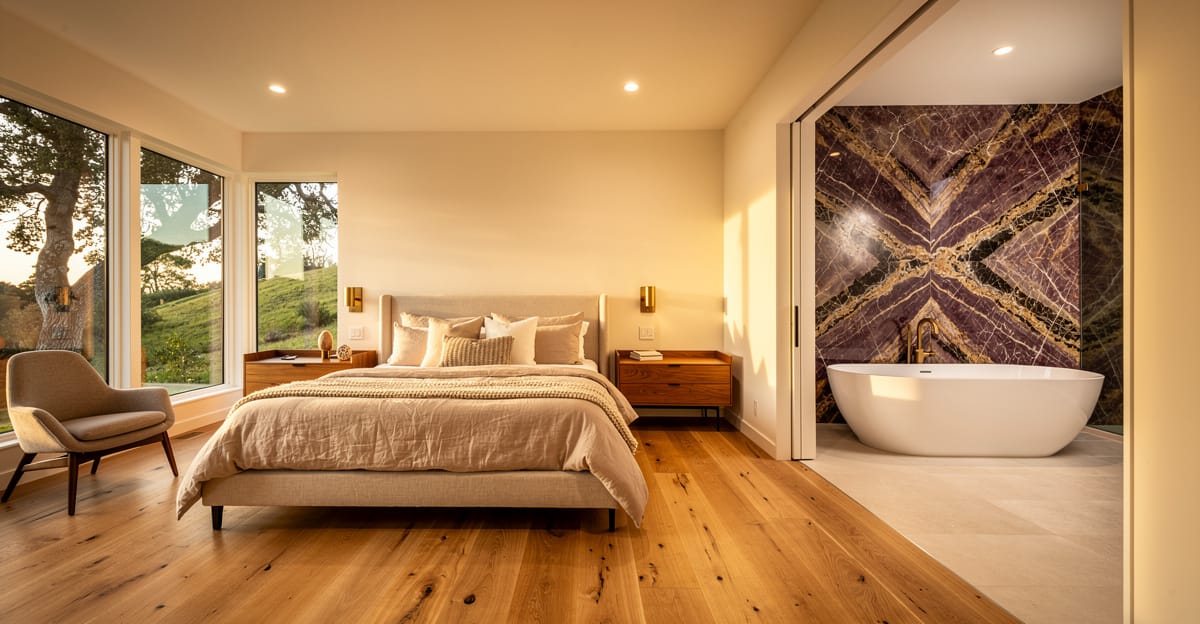
In our experience building across Silicon Valley since 2017, the ensuite bathroom is also where clients invest most heavily in premium finishes. Popular choices in 2026 include Calacatta Viola marble slab walls, Kohler or Waterworks fixtures, Thermador towel warmers, and heated porcelain tile floors. A spa-level primary bathroom with a freestanding soaking tub and a curbless walk-in shower can easily push the bathroom portion alone to $150,000 or more in materials and labor.
If you are considering a whole house remodel alongside your primary suite addition, bundling the projects typically saves 8-12% on overall costs through shared mobilization, permits, and trade coordination.
How Do Primary Suite Addition Costs Compare by City Across the Bay Area?
Primary suite addition costs vary by 15-25% across Bay Area cities, driven by local permit fees, design review requirements, lot conditions, and the prevailing finish expectations in each market. According to our 2026 Bay Area project data, here is what homeowners are paying by city for a mid-range primary suite addition of approximately 400 square feet:
| City / Area | Mid-Range Suite Cost (400 sq ft) | Permit Timeline | Notable Factors |
|---|---|---|---|
| Los Gatos | $290,000 - $380,000 | 8-14 weeks | Town design review required for most additions. Hillside overlay adds engineering costs. |
| Saratoga | $310,000 - $420,000 | 10-16 weeks | Heritage tree ordinance and hillside development standards. Largest lots, highest finish expectations. |
| Los Altos | $280,000 - $370,000 | 8-12 weeks | Story pole requirement for neighbor notification. FAR limits can constrain addition size. |
| Palo Alto | $285,000 - $375,000 | 10-16 weeks | Individual review required over certain thresholds. Professorville and Old Palo Alto historic overlays add complexity. |
| Menlo Park | $275,000 - $360,000 | 8-12 weeks | Relatively streamlined process for additions under 500 sq ft. Allied Arts neighborhood has specific guidelines. |
| Campbell | $250,000 - $330,000 | 6-10 weeks | More efficient permit process. Lower prevailing finish tier than hill towns. |
| Cupertino | $260,000 - $345,000 | 8-12 weeks | R1 zoning with clear setback rules. Strong demand from tech professionals near Apple Park. |
| San Jose (Willow Glen / Almaden Valley) | $245,000 - $325,000 | 6-10 weeks | Fastest permit turnaround among major cities. Willow Glen homes command higher finishes. |
| Mountain View | $265,000 - $350,000 | 8-12 weeks | Old Mountain View bungalows are popular candidates for suite additions. |
| Sunnyvale | $255,000 - $340,000 | 6-10 weeks | Straightforward zoning. Many 1960s ranches ideal for rear or side additions. |
The cost differences are not just about permit fees. In Saratoga, the average primary suite client selects Calacatta Viola marble, unlacquered brass fixtures from Waterworks, and custom walnut cabinetry. In Campbell, homeowners more often choose Cambria quartz, Kohler fixtures, and semi-custom painted cabinetry. The material selections alone account for a $30,000 to $60,000 swing on a 400-square-foot suite.
Lot topography also matters significantly. Hillside lots in Saratoga and parts of Los Gatos can require retaining walls, grading, and specialized drainage systems that add $20,000 to $50,000 beyond flat-lot construction costs. According to Bay Area permit data, approximately 25% of residential addition permits in Saratoga involve some form of hillside engineering review.
What Permits and Approvals Do You Need for a Primary Suite Addition in the Bay Area?
Every primary suite addition in the Bay Area requires a building permit from your local jurisdiction, and most cities also require plan check review, structural engineering calculations, and Title 24 energy compliance documentation. Based on current Santa Clara County building department records, permit fees for a residential addition of 300-500 square feet typically run $8,000 to $18,000 depending on the city, with Los Gatos and Saratoga at the higher end and San Jose and Campbell at the lower end.
Here is the typical permit and approval process for a primary suite addition in Santa Clara County:
Step 1: Architectural Plans and Engineering - You need stamped architectural drawings and structural engineering calculations. For a primary suite addition, expect to invest $12,000 to $25,000 in design and engineering fees. We include this in our design-build process, which saves time and prevents the communication gaps that happen when an architect and contractor work separately.
Step 2: Plan Check Submission - Submit plans to the local building department. The Town of Los Gatos Building Division typically processes residential additions in 6-8 weeks for plan check. City of Palo Alto Development Services runs 8-12 weeks. San Jose averages 4-6 weeks. San Mateo County Building Department handles unincorporated areas and typically runs 6-10 weeks.
Step 3: Design Review (if applicable) - Cities like Los Gatos, Saratoga, and Palo Alto require design review for additions that alter the street-facing facade, exceed certain square footage thresholds, or sit in designated overlay zones. This adds 4-8 weeks to the timeline and may require neighbor notification. In Saratoga, the Planning Commission reviews additions that increase floor area by more than 50% of the existing home or exceed certain FAR thresholds.
Step 4: Title 24 Energy Compliance - California's energy code requires that new additions meet current insulation, glazing, HVAC efficiency, and lighting standards. This often means the addition will perform significantly better than the existing home. Solar-ready provisions and electric panel capacity must be addressed per the 2025 California Energy Code (effective through 2028).
Step 5: Inspections During Construction - Santa Clara County Planning and local inspectors will visit at foundation, framing, insulation, rough plumbing, rough electrical, and final stages. A typical primary suite addition requires 8-12 inspections over the course of construction.
One critical detail that homeowners in Los Gatos and Saratoga often overlook: if your property has heritage or protected trees within the building footprint, you will need a tree survey and possibly an arborist report before any grading or foundation work can begin. Tree protection plans can add $2,000 to $5,000 to the pre-construction budget, and in some cases, the tree setback requirements force changes to the addition footprint.
How Long Does a Primary Suite Addition Take From Design to Move-In?
| Phase | Duration | What Happens |
|---|---|---|
| Design and planning | 4-8 weeks | Site measurement, floor plan development, 3D renderings, material selections, structural feasibility |
| Engineering and plan preparation | 3-5 weeks | Structural engineering, Title 24 calcs, plan set completion |
| Permit review | 6-14 weeks | City plan check, corrections, design review (if required), permit issuance |
| Construction - foundation and framing | 4-6 weeks | Excavation, foundation pour, framing, roof tie-in, windows |
| Construction - rough systems | 3-4 weeks | Electrical, plumbing, HVAC rough-in, insulation, inspections |
| Construction - finishes | 5-8 weeks | Drywall, tile, cabinetry, flooring, paint, fixtures, trim |
| Final inspections and punch list | 1-2 weeks | Final inspections, touch-ups, cleaning, walkthrough |
The finish phase is where timelines are most likely to stretch. Custom tile installations using materials like hand-cut zellige tile or book-matched marble slabs require more layout time and skilled labor than standard format porcelain. A spa-level primary bathroom with a curbless shower, freestanding tub, and custom vanity can take 3-4 weeks of tile and fixture work alone.
"In my experience, the biggest timeline risk for primary suite additions is not construction. It is the permit phase. I always tell clients to start the design process 3-4 months before they want construction to begin, especially in cities like Saratoga and Palo Alto where design review can add two months to the approval timeline." - Bar Benbenisty, Founder and CEO, Barcci Builders
For homeowners considering a summer 2026 construction start, that means design should be underway now. Our 3D design-rendering service helps clients visualize every detail of the suite before a single permit is pulled, which reduces change orders during construction and keeps the project on schedule.
What Are the Most Popular 2026 Design Trends for Primary Suite Additions?
Freestanding soaking tubs are standard in primary suite additions over 400 square feet. The most requested models come from Kohler (Veil and Ceric lines) and Waterworks. A freestanding tub with floor-mounted filler typically adds $5,000 to $15,000 to the bathroom budget, depending on the brand and material.
Curbless walk-in showers with linear drains have replaced traditional step-in showers in nearly every primary suite addition we build. These require careful waterproofing with systems like Schluter DITRA or liquid-applied membranes, adding $3,000 to $5,000 in waterproofing costs. The payoff is a clean, accessible design that also supports aging in place.
Hand-applied plaster walls using products like Limestrong or Vasari have replaced traditional paint in many primary bedrooms. The subtle texture and depth of color create a warmth that flat paint cannot match. Material and labor for hand-applied plaster runs $12 to $22 per square foot, compared to $3 to $5 for premium paint.
Unlacquered brass fixtures from Brizo, Rohl, and California Faucets have overtaken brushed nickel and matte black as the preferred bathroom hardware. These fixtures develop a natural patina over time, adding character to the space. A full suite of unlacquered brass shower fixtures, faucets, and accessories runs $4,000 to $12,000.
Integrated finger pulls on cabinetry, replacing visible hardware entirely, are standard in our 2026 bathroom renovation and primary suite projects. This clean-line approach pairs well with rift-cut white oak or walnut vanity cabinets and reduces the visual clutter in the bathroom and closet.
Other trends we are seeing consistently include Dekton Kreta countertops in bathroom vanities, zellige tile in shower niches, microcement accent walls, recessed medicine cabinets with integrated lighting, and heated porcelain tile floors throughout the ensuite bathroom.
Does a Primary Suite Addition Increase Home Value in the Bay Area?
A well-designed primary suite addition in the Bay Area typically recovers 65-80% of its cost at resale, and in some neighborhoods, it recovers significantly more. Our 2026 project data shows that homes in Los Gatos, Los Altos, and Palo Alto see the strongest return because buyers in these markets expect a generous primary suite and will pay a premium for one.
The ROI calculation for a primary suite addition is not just about the construction cost versus the appraisal bump. It is about bridging a functional gap in the home. A three-bedroom, one-bathroom ranch in Willow Glen that sells for $1.6 million without a primary suite might sell for $1.95 million to $2.1 million with a properly executed 450-square-foot suite addition. That is a $350,000 to $500,000 increase on a $280,000 to $350,000 investment.
Several factors influence the ROI of a primary suite addition in the Bay Area:
Neighborhood comparables matter most. If comparable homes in your neighborhood all have primary suites and yours does not, you are at a competitive disadvantage. Adding the suite does not create bonus value. It eliminates a discount. In the Rose Garden neighborhood of San Jose, Almaden Valley, and Downtown Los Gatos, three-bedroom homes without primary suites consistently sell at 12-18% discounts compared to homes of similar size that have them.
Quality of execution is critical. A primary suite that looks and feels like an afterthought, with a cramped bathroom, low ceilings, or a disconnected roofline, will not recover its cost. The addition must integrate with the existing home's architecture, both inside and outside. This is where working with a design-build firm pays off. The architect and builder coordinate from day one, so the addition looks original to the home.
Bathroom finish level drives buyer perception. According to our 2026 Bay Area project data, the primary bathroom is the single most scrutinized room during open houses. Buyers in the $1.5 million to $3 million range expect natural stone, frameless glass, and premium fixtures. A primary bathroom with builder-grade tile and basic fixtures can actually hurt the perceived value of the addition.
"I always tell homeowners that a primary suite addition is not a cost. It is a repositioning of their home in the market. A three-bed, one-bath ranch in Los Gatos competes in a completely different buyer pool than a four-bed, two-and-a-half-bath home on the same street." - Bar Benbenisty, Founder and CEO, Barcci Builders
Should You Build a Primary Suite Addition or Remodel Your Existing Suite?
If your existing primary suite is structurally sound but cosmetically dated, a remodel is almost always more cost-effective. If your home lacks a primary suite entirely, or if the existing one is undersized and poorly located, an addition is the better investment. In our experience building across Silicon Valley since 2017, roughly 55% of primary suite projects are additions and 45% are remodels of existing spaces.
Here is how the two approaches compare in the Bay Area market:
| Factor | Primary Suite Addition | Primary Suite Remodel |
|---|---|---|
| Typical cost (Bay Area 2026) | $175,000 - $450,000+ | $85,000 - $200,000 |
| Timeline (design through completion) | 7-12 months | 3-6 months |
| Permit complexity | Full building permit, possible design review | Building permit, typically no design review |
| Square footage gained | 250-650 sq ft new space | 0 sq ft (existing footprint) |
| ROI at resale | 65-80% cost recovery | 70-85% cost recovery |
| Disruption to daily life | Moderate (work is mostly outside existing walls) | High (your primary bathroom is out of service) |
| Best for | Homes without a primary suite, or with a suite under 200 sq ft | Homes with a well-sized suite that needs updated finishes and layout |
There is also a hybrid approach that we execute frequently: expanding the existing primary suite by borrowing space from an adjacent bedroom or hallway closet. This is especially common in Mountain View and Sunnyvale ranch homes where the original floor plan includes four small bedrooms and one bathroom. By converting the smallest bedroom into a walk-in closet and ensuite bathroom for the adjacent bedroom, you create a primary suite without the structural cost of a full addition. This hybrid approach typically costs $120,000 to $220,000 and takes 4-7 months.
Whichever approach fits your home, the critical step is getting an accurate assessment of the existing structure before committing to a plan. We start every primary suite project with a thorough site evaluation, including foundation inspection, framing assessment, and utility mapping, before we draw a single line on the plans. This is included in our design-build process and prevents costly surprises once construction begins.
Ready to explore what a primary suite addition or remodel looks like for your home? Our 3D design-rendering process lets you see the finished space before construction starts, so you can make confident decisions about layout, finishes, and budget. Call us at (650) 200-3149 or visit barccibuilders.com to schedule a consultation.
Frequently Asked Questions About Primary Suite Additions in the Bay Area
How much does a master suite addition cost in the Bay Area in 2026?
Do I need a permit to add a primary suite in Los Gatos or Saratoga?
Yes. Every primary suite addition in Los Gatos and Saratoga requires a building permit from the Town of Los Gatos Building Division or the City of Saratoga. Both cities also require design review for most additions, which adds 4-8 weeks to the approval timeline. Permit fees typically range from $10,000 to $18,000 in these jurisdictions, and you will need stamped architectural drawings and structural engineering calculations.
How long does a primary suite addition take to build in the Bay Area?
A primary suite addition takes 7 to 12 months from design kickoff to move-in day, with construction itself taking 3 to 5 months. The pre-construction phase including design, engineering, and permit review accounts for 3 to 7 months of that timeline. Cities like Palo Alto and Saratoga tend to have longer permit review periods than San Jose or Campbell.
What is the cost per square foot for a primary suite addition in Silicon Valley?
Primary suite additions in Silicon Valley cost $550 to $850 or more per square foot in 2026, depending on finish level. A standard suite with quality but not luxury finishes runs $550 to $715 per square foot. A luxury suite with Calacatta Viola marble, custom cabinetry, and premium fixtures from Kohler or Waterworks runs $700 to $850+ per square foot. These rates include all construction costs, but design and permit fees are typically additional.
Does adding a primary suite increase home value in the Bay Area?
A well-executed primary suite addition in the Bay Area typically recovers 65-80% of its cost at resale, and often more in competitive neighborhoods. In areas like Willow Glen, Downtown Los Gatos, and Professorville where comparable homes have primary suites, the addition can eliminate a 12-18% sale price discount and reposition the home in a higher buyer pool.
Primary suite addition vs second-story addition - what is the difference in cost?
A primary suite addition and a second-story addition are different scopes. A primary suite addition adds 250-650 square feet specifically configured as a bedroom, bathroom, and closet, costing $175,000 to $450,000. A full second-story addition adds an entire new floor (often 800-1,500 square feet) with multiple rooms, costing $350,000 to $750,000+. If you only need the primary suite, a ground-level bump-out or over-garage addition is usually more cost-effective.
Can I add a primary suite to a single-story ranch house in the Bay Area?
What are the best materials for a primary suite bathroom in 2026?
The most popular materials for primary suite bathrooms in 2026 include Calacatta Viola marble or Taj Mahal quartzite for shower walls and countertops, zellige tile for shower niches, rift-cut white oak or walnut for vanity cabinetry, and unlacquered brass fixtures from Brizo, Rohl, or California Faucets. Dekton Kreta is a popular maintenance-free alternative to natural stone. Heated porcelain tile floors and curbless showers with linear drains are now standard in most Bay Area luxury suite additions.
How much does the bathroom portion of a primary suite addition cost?
The ensuite bathroom accounts for 35-40% of the total primary suite addition budget. For a mid-range suite costing $280,000, the bathroom portion typically runs $95,000 to $140,000. This covers plumbing rough-in, waterproofing, tile installation, shower glass, vanity, fixtures, lighting, and ventilation. Luxury-level bathrooms with book-matched marble slabs, Waterworks fixtures, and a freestanding soaking tub can push the bathroom cost to $150,000 or more.
Should I remodel my existing primary suite or build an addition?
If your existing primary suite is at least 300 square feet but has outdated finishes, a remodel ($85,000-$200,000) is more cost-effective. If your home has no primary suite, or if the existing one is under 200 square feet with a cramped bathroom, an addition ($175,000-$450,000+) is the better long-term investment. A hybrid approach, borrowing space from an adjacent bedroom to create a suite without a full structural addition, typically costs $120,000 to $220,000.