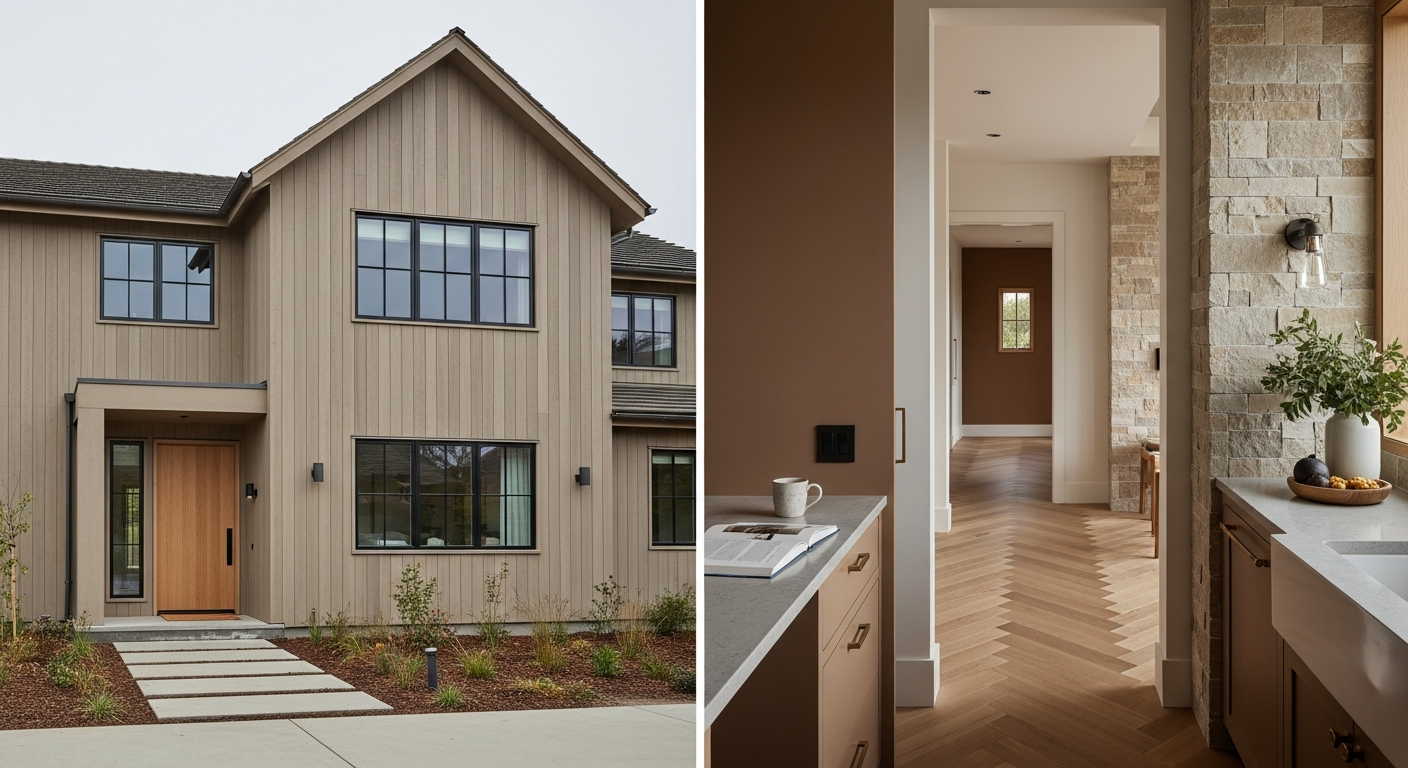
What Is Modern Farmhouse Design and Why Does It Work in Silicon Valley?
Modern farmhouse design blends the warmth and character of traditional agrarian architecture — board-and-batten siding, gabled rooflines, covered porches — with the clean lines, open floor plans, and high-performance materials that Silicon Valley homeowners expect. It works so well here because it solves a problem most contemporary homes create: it feels inviting without sacrificing sophistication.
What makes the style particularly well-suited to cities like Los Gatos, Saratoga, and Los Altos is the way it bridges indoor and outdoor living. The deep covered porches, oversized steel-framed windows, and open great rooms connect perfectly with the Bay Area's year-round temperate climate. Lots with mature oaks and rolling hillside views — common in the Los Gatos foothills or along Saratoga's tree-lined streets — become the backdrop the architecture was designed for.
How Much Does a Modern Farmhouse New Build Cost in the Bay Area in 2026?
That is a wide range, so here is what drives the spread:
| Cost Factor | Budget-Conscious Choice | Premium Choice | Cost Impact |
|---|---|---|---|
| Exterior cladding | Fiber cement (James Hardie) | Real cedar board-and-batten + natural stone veneer | +$40,000–$90,000 |
| Windows | Milgard Essence series (wood interior/fiberglass exterior) | Marvin Ultimate black steel-look or true steel (Crittall, Euroline) | +$60,000–$180,000 |
| Kitchen | Quartz counters, semi-custom cabinetry, mid-range appliances | Calacatta Viola marble, custom rift-cut white oak cabinetry, Miele or Thermador Column series | +$50,000–$120,000 |
| Flooring | Engineered white oak wide-plank | Solid rift-cut white oak herringbone with custom stain | +$25,000–$65,000 |
| HVAC & smart systems | Standard ducted system + Nest | VRF system (Mitsubishi/Daikin) + Savant or Lutron whole-home | +$40,000–$100,000 |
| Landscape | Basic grading + sod + hardscape | Drought-tolerant native garden, outdoor kitchen, fire pit, mature specimen trees | +$80,000–$250,000 |
One cost factor unique to Silicon Valley: permit and planning fees. In Santa Clara County, plan check and building permits for a new single-family home can run $30,000–$80,000 depending on the city. Los Gatos in particular has a rigorous Architecture and Site Application (ASA) review for new construction that adds 8–16 weeks and requires neighborhood compatibility analysis. If your lot is in the hillside overlay zone, expect additional geotechnical studies and grading reviews.
Our new construction service includes a detailed cost model before we break ground. We use 3D design renderings so you can see exactly how material choices affect both aesthetics and budget before a single foundation form is set.
Modern Farmhouse vs. Contemporary vs. Craftsman: Which Style Fits Your Bay Area Lot?
Choosing between modern farmhouse, contemporary, and Craftsman comes down to three things: your lot's context, your city's design guidelines, and how you actually live. Here is an honest comparison based on what we see across Palo Alto, Menlo Park, Cupertino, and the greater South Bay.
| Feature | Modern Farmhouse | Contemporary / Modern | Craftsman |
|---|---|---|---|
| Roofline | Steep gables, standing-seam metal accents | Flat or low-slope butterfly | Low-pitched gable with wide eaves |
| Exterior materials | Board-and-batten, cedar cladding, stone veneer, steel windows | Stucco, Shou Sugi Ban, glass curtain walls | Shingles, natural wood siding, stone columns |
| Interior vibe | Warm, layered, organic textures | Minimal, sculptural, gallery-like | Rich wood tones, built-in cabinetry, cozy nooks |
| Best lot type | Quarter-acre+ with trees or views | Narrow urban infill or hillside view lots | Traditional neighborhood grid (Willow Glen, Old Mountain View, Professorville) |
| Bay Area permit friendliness | High — most cities approve easily | Medium — some historic districts restrict flat roofs | High — matches many existing neighborhood contexts |
| 2026 resale appeal | Very strong | Strong in tech corridors | Strong in established neighborhoods |
| Typical cost/sq ft (new build) | $450–$750+ | $500–$850+ | $425–$650+ |
One thing I tell every client: don't pick a style in a vacuum. Drive your neighborhood. Look at what the planning department has approved recently. In Downtown Los Gatos, for example, the design review board favors architecture that respects the town's historic character — a modern farmhouse with restrained scale and natural materials passes easily, while an ultra-modern glass box may face significant pushback. In contrast, neighborhoods like Cupertino's newer developments near Apple Park lean heavily contemporary.
If you're torn, our team often creates two to three facade studies in 3D so you can compare styles on your actual lot, with real landscaping context and street-level views. It is the single best way to make a confident decision.
What Are the Key Design Elements of a Modern Farmhouse in 2026?
The defining design elements of a 2026 modern farmhouse have shifted away from the stark white-and-black palette that dominated earlier versions. Today's Silicon Valley modern farmhouse is warmer, more textural, and grounded in natural materials that age gracefully. Here are the elements our team is specifying right now across active projects:
Exterior Elements
- Board-and-batten siding — Real cedar or fiber cement (James Hardie) in warm tones: warm greige, soft sage, or charcoal rather than bright white
- Standing-seam metal roof accents — Matte black or dark bronze on gable sections, with a primary architectural shingle or slate-profile synthetic roof
- Natural stone veneer — Dry-stacked limestone or ledgestone on chimney masses and entry walls, adding mass and visual grounding
- Black steel-look windows — Marvin Ultimate or Pella Reserve with simulated divided lites. True steel (Crittall or Euroline) for statement entries and pivot doors
- Cedar cladding accents — Tongue-and-groove or shiplap cedar soffits and covered porch ceilings, left to weather naturally or sealed in a light honey tone
- Covered front porch — Minimum 8-foot depth to be functional, with exposed timber or steel rafter tails
Interior Elements
- Hand-applied plaster walls — Venetian plaster or Roman clay (Portola Paints) on feature walls, replacing the old shiplap accent. Applied by specialist plasterers, these finishes create depth and movement that flat paint cannot replicate
- Plaster range hoods — Curved or arched plaster hoods over professional-grade ranges (Wolf, Thermador Pro Harmony, or the increasingly popular induction cooktops from Miele andDERA) have replaced the stainless steel chimney hoods of earlier farmhouse kitchens
- Unlacquered brass hardware and fixtures — From Waterworks, California Faucets, or Emtek. The living finish develops a unique patina that reinforces the farmhouse character
- Fluted details — Fluted wood or plaster panels on kitchen islands, bathroom vanities, and built-in cabinetry. This subtle texture adds visual interest without adding color
- Zellige tile — Handmade Moroccan tiles with irregular edges and color variation. We source from Cle Tile and Tabarka Studio for backsplashes, mudroom walls, and shower niches
- Warm earthy tones — Creamy whites, warm taupes, terracotta, sage, and charcoal replace the cool grey palette. Benjamin Moore's Edgecomb Gray, Sherwin-Williams Accessible Beige, and Farrow & Ball Jitney are colors we're specifying weekly
The through line across all of these elements is organic imperfection. A 2026 modern farmhouse should feel collected and lived-in from day one, not sterile or stage-set. That is the difference between a house that photographs well and a home that actually feels good to live in.
How Long Does It Take to Build a Modern Farmhouse in Los Gatos or Saratoga?
- Design and engineering: 3–5 months — architectural plans, structural engineering, energy calculations (Title 24), and interior design selections
- Permit review: 4–10 weeks for plan check in most Santa Clara County jurisdictions. Los Gatos ASA (Architecture and Site Application) review adds an additional 6–12 weeks if your project triggers design review, which most new construction does
- Construction: 9–14 months — foundation through final punch list. The wide range depends on complexity: a single-story 2,800 sq ft farmhouse on a flat lot is closer to 9 months; a two-story 4,000+ sq ft home with a basement or hillside grading is closer to 14
The most common timeline killer I see? Indecision on finishes during construction. When a client waits until the drywall is up to start picking tile, plumbing fixtures, and lighting, we lose weeks waiting on orders. That's why our 3D design rendering process locks down every major material selection before we pull permits. It is not a nice-to-have — it is what keeps a project on schedule.
For homeowners in Saratoga specifically, be aware that the city's planning department often requires a pre-application meeting for new construction on lots over half an acre or in designated scenic corridors. Building this into your timeline early prevents surprises.
If a full new build feels like more than you need, many of our clients in established neighborhoods achieve the modern farmhouse look through a whole-house remodel — re-skinning the exterior, opening up the floor plan, and replacing every interior finish. On a ranch-style home from the 1960s or 1970s, which are extremely common in Cupertino, Sunnyvale, and Mountain View, this approach can save 30–40% compared to tearing down and rebuilding, while delivering nearly identical results inside and out.
5 Mistakes to Avoid When Building a Modern Farmhouse in Silicon Valley
After building and remodeling modern farmhouse-style homes across Silicon Valley for years, these are the five mistakes I see homeowners make most often — and how to avoid them:
1. Going Too White
The all-white modern farmhouse with grey LVP flooring was a 2019 look. In 2026, it reads as dated and builder-grade. Instead, layer warm neutrals: a creamy plaster wall, rift-cut white oak cabinetry with a natural matte finish, and Caesarstone or Dekton countertops in warm tones like Dekton Kreta (a limestone look) rather than stark white quartz. Leave bright white for the trim.
2. Oversizing the House for the Lot
Santa Clara County and San Mateo County both have strict floor-area-ratio (FAR) and setback requirements, but just because you can build to the maximum envelope doesn't mean you should. Modern farmhouse architecture needs breathing room — generous porches, wide eaves, and landscaped buffers. A 4,500 sq ft house that fills 55% of a 7,500 sq ft lot will look and feel compressed, no matter how beautiful the architecture.
3. Choosing Fake Materials Over Honest Ones
Porcelain tile that mimics wood, vinyl siding that mimics board-and-batten, quartz that mimics marble — the farmhouse ethos is fundamentally about honest materials. You do not need Calacatta Viola marble on every surface, but the materials you do use should be real. Where budget matters, use real materials in smaller quantities rather than fake materials everywhere. One accent wall of genuine reclaimed barn wood does more than a whole room of printed laminate.
4. Ignoring Energy Performance
California's 2025 Building Energy Efficiency Standards (Title 24) require high-performance envelopes, and the 2026 code cycle emphasizes electrification. A modern farmhouse should not just look good — it should perform. We routinely specify spray-foam insulation, triple-pane windows on north-facing elevations, heat-pump HVAC systems, and induction cooktops. These are not upgrades; they are baseline for any serious new construction in California.
5. Treating Landscaping as an Afterthought
The landscaping is half the architecture in a modern farmhouse. Native grasses, olive trees, lavender borders, decomposed granite pathways, and natural stone retaining walls create the rural-meets-refined context the house needs to shine. Budget 10–15% of your total project cost for landscaping and exterior design. Our team designs the landscape in parallel with the house — not after — so plant selections, hardscape materials, and lighting all coordinate.
Can You Add a Modern Farmhouse ADU or Addition to an Existing Home?
Yes — and it is one of the most popular requests we handle. A modern farmhouse ADU (accessory dwelling unit) in Silicon Valley costs between $350 and $550 per square foot in 2026, and California's ADU-friendly legislation (AB 68, SB 9, and subsequent updates) means most homeowners can add one by right without discretionary design review.
The key to making an ADU or addition look like it belongs is matching the architectural vocabulary of the main house — or, if the main house is a different style, creating a deliberate contrast that reads as intentional. We have completed farmhouse-style ADUs behind mid-century ranches in Mountain View and Sunnyvale that look fantastic because we matched the scale, roof pitch, and material warmth while keeping the form contemporary.
A typical detached farmhouse ADU of 800–1,200 sq ft — one bedroom, one bathroom, a kitchenette or full kitchen, and a combined living/dining area — takes 7–11 months from design through move-in. Our ADU and home additions team handles the full permitting process, including the utility coordination with San Jose Water, PG&E, and local sewer districts that trips up many homeowners who try to owner-build.
Frequently Asked Questions
How much does it cost to build a modern farmhouse in Los Gatos in 2026?
What is the difference between modern farmhouse and traditional farmhouse style?
Traditional farmhouse style features ornate millwork, country-inspired decor, antique fixtures, and a more rustic, cluttered aesthetic rooted in 19th-century American rural architecture. Modern farmhouse strips away the ornamentation and introduces clean lines, open floor plans, floor-to-ceiling windows, and a restrained material palette — board-and-batten siding, steel-framed windows, rift-cut white oak, and natural stone. The 2026 interpretation leans further into warm earthy tones, organic shapes, and textural finishes like hand-applied plaster and zellige tile, moving well beyond the black-and-white 'Fixer Upper' look.
How long does it take to build a modern farmhouse in Silicon Valley?
Is modern farmhouse style going out of style in 2026?
What are the best exterior materials for a modern farmhouse in California?
The best exterior materials for a California modern farmhouse in 2026 are board-and-batten siding (real cedar for premium projects, James Hardie fiber cement for cost-conscious builds), natural stone veneer (dry-stacked limestone or ledgestone), standing-seam metal roof accents in matte black or bronze, and black steel-look windows (Marvin Ultimate or Pella Reserve). Cedar cladding on soffits and porch ceilings adds warmth. All exterior materials should be fire-rated for WUI (Wildland-Urban Interface) zones, which affect many hillside lots in Los Gatos, Saratoga, and the Santa Cruz Mountains.
Can I remodel my existing home to look like a modern farmhouse in the Bay Area?
Absolutely. A whole-house remodel that converts an existing home — especially the 1960s–1970s ranch-style homes common in Cupertino, Sunnyvale, Mountain View, and San Jose — into a modern farmhouse typically costs 30–40% less than tearing down and building new. The process involves re-cladding the exterior with board-and-batten and stone veneer, replacing windows with larger steel-look units, opening up interior walls, and replacing every finish surface. Our team has completed numerous ranch-to-farmhouse transformations that are virtually indistinguishable from new construction.
How much does a modern farmhouse ADU cost in Silicon Valley in 2026?
A detached modern farmhouse ADU in Silicon Valley costs $350–$550 per square foot in 2026. For a typical 800–1,200 sq ft unit with one bedroom, one bathroom, and a full kitchen, that translates to $280,000–$660,000 in total construction cost. California's ADU legislation allows most units to be built by right without discretionary design review, which significantly reduces permitting time. We typically complete farmhouse-style ADUs in 7–11 months from design through occupancy.
What kitchen design works best in a modern farmhouse home?
The ideal 2026 modern farmhouse kitchen features custom rift-cut white oak cabinetry (often with integrated finger pulls rather than visible hardware), a plaster range hood with a curved or arched profile, a professional-grade induction cooktop or range (Miele, Thermador, or Wolf), natural stone or Dekton countertops (Dekton Kreta for a limestone look or Calacatta Viola marble for a statement), zellige tile backsplash, unlacquered brass fixtures (California Faucets or Waterworks), and open shelving in the same wood species as the cabinets. A large island with fluted panel detail and pendant lighting anchors the space. Bay Area kitchen remodels in this style typically cost $85,000–$175,000 in 2026.