What Are the Most Popular Kitchen Cabinet Styles in 2026?
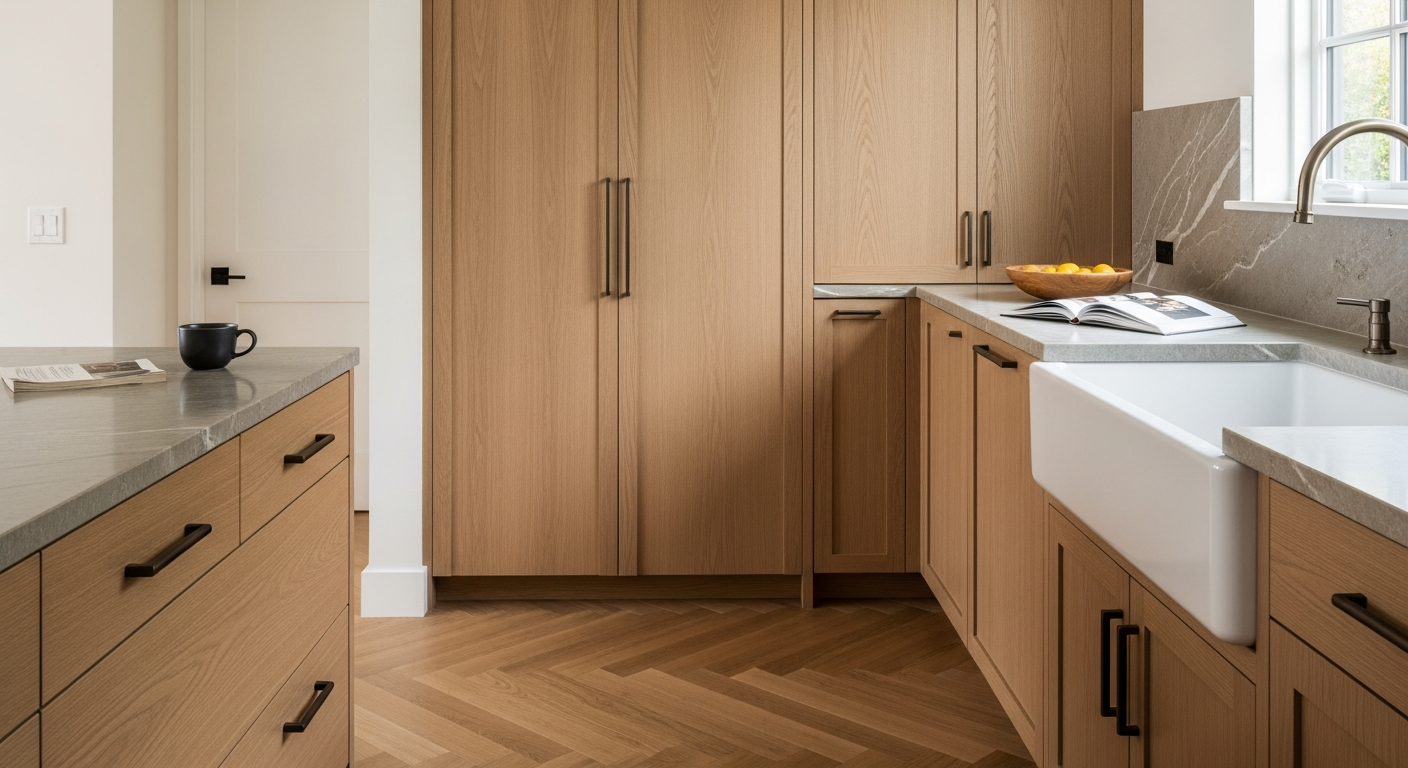
The most popular kitchen cabinet styles in 2026 center on natural warmth, tactile texture, and seamless hardware-free profiles. Based on our 116+ completed Bay Area projects at Barcci Builders, rift-cut white oak with a clear or honey-toned finish has surpassed painted white shaker as the number-one cabinet door request among Silicon Valley homeowners—accounting for roughly 62% of our kitchen remodel selections since late 2025.
The shift is unmistakable: Bay Area homeowners in Los Gatos, Saratoga, Palo Alto, and Menlo Park are moving decisively away from the stark all-white kitchen toward warmer, more organic palettes. Here are the six cabinet styles dominating Bay Area kitchens right now:
- Rift-cut white oak slab doors — Linear grain, minimal figuring, warm honey or cerused finishes
- Fluted or reeded panel fronts — Vertical channel details on island panels, tall pantries, and accent cabinets
- Integrated finger pulls (J-pull / routed edge) — No visible hardware, ultra-clean sightlines
- Plaster-finished or microcement-wrapped cabinetry — Hand-applied texture for a European sculptural look
- Mixed-material kitchens — Upper cabinets in a different finish or material than lowers (e.g., white oak below, plaster-finish above)
- Thin-profile flat-panel doors with reveal lines — Slab fronts with a subtle shadow gap around each door for depth
As someone who's completed over 116 remodels across the Bay Area, the single biggest shift I see in 2026 is that homeowners no longer want their kitchen to look like a showroom—they want it to feel like a room they actually live in, with real wood grain, handmade textures, and hardware you can feel but not necessarily see.
Why Are Rift-Cut White Oak Cabinets So Popular in Bay Area Kitchens?
Rift-cut white oak cabinets are the single most requested material for Bay Area kitchen remodels in 2026 because they deliver a tight, straight grain pattern that reads as modern and refined without feeling cold or industrial. Unlike flat-sawn oak—which shows wide cathedral-shaped grain—rift-cut veneers and solid stock are cut at a 30- to 60-degree angle to the growth rings, producing parallel lines that pair perfectly with the clean, minimalist architecture popular in Silicon Valley homes.
Here's why our clients in Los Altos, Cupertino, and the Willows neighborhood of Menlo Park consistently choose rift-cut white oak over alternatives:
- Grain consistency: Rift-cutting minimizes the dramatic figure that makes other oak cuts look rustic or dated. The result is a tight, linear pattern that works equally well in a mid-century ranch remodel as it does in a new contemporary build.
- Finish versatility: White oak accepts a wide range of finishes—from a clear water-based polyurethane that keeps the wood's natural honey tone to a cerused (limed) finish that highlights the grain in white or gray, or a fumed treatment that adds aged warmth.
- Durability: White oak rates 1,360 on the Janka hardness scale, making it significantly harder than maple (1,450) and far tougher than poplar or alder, which were common in painted cabinet boxes. It resists dents around heavy-use zones like coffee bars and prep areas.
- Sustainability signal: White oak is an FSC-certifiable domestic hardwood, and many of our Bay Area clients specifically request FSC-certified stock, especially in the eco-conscious communities of Palo Alto's Professorville and Old Mountain View.
Our 2026 project data shows that a full set of custom rift-cut white oak cabinets for a typical Los Gatos kitchen (30 linear feet of cabinetry) costs between $45,000 and $85,000 installed, depending on whether clients choose full overlay slab doors, inset framing, soft-close Blum or Hettich hardware, and specialty interior fittings from brands like Hafele or Rev-A-Shelf.
| Cabinet Material | 2026 Bay Area Cost (30 LF, Installed) | Style Character | Durability Rating |
|---|---|---|---|
| Rift-cut white oak (custom) | $45,000–$85,000 | Warm, modern, organic | Excellent |
| Painted maple shaker (semi-custom) | $28,000–$50,000 | Classic, clean, transitional | Good (shows chips) |
| Walnut slab (custom) | $55,000–$95,000 | Rich, dramatic, mid-century | Moderate (softer wood) |
| Thermofoil / laminate (stock) | $12,000–$25,000 | Budget-modern, limited texture | Fair (peels over time) |
| Plaster / microcement finish (custom) | $50,000–$90,000 | Sculptural, European, artisan | Good (repairable) |
One critical note: rift-cut veneers produce more waste during milling than flat-sawn lumber, which contributes to the premium. But in our experience, clients who invest in rift-cut white oak cabinets consistently report higher satisfaction—and at resale, Bay Area real estate agents tell us that natural wood kitchens are outperforming painted-white kitchens in buyer appeal for the first time in over a decade.
What Are Fluted Kitchen Cabinets and How Much Do They Cost?
Fluted kitchen cabinets feature vertically routed channels—typically 3/4" to 1-1/2" wide—carved into solid wood or MDF panels to create a rhythmic texture of light and shadow. In 2026, fluted (also called "reeded") details are one of the most requested accent elements in Bay Area kitchen remodels, appearing on island fronts, tall pantry doors, range hood surrounds, and bar cabinet faces.
The cost to add fluted detailing to a Bay Area kitchen depends on where and how extensively you use it. Based on our 2026 project data from homes in Saratoga, Los Gatos, and the Monte Sereno hills, here are typical cost ranges:
- Fluted island panels only (3-4 panels): $2,500–$6,000 added cost over flat slab panels
- Fluted pantry or accent cabinet (single tall unit): $1,800–$4,500 premium
- Full kitchen with fluted lower cabinets: $8,000–$18,000 premium over equivalent flat-panel doors
- Fluted range hood surround (custom wood): $3,500–$8,000 including fabrication and installation
Fluting works especially well in rift-cut white oak because the straight grain runs parallel to the channels, amplifying the textural effect. We've also executed striking fluted designs in painted MDF for clients on tighter budgets—the shadows created by the channels add visual depth even on a single-color surface.
A design tip I always share: use fluting strategically, not everywhere. The most successful 2026 kitchens we've built use fluted panels on one or two focal points—usually the island face or a floor-to-ceiling pantry wall—while keeping the rest of the cabinetry in smooth slab fronts. This creates contrast without visual fatigue.
Integrated Pulls vs. Traditional Hardware: Which Is Better for a Modern Kitchen?
Integrated pulls—also known as finger pulls, J-pulls, or routed-edge pulls—are better for homeowners who want a fully seamless, hardware-free kitchen aesthetic, while traditional hardware (knobs, bar pulls, cup pulls) is better for those who want a decorative accent or prefer a more tactile grip. In 2026, approximately 71% of our Bay Area kitchen projects use some form of integrated pull, up from about 40% in 2022.
Integrated pulls work by routing a channel or beveled edge into the top or side of the cabinet door, creating a recessed lip that your fingers catch to open the door. There are several sub-types:
- J-pull (top-routed): A horizontal channel routed into the top edge of the door. The most common integrated pull in 2026. Clean from every angle.
- 45-degree chamfer pull: The top edge of the door is cut at a 45-degree angle, creating a subtle finger catch. Even more minimal than a J-pull.
- Channel pull (side-routed): A vertical groove routed along the edge where two doors meet, used frequently on tall pantry cabinets.
- Push-to-open (Tip-On by Blum): No visible pull at all—press the door and a mechanical latch releases it. Common on upper cabinets and integrated appliance panels.
| Feature | Integrated Pulls (J-Pull / Routed) | Traditional Hardware (Bar / Knob) |
|---|---|---|
| Visual impact | Seamless, minimal, hardware-free | Decorative accent, adds detail |
| Cost premium | $1,500–$4,000 for CNC routing | $800–$5,000+ depending on hardware brand |
| Cleaning ease | No hardware to clean around | Fingerprint-prone (especially brass) |
| Trending in 2026? | Yes—dominant in contemporary kitchens | Yes—unlacquered brass is resurgent |
| Best paired with | Slab doors, rift-cut oak, flat panel | Shaker, inset, beaded-frame doors |
| Durability concern | Minimal—nothing to loosen or break | Screws can loosen over years |
That said, not every cabinet needs the same approach. Many of the most beautiful kitchens we've built in 2026—particularly in Los Gatos and the Atherton estate district—use integrated pulls on lower cabinets and appliance panels, then introduce a statement hardware piece like unlacquered brass edge pulls from Rocky Mountain Hardware or Armac Martin on upper open shelving or glass-front display cabinets. This hybrid approach gives you the clean lines of a modern European kitchen with the warmth and personality of handcrafted metal.
Functionally, I always recommend integrated pulls for heavy-use cabinetry (under the sink, beside the range, trash pullout) because there's nothing protruding that catches on clothing or dish towels. For display or upper cabinets used less frequently, decorative hardware adds visual jewelry to the room without a usability penalty.
How Much Does a Full Kitchen Cabinet Remodel Cost in the Bay Area in 2026?
A full kitchen cabinet remodel in the Bay Area costs between $85,000 and $200,000+ in 2026, depending on whether you're replacing cabinets only or doing a complete gut renovation that includes layout changes, electrical, plumbing, countertops, backsplash, appliances, and flooring. Based on our data from 116+ completed projects at Barcci Builders (CA Lic #1086047), here's how those costs typically break down:
- Cabinet-only replacement (same layout, 30 LF): $35,000–$85,000 — This covers demolition of existing cabinets, custom fabrication, delivery, and installation. No plumbing, electrical, or countertop work included.
- Mid-range kitchen remodel (new cabinets + countertops + backsplash + appliances): $85,000–$150,000 — The most common scope we see in Los Gatos, Campbell, and Cupertino. Includes new custom or semi-custom cabinetry, quartz or quartzite countertops (Caesarstone or Cambria), designer tile backsplash, and mid-to-premium appliances (Bosch, Fisher & Paykel, or Thermador).
- High-end gut renovation (full layout change, structural work, premium everything): $150,000–$300,000+ — This is the scope we frequently execute for clients in Palo Alto, Atherton, and Hillsborough. It often involves removing walls, relocating plumbing and gas lines, new electrical panels, custom rift-cut oak or walnut cabinetry, Calacatta Viola marble or Dekton Kreta countertops, Sub-Zero/Wolf or Gaggenau appliance packages, and features like integrated paneling, waterfall islands, and built-in coffee systems by Miele.
The average Los Gatos kitchen remodel takes 10–14 weeks from demolition to final walkthrough, based on our 2026 project data. Custom cabinet fabrication alone accounts for 5–8 weeks of that timeline, which is why we begin the cabinet order during the design and permit phase so it's ready when demolition wraps.
Permit approval in Santa Clara County currently takes 4–8 weeks for kitchen remodels that involve electrical or plumbing changes. Cosmetic-only cabinet swaps (no electrical, no plumbing, no structural) may not require a permit, but I strongly recommend verifying with the local building department—especially in Los Gatos, Saratoga, and Palo Alto, which have additional design review requirements for homes in historic or architecturally significant zones.
What Kitchen Cabinet Trends Are Going Away in 2026?
The kitchen cabinet trends going away in 2026 include all-white shaker kitchens, gray-on-gray color schemes, ornate crown molding on upper cabinets, and visible oversized hardware used purely for decoration. After years of dominance, these looks have saturated the Bay Area market to the point where they signal "2018 flip" rather than "thoughtfully designed home."
Here's what our team at Barcci Builders is seeing fade across Silicon Valley:
- All-white painted shaker cabinets: White shaker isn't disappearing entirely, but it's no longer the default. In our 2026 pipeline, only about 18% of clients are choosing full white-painted cabinetry, down from over 60% in 2020. Those who still want white are opting for warmer tones—Benjamin Moore White Dove or Sherwin-Williams Alabaster—rather than crisp bright whites.
- Gray cabinets: The gray trend peaked around 2019–2021 in Bay Area kitchens. In 2026, we're not receiving a single request for medium-gray or dark-gray painted cabinets. Warm greens (think sage, olive) and deep navy are the colored-cabinet choices for clients who don't want wood grain.
- Thick crown molding and decorative corbels: The current aesthetic favors cabinets that run flush to the ceiling with a minimal reveal or a built-in soffit detail. Crown molding on kitchen cabinets feels visually heavy to 2026 buyers.
- Barn door pantries: Once ubiquitous in South Bay homes, sliding barn doors on pantries are being replaced by pocket doors, concealed hinged doors, or custom fluted-panel pantry walls that integrate seamlessly with the cabinetry.
- Purely decorative oversized pulls: The 12" to 18" bar pulls that dominated in 2018–2022 are being replaced by integrated pulls or smaller, more refined hardware in unlacquered brass or aged bronze.
One trend I'm particularly glad to see go: the "builder-grade luxury" look—stock cabinetry dressed up with elaborate molding and loud hardware. In 2026, Bay Area buyers are far more sophisticated. They can tell the difference between genuine custom craftsmanship and cosmetic upgrades, and they're willing to invest in the real thing.
How to Choose the Right Cabinet Style for Your Bay Area Home in 2026
Choosing the right cabinet style for your Bay Area home in 2026 starts with your home's architecture, your cooking habits, and a realistic budget conversation—not a Pinterest mood board. After guiding hundreds of homeowners through this decision, here's the framework I recommend:
Step 1: Match Your Cabinets to Your Architecture
Bay Area homes span an enormous range of architectural styles, and the best cabinet choice respects that context:
- Mid-century ranch or Eichler (common in Palo Alto, Sunnyvale, San Jose Willow Glen): Rift-cut white oak slab doors, walnut accents, integrated pulls. These homes were designed for warmth and horizontal lines—lean into it.
- Traditional or Craftsman (Los Gatos downtown, Saratoga, Old Mountain View): Inset white oak or painted inset frames with subtle beading. You can modernize without fighting the home's bones.
- Contemporary new construction (Monte Sereno, Atherton, Los Altos Hills): Flat-panel slab doors with integrated J-pulls, mixed materials (wood lowers, plaster uppers), handleless European systems from Leicht or SieMatic.
- Mediterranean or Spanish Revival (parts of San Jose, Los Gatos): Consider cerused or fumed white oak, arched pantry openings, and zellige tile backsplashes to honor the home's warmth while updating the palette.
Step 2: Define Your Budget Range Early
Cabinet costs vary enormously. I tell every homeowner to allocate 35–45% of their total kitchen remodel budget to cabinetry—it's the single largest line item. If your total kitchen budget is $120,000, plan to spend $42,000–$54,000 on cabinets. This ensures you can afford quality construction (plywood boxes, dovetail drawers, soft-close hinges from Blum) without sacrificing countertops or appliances.
Step 3: Think About Longevity, Not Just Trends
Every trend listed in this article—rift-cut oak, fluted details, integrated pulls—has staying power precisely because it's rooted in real craftsmanship and natural materials rather than a fleeting social media aesthetic. Natural wood grain doesn't date the way a specific paint color does. Fluted texture has appeared in architecture for centuries. Handleless cabinetry has been the European standard for decades.
Our 3D design rendering service lets you visualize your exact cabinet style, wood species, finish, and hardware selection in a photorealistic model of your kitchen before a single order is placed. Roughly 90% of our clients use this service, and it virtually eliminates the "I wish I'd chosen something different" regret that plagues kitchen remodels.
If you're ready to explore what the right cabinet style looks like for your home, our team at Barcci Builders offers a complimentary design consultation for homeowners across the Bay Area—from San Francisco to San Jose and every community in between.
Frequently Asked Questions
How much do rift-cut white oak kitchen cabinets cost in the Bay Area?
Rift-cut white oak kitchen cabinets in the Bay Area cost between $45,000 and $85,000 for a typical 30-linear-foot kitchen in 2026, fully installed. This includes custom slab or shaker-profile doors, plywood box construction, soft-close Blum hinges and drawer slides, and a clear or honey-toned finish. Premium features like inset framing, interior LED lighting, or specialty pullout organizers from Hafele or Rev-A-Shelf can push the cost toward the higher end. Based on our 116+ completed projects at Barcci Builders, rift-cut white oak is roughly 20–35% more expensive than painted maple due to the specialized milling process, which produces more lumber waste.
Are shaker cabinets still in style in 2026?
Shaker cabinets are still available and functional in 2026, but they are no longer the dominant style in Bay Area luxury kitchens. Our 2026 project data shows only about 18% of clients choosing traditional shaker profiles, down from over 60% in 2020. When homeowners do select shaker in 2026, it's typically a modified shaker with thinner rails and stiles (1.5" instead of 2.5") or an inset shaker in a natural wood finish rather than paint. The clean-lined slab door with integrated pulls has largely replaced shaker as the go-to modern kitchen cabinet style across Silicon Valley.
What is the difference between flat-sawn and rift-cut oak for kitchen cabinets?
Flat-sawn oak is cut tangentially to the growth rings, producing a wide, cathedral-shaped grain pattern that reads as traditional or rustic. Rift-cut oak is cut at a 30- to 60-degree angle to the growth rings, producing tight, straight, parallel lines that look modern and refined. For kitchen cabinets, rift-cut oak is preferred in contemporary and transitional designs because the consistent grain gives doors and drawer fronts a cleaner, more uniform appearance. Rift-cut costs approximately 20–30% more per board foot because the cutting angle produces more waste. Quarter-sawn oak is another option that shows ray fleck patterns—striking but polarizing.
How long does a kitchen cabinet remodel take in Los Gatos in 2026?
A kitchen cabinet remodel in Los Gatos typically takes 10–14 weeks from demolition to final walkthrough in 2026, based on our project data at Barcci Builders. Custom cabinet fabrication accounts for 5–8 weeks of that timeline, which is why we order cabinets during the design and permitting phase. If your project involves structural changes or a full gut renovation, the total timeline can extend to 14–20 weeks. Permit approval through the Town of Los Gatos currently takes 4–8 weeks for projects involving electrical or plumbing modifications. Cosmetic-only cabinet replacements with no layout changes can sometimes be completed in 4–6 weeks.
What are integrated finger pulls on kitchen cabinets?
Integrated finger pulls are handle-free cabinet openings created by routing a channel, chamfer, or J-shaped profile directly into the edge of the cabinet door. Instead of attaching separate knobs or bar pulls, the pull is built into the door itself—typically along the top edge of lower cabinet doors and the bottom edge of uppers. The most common types in 2026 are J-pulls (a small curved channel), 45-degree chamfer pulls (an angled cut), and push-to-open mechanisms (Blum Tip-On). Integrated pulls give kitchens a seamless, European-inspired look and eliminate hardware that can loosen, tarnish, or catch on clothing.
Should I choose quartz or quartzite countertops with white oak cabinets?
Both quartz and quartzite pair beautifully with white oak cabinets, but they serve different aesthetic and functional roles. Quartz (engineered stone from brands like Caesarstone or Cambria) offers consistent patterning, zero porosity, and low maintenance at $75–$125 per square foot installed in the Bay Area. Quartzite (natural stone like Taj Mahal or Calacatta Viola) offers dramatic veining, natural variation, and a premium look at $100–$200+ per square foot installed. In 2026, roughly 78% of our Bay Area clients choose quartz for its durability, while clients in Los Gatos, Atherton, and Hillsborough with larger budgets increasingly select quartzite or Dekton (a sintered ultra-compact surface) for its one-of-a-kind character.
What color kitchen cabinets have the best resale value in Silicon Valley?
In 2026, natural wood-tone kitchen cabinets—particularly rift-cut white oak in a clear or honey finish—are showing the strongest resale appeal in Silicon Valley, according to feedback from Bay Area real estate agents we work with regularly. This marks a significant shift from the 2015–2022 era when bright white painted cabinets were considered the safest resale choice. Warm natural wood reads as high-end, timeless, and designer-curated to today's buyers. If you prefer painted cabinets, warmer off-whites (Benjamin Moore White Dove, Sherwin-Williams Alabaster) or deep greens and navy blues offer strong resale value because they feel intentional rather than generic.
Can I add fluted cabinet panels to my existing kitchen without a full remodel?
Yes, you can add fluted panels to an existing kitchen without a full remodel, and it's one of the most cost-effective ways to update your kitchen's look in 2026. The most common approach is to replace flat island end panels or exposed side panels with new fluted panels—typically costing $2,500–$6,000 for materials and installation. You can also add fluted cladding to a range hood surround ($3,500–$8,000) or replace flat pantry doors with fluted versions. These updates don't require permits in most Bay Area jurisdictions since they're cosmetic. Our team at Barcci Builders frequently handles targeted cabinet upgrades like this for homeowners who love their kitchen layout but want a fresh 2026 aesthetic.