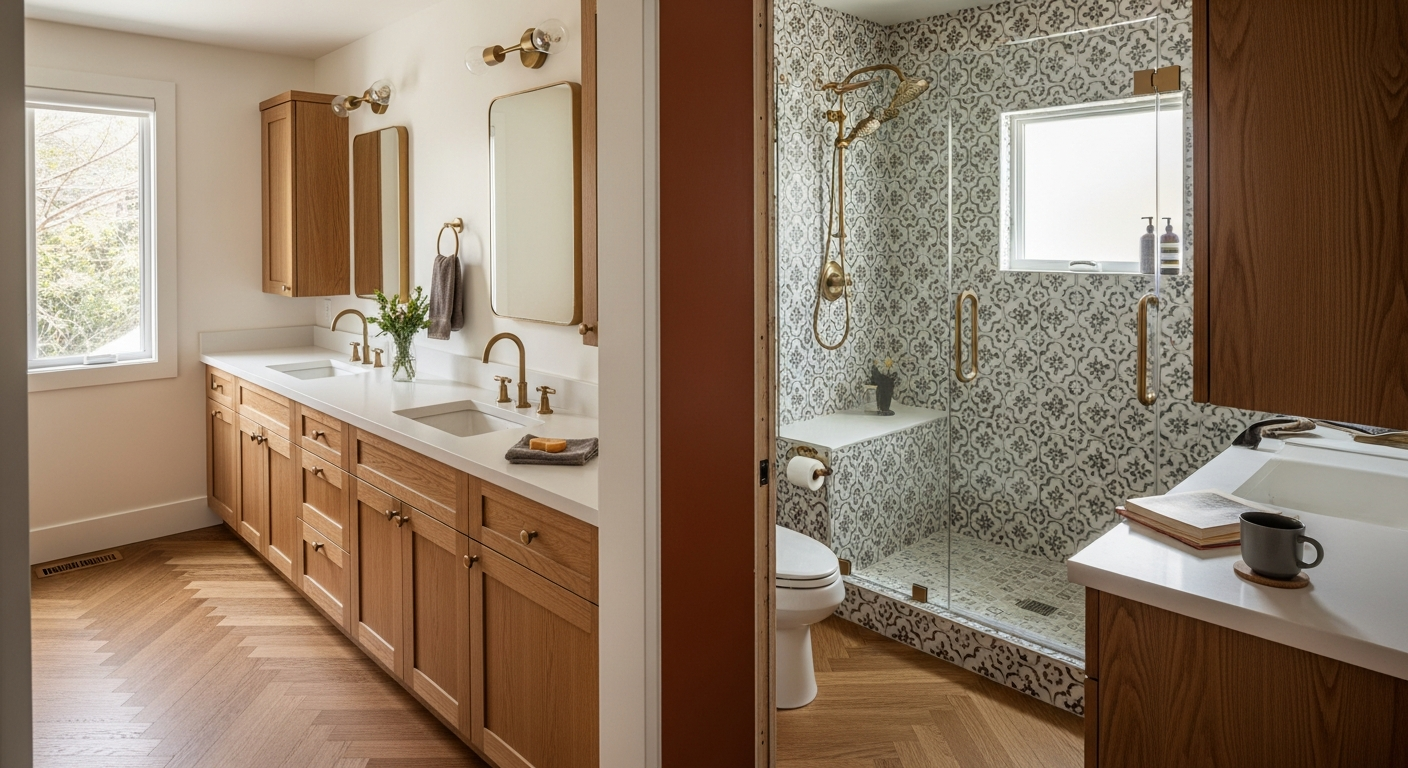
What Is a Jack and Jill Bathroom and Why Remodel One in 2026?
A Jack and Jill bathroom is a shared bathroom positioned between two bedrooms, accessible through separate doors from each room. It's one of the most practical layouts in family homes — and one of the most frequently outdated ones we encounter across the Bay Area. In 2026, a well-designed jack and jill bathroom remodel does more than update tile and fixtures; it transforms a cramped, dated pass-through into a space that gives each child (or guest) a sense of privacy while maximizing every square foot.
As someone who's completed over 116 remodels across Silicon Valley and the Peninsula, I can tell you the jack and jill layout is especially common in homes built between the 1970s and early 2000s in neighborhoods like Saratoga, Los Gatos, and Cupertino. The original designs usually feature a single shared vanity, a tub/shower combo with a cheap fiberglass surround, laminate countertops, and builders-grade tile from the Clinton administration. They're functional, but barely.
Here's the reality: a thoughtfully remodeled Jack and Jill bathroom adds measurable value to a Bay Area home. In a market where median home prices in Santa Clara County hover around $1.8 million, upgrading a Jack and Jill bath with dual vanities, quality materials, and smart privacy features is one of the highest-ROI bathroom projects you can take on. Our 2026 project data shows that homeowners who remodel their Jack and Jill bathrooms see an estimated 60–70% return on investment at resale — higher than most secondary bathroom renovations.
The 2026 design trends we're seeing in these projects lean heavily into warmth and texture: think zellige tile in earthy greens or creamy whites, rift-cut white oak vanities, unlacquered brass hardware, and microcement or hand-applied plaster walls instead of standard painted drywall. Families are moving away from the sterile all-white bathroom toward organic, warm-toned spaces that feel intentional yet kid-durable. The best Jack and Jill designs in 2026 pair luxury materials with practical touches — think easy-clean quartz countertops, curbless showers with linear drains, and soft-close cabinet hardware that survives a decade of daily use by teenagers.
How Much Does a Jack and Jill Bathroom Remodel Cost in the Bay Area?
A Jack and Jill bathroom remodel in the Bay Area typically costs between $35,000 and $90,000+ in 2026, depending on the scope of work, material selections, and whether you're reconfiguring the layout or keeping the existing footprint. Based on our 116+ completed projects, the average mid-range Jack and Jill remodel with dual vanities, new tile, updated plumbing, and quality fixtures lands between $55,000 and $75,000 for a bathroom in the 70–100 square foot range.
Here's a breakdown of what drives costs in the South Bay and Peninsula markets:
| Project Scope | Typical Cost (Bay Area 2026) | What's Included |
|---|---|---|
| Cosmetic Refresh | $25,000 – $40,000 | New vanity, countertops, paint, mirror, lighting, hardware swap; existing layout unchanged |
| Mid-Range Remodel | $55,000 – $75,000 | Dual vanities, new tile (floor + shower), updated plumbing, new fixtures, lighting, ventilation, glass shower enclosure |
| High-End / Layout Change | $80,000 – $120,000+ | Full gut, wall relocation, plumbing re-route, custom cabinetry, premium materials (Calacatta Viola marble, Dekton), radiant floor heating, custom glass |
Several factors make Bay Area Jack and Jill bathroom remodels more expensive than national averages. Labor costs in Santa Clara and San Mateo Counties run 25–40% higher than the national average — a skilled tile setter in Los Gatos charges $85–$120 per hour compared to $50–$70 nationally. Permit fees through the Santa Clara County Planning Department typically add $1,500–$4,000 depending on the scope, and permit approval currently takes 4–8 weeks for standard bathroom renovations.
Material choices are the single biggest cost variable. Choosing Caesarstone or Cambria quartz for countertops ($65–$100/sq ft installed) versus Calacatta Viola marble ($120–$200/sq ft installed) can swing the project total by $3,000–$6,000 on countertops alone. Similarly, standard porcelain tile runs $12–$25/sq ft installed, while handmade zellige tile from suppliers like Clé Tile costs $30–$55/sq ft installed.
One area I encourage Bay Area homeowners not to cut corners on is waterproofing. A properly waterproofed shower using Schluter DITRA or Laticrete HydroBan with a Kerdi membrane system costs about $2,000–$3,500 more than a basic approach, but it eliminates the risk of moisture damage that we see in roughly 1 in 5 older Jack and Jill bathrooms we demo. That's a repair that costs $15,000–$25,000 to fix after the fact.
For a detailed bathroom renovation estimate tailored to your specific layout and goals, our team provides free consultations with a scope-and-budget walkthrough before any commitment.
Best Jack and Jill Bathroom Layout Ideas for Families
The best Jack and Jill bathroom layout separates the wet zone (shower/tub) from the dry zones (vanities and toilets) so two people can use the bathroom simultaneously without conflict. This is the single most important design principle I apply on every Jack and Jill project, and it's the one that makes the biggest difference in daily livability.
Here are the four Jack and Jill layouts we design most frequently for Bay Area families in 2026:
1. The Dual-Vanity Compartment Layout
Each bedroom gets its own vanity area (with sink, mirror, and storage) behind its own door. The shared middle zone contains the toilet and shower/tub, often with its own pocket door or barn door separating it from the vanity areas. This is our most-requested layout for homes in Los Altos and Palo Alto where bedroom sizes can support the extra square footage. It requires roughly 90–120 sq ft of bathroom space.
2. The Linear Pass-Through
A simpler layout where one long room connects both bedrooms. One side holds a double vanity, the other side has the shower and toilet. Privacy is managed with a lockable barn door or pocket door on each end plus a privacy door or curtain separating the toilet from the vanity area. This works well in ranch-style homes common in Campbell and Willow Glen where the bathroom is narrow but long (often 6×14 or 7×12 feet).
3. The T-Shape Layout
The shower and tub occupy a central alcove, with vanity areas branching off to each side toward the respective bedrooms. This is ideal when you have enough width (10+ feet) but limited depth. We've used this layout successfully in several mid-century homes in Mountain View and Sunnyvale where we combined a small hall bath and closet to create sufficient space.
4. The Shared-Vanity Privacy Layout
When square footage is truly limited (under 70 sq ft), we keep one shared vanity with a double sink but add a fully enclosed toilet closet and a properly enclosed shower. Two kids can still get ready simultaneously — one at the sink, one in the shower — without seeing each other. Locking hardware on each entry door is essential.
Regardless of layout, here are the features I recommend on every Jack and Jill bathroom remodel in 2026:
- Privacy locks on both entry doors — barn door hardware with a lock (Emtek or Baldwin), or pocket doors with privacy latches
- A dedicated toilet compartment with its own ventilation (code requires a minimum 50 CFM exhaust fan in enclosed water closets per Santa Clara County building code)
- Soft-close everything — doors, drawers, toilet seats. This is a shared space used by kids; quiet hardware is not optional, it's essential
- Adequate lighting zones — each vanity area should have its own light switch and dimmer so one child can get ready at 6:30 AM without disturbing the other
- Floor-level nightlight — a small LED strip under the vanity toe kick on a motion sensor. Prevents the overhead light from waking a sibling at 2 AM
Jack and Jill Bathroom vs. Shared Bathroom vs. En Suite: Which Is Best for Resale?
For Bay Area homes with 3+ bedrooms, a well-designed Jack and Jill bathroom generally outperforms a basic shared hall bath for resale value, but underperforms a true en suite primary bathroom. The key is understanding which configuration makes sense for your home's bedroom count and target buyer profile.
| Bathroom Type | Pros | Cons | Best For |
|---|---|---|---|
| Jack and Jill | Two bedrooms share one bath; more private than a hall bath; efficient use of space | Shared space requires coordination; locking doors can be forgotten; only serves two rooms | Families with 2 kids; 3–4 bedroom homes where adding a full second bath isn't feasible |
| Shared Hall Bath | Accessible to all bedrooms and guests; simplest plumbing layout; no door-coordination issues | Less private; only one person can use it; feels dated in higher-end homes | Smaller homes (2–3 bedrooms); guest-facing bathrooms |
| En Suite (Attached) | Maximum privacy; adds the most resale value; dedicated to one room | Most expensive to add ($60K–$150K for new construction); requires significant space | Primary bedrooms; luxury guest suites; ADU bedrooms |
Based on our project experience, the strongest resale configuration for a 4-bedroom home in Los Gatos or Saratoga in 2026 is: one primary en suite, one Jack and Jill bathroom connecting bedrooms 2 and 3, and one powder room (half bath) for guests on the main floor. This gives you maximum utility without over-building.
If you're considering converting a Jack and Jill bathroom into two separate en suites, understand that this typically requires adding 30–50 sq ft of floor space (borrowed from an adjacent closet or hallway) and a complete plumbing re-route. Based on our 2026 project data, this conversion costs $90,000–$140,000 in the Bay Area when you factor in the structural work, dual shower installations, and the associated bedroom closet reconfiguration. For most families, a smartly compartmentalized Jack and Jill remodel at $55,000–$75,000 delivers better value.
One thing I tell homeowners considering this question: don't convert a functional Jack and Jill into a hall bath. Removing one of the bedroom entry points eliminates a feature that families specifically search for. In the South Bay market, real estate agents I work with consistently report that buyers with school-age children view a Jack and Jill bathroom as a strong positive when evaluating 3–4 bedroom homes.
Jack and Jill Bathroom Design Trends for 2026: Materials, Fixtures, and Finishes
The dominant Jack and Jill bathroom design trend in 2026 is warm, textural, and organic — a decisive move away from the cold gray-and-white aesthetic that dominated Silicon Valley bathrooms from 2015 to 2022. Here's exactly what our team is specifying on current projects and what we're seeing Bay Area homeowners request most:
Countertops and Vanities
Rift-cut white oak is the vanity material of 2026. About 65% of our current bathroom projects feature white oak in some capacity — either as a floating vanity, a full custom cabinet, or a mixed design with painted lower cabinets and a white oak open shelf. For countertops, Dekton Kreta and Caesarstone Empira White are the most popular surfaces we're installing. Both offer the visual warmth of natural stone with near-zero maintenance — critical in a bathroom shared by kids. For higher-end projects, Calacatta Viola marble (the warm-toned cousin of Calacatta Gold) is absolutely stunning as a vanity top, though I always recommend sealing it every 6–12 months in a Jack and Jill bath given the heavy use.
Tile and Walls
Zellige tile continues to dominate Bay Area bathroom design, and for good reason. The handmade variation in each tile adds depth and character that mass-produced subway tile simply cannot match. For Jack and Jill showers, we're using zellige in the shower niche and as an accent wall, paired with larger-format porcelain (typically 24×48 or 12×24) on the main shower walls for ease of cleaning. Colors trending in 2026: sage green, warm white, terracotta, and a blue-gray that Clé Tile calls "Weathered White."
For walls outside the wet zone, microcement and hand-applied plaster finishes (like Limestrong or Vasari) are replacing standard paint in premium projects. These finishes add a subtle, tactile quality that photographs beautifully and resists moisture better than flat paint — a real advantage in a bathroom with heavy steam.
Fixtures and Hardware
Unlacquered brass is the hardware finish of the moment, and it's perfect for Jack and Jill bathrooms. Unlike polished chrome that shows every water spot, unlacquered brass develops a living patina that actually looks better with daily use. Brands we specify most: Waterworks for high-end projects, Newport Brass for mid-range, and Brizo Litze for clients who want a modern take on warm metal. For shower valves, Thermador thermostatic systems are giving way to Kohler Anthem and Brizo TempAssure digital valve systems with built-in scald protection — a smart safety feature when kids are using the shower independently.
Flooring
Herringbone-pattern porcelain tile that mimics natural stone is the most-requested Jack and Jill bathroom floor in our 2026 projects. We're also installing cement-look porcelain in large format and, for higher budgets, natural limestone in a honed finish. Radiant floor heating (Nuheat or WarmlyYours systems, $800–$1,500 installed for a typical Jack and Jill footprint) is now requested on roughly 40% of our bathroom projects — up from about 15% in 2022.
Smart Features
Motion-activated ventilation fans (Panasonic WhisperGreen Select with humidity sensors), LED-backlit medicine cabinets, and USB-C outlets integrated into the vanity backsplash are now standard requests. One feature I particularly recommend for Jack and Jill bathrooms: integrated finger-pull cabinet hardware instead of protruding knobs or pulls. It eliminates the hip-catching hardware problem that's common in tight Jack and Jill layouts where two people navigate the same space.
How Long Does a Jack and Jill Bathroom Remodel Take in the Bay Area?
A typical Jack and Jill bathroom remodel in the Bay Area takes 8–14 weeks from demolition to final walkthrough, with an additional 4–8 weeks of pre-construction for design, material selection, and permits. Based on our 2026 project data, here's a realistic timeline breakdown:
| Phase | Duration | Key Activities |
|---|---|---|
| Design and Planning | 2–4 weeks | Layout design, material selections, fixture specification, 3D design rendering |
| Permitting | 4–8 weeks | Permit application and approval through Santa Clara County or San Mateo County Building Dept |
| Material Procurement | 2–6 weeks (overlaps with permitting) | Ordering tile, vanities, countertops, fixtures; custom cabinetry lead time is 4–8 weeks |
| Demolition | 2–3 days | Remove existing tile, vanity, fixtures, drywall as needed; inspect for water damage or mold |
| Rough Plumbing and Electrical | 1–2 weeks | Move or add supply/drain lines, add circuits, install exhaust fan ducting, in-wall blocking for grab bars or accessories |
| Waterproofing and Substrate | 3–5 days | Schluter Kerdi or Laticrete HydroBan membrane system; cement board installation; shower pan or linear drain installation |
| Tile Installation | 1–2 weeks | Floor tile, shower tile, accent walls, grout and seal |
| Vanity, Countertop, and Fixture Installation | 1 week | Custom or semi-custom vanity, countertop template and install, plumbing trim, lighting, mirrors |
| Final Details and Punch List | 3–5 days | Hardware, caulking, touch-up, glass enclosure, accessories, final inspection |
The most common delays on Jack and Jill remodels are material lead times (custom vanities and specialty tile can take 6–10 weeks to arrive) and hidden conditions discovered during demo. In roughly 25% of the Jack and Jill bathrooms we demolish in older Bay Area homes, we uncover some level of water damage, outdated galvanized plumbing, or subfloor rot that wasn't visible before demo. This typically adds 3–7 days and $2,000–$8,000 to the project depending on severity.
My advice: start selecting materials during the design phase, not after permits are approved. On our projects, we run design and procurement concurrently with permitting so that materials arrive before demo day. This approach, which our team uses on every bathroom renovation, typically shaves 2–4 weeks off the total timeline compared to a sequential approach.
Do You Need a Permit to Remodel a Jack and Jill Bathroom in Los Gatos or the Bay Area?
Yes — any Jack and Jill bathroom remodel that involves plumbing changes, electrical work, or structural modifications requires a building permit in every Bay Area jurisdiction. A cosmetic-only update (paint, mirror swap, hardware change) typically does not require a permit, but the moment you move a drain line, add a circuit, relocate a wall, or change the shower configuration, you need one.
Here's what I've learned from pulling hundreds of permits across multiple Bay Area cities:
- Santa Clara County (Los Gatos, Saratoga, Monte Sereno, unincorporated areas): Bathroom remodel permits are processed through the Santa Clara County Planning and Development Department. Standard review takes 4–6 weeks. Fees range from $1,500 to $3,500 depending on project valuation. Electronic plan submission has been available since 2023 and speeds up the process.
- City of Los Gatos: The Community Development Department handles permits separately from the county. They're generally responsive, with 3–5 week review times for standard bathroom remodels. Plan check fees are calculated as a percentage of project valuation.
- San Mateo County (Menlo Park, Redwood City, San Mateo, Burlingame): The San Mateo County Building Department requires separate plumbing, electrical, and building permits for full bathroom remodels. Total permit costs run $2,000–$4,500. Review times are currently 5–8 weeks.
- Palo Alto: Known for one of the most rigorous review processes in the Bay Area. Bathroom remodel permits can take 6–10 weeks. If your home is in the Professorville Historic District or another designated historic area, additional design review may apply.
Skipping permits is never worth the risk. Beyond the obvious safety concerns, an unpermitted bathroom remodel in a Bay Area home creates a disclosure issue at resale that can cost you tens of thousands of dollars in renegotiation or require you to tear out and redo completed work. As a licensed contractor (CA License #1086047), I only perform permitted work — it's the only way to protect both the homeowner and the integrity of the project.
For homeowners in Menlo Park, Los Gatos, or anywhere else in the Bay Area, our team handles the entire permit process — application, plan preparation, submission, and all required inspections — as a standard part of our bathroom renovation service.
Frequently Asked Questions
How much does a Jack and Jill bathroom remodel cost in the Bay Area in 2026?
A Jack and Jill bathroom remodel in the Bay Area costs between $35,000 and $90,000+ in 2026, depending on scope and material selections. Based on Barcci Builders' data from 116+ completed projects, a mid-range remodel with dual vanities, new tile, updated plumbing, and quality fixtures typically costs $55,000–$75,000 for a 70–100 square foot bathroom. A cosmetic refresh runs $25,000–$40,000, while a full gut renovation with layout changes and premium materials like Calacatta Viola marble can exceed $100,000. Bay Area labor costs run 25–40% above national averages, which is the primary driver of higher pricing.
What is the best layout for a Jack and Jill bathroom with two kids?
The best layout for a Jack and Jill bathroom serving two children is the dual-vanity compartment layout, where each bedroom has its own vanity area behind its own door, and the shared shower/tub and toilet occupy a central compartment with privacy doors. This allows both kids to get ready simultaneously — brushing teeth, doing hair — without needing to share the mirror. If space is limited (under 70 sq ft), a shared double-sink vanity with an enclosed toilet closet and enclosed shower is the most practical alternative. The key design principle is separating wet zones from dry zones so the bathroom can serve two users at once.
Jack and Jill bathroom vs hall bathroom: which adds more home value?
For 3–4 bedroom family homes in the Bay Area, a well-designed Jack and Jill bathroom generally adds more resale value than a standard hall bath because it provides semi-private bathroom access for two bedrooms — a feature that families with school-age children specifically seek. However, a true en suite (attached to a single bedroom) adds the most value per dollar for primary bedrooms. The ideal configuration for a 4-bedroom Bay Area home is one primary en suite, one Jack and Jill connecting bedrooms 2 and 3, and one powder room on the main floor. Converting a functional Jack and Jill to a hall bath is generally not recommended, as it removes a feature buyers value.
How long does it take to remodel a Jack and Jill bathroom near Los Gatos?
A Jack and Jill bathroom remodel near Los Gatos takes approximately 8–14 weeks of active construction, plus 4–8 weeks of pre-construction for design, material procurement, and permitting through the Town of Los Gatos Community Development Department or Santa Clara County. The full timeline from first design meeting to final walkthrough is typically 14–22 weeks. The most common delays are custom vanity and specialty tile lead times (6–10 weeks) and hidden water damage discovered during demolition, which our team finds in roughly 25% of older Jack and Jill bathrooms.
Do I need a permit to remodel a Jack and Jill bathroom in California?
Yes, you need a building permit for any Jack and Jill bathroom remodel in California that involves plumbing changes, electrical work, or structural modifications. This includes moving or adding drain lines, adding electrical circuits, installing new exhaust fans, or changing the shower configuration. Cosmetic-only updates (paint, hardware, mirror swaps) typically do not require permits. In Santa Clara County, bathroom remodel permit fees range from $1,500 to $3,500 with a 4–6 week review period. All work should be performed by a licensed contractor — unpermitted work creates disclosure issues at resale.
What are the best tiles for a Jack and Jill bathroom in 2026?
The most popular tiles for Jack and Jill bathrooms in 2026 are handmade zellige tile for shower niches and accent walls (in sage green, warm white, or terracotta, $30–$55/sq ft installed), large-format porcelain (24×48 or 12×24) for main shower walls and floors ($12–$25/sq ft installed), and herringbone-pattern porcelain that mimics natural stone for bathroom floors. For countertops, quartz surfaces like Caesarstone Empira White and Cambria Brittanicca Warm are the most specified because they combine the look of marble with zero-maintenance durability — critical in a bathroom used daily by children.
Can you convert a Jack and Jill bathroom into two separate bathrooms?
Yes, but it's expensive. Converting a Jack and Jill bathroom into two separate en suite bathrooms in the Bay Area typically costs $90,000–$140,000 in 2026 because it requires adding 30–50 square feet of floor space (usually borrowed from adjacent closets or hallways), a complete plumbing re-route to create two independent drain and supply systems, structural work, and dual shower installations. For most families, a smartly compartmentalized Jack and Jill remodel at $55,000–$75,000 delivers better value. The conversion makes the most sense in homes where the bedrooms will be used as guest suites or where each room will function as a rental unit.
What privacy features should a Jack and Jill bathroom have?
Every Jack and Jill bathroom should include privacy locks on both bedroom entry doors (Emtek or Baldwin barn door locks, or pocket doors with privacy latches), a fully enclosed toilet compartment with its own exhaust fan (minimum 50 CFM per Santa Clara County building code), independent lighting zones with separate switches and dimmers for each vanity area, and soft-close mechanisms on all doors, drawers, and toilet seats. For enhanced privacy, consider a floor-level LED nightlight on a motion sensor (under the vanity toe kick) so one child can use the bathroom at night without turning on overhead lights that might wake a sibling.