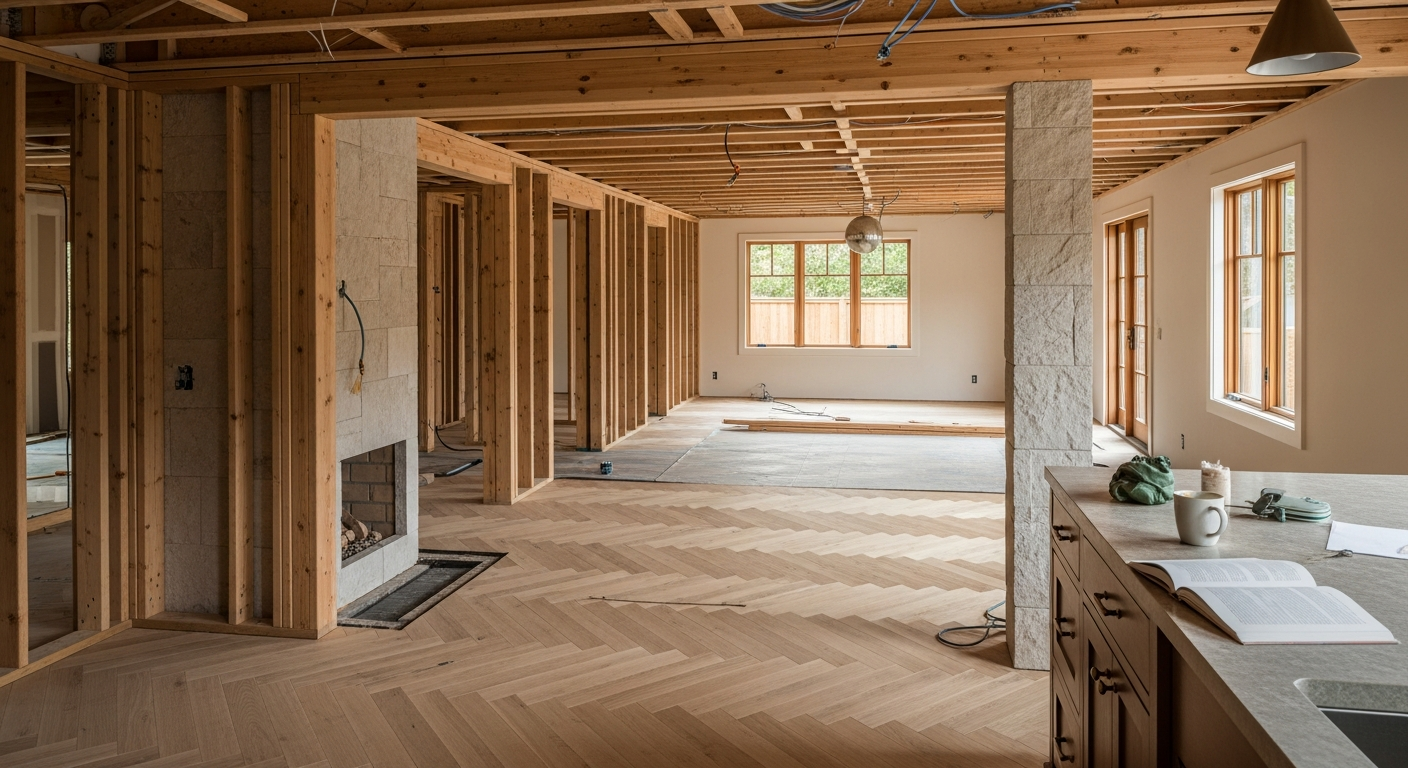
How Long Does a Whole House Remodel Take in 2026?
A whole house remodel in the Bay Area typically takes 5 to 12 months from demolition to final walkthrough in 2026, with most projects landing in the 7-to-9-month range. That timeline does not include the design and permitting phase, which adds another 2 to 5 months before any hammer swings. So from the day you first call a contractor to the day you pop champagne in your new kitchen, you're realistically looking at 8 to 16 months total.
I'm Bar Benbenisty, founder of Barcci Builders (CA License #1086047), and our team has completed 116+ whole house remodels, kitchen renovations, and additions across the Bay Area — from mid-century ranches in Los Gatos to Eichler homes in Palo Alto and two-story Victorians in San Jose. The number one question I hear from homeowners is "How long is this going to take?" — and the honest answer is that it depends on scope, permits, and decisions you make before construction even begins.
Here's the reality: 78% of whole house remodel delays in our experience come from just three causes — permit processing, material lead times, and mid-project design changes. If you plan proactively for all three, your project can stay on schedule. This guide breaks down every phase so you know exactly what to expect.
What Are the Phases of a Whole House Remodel and How Long Does Each Take?
| Phase | Duration (Typical) | Key Activities |
|---|---|---|
| 1. Design & Architecture | 4–10 weeks | Space planning, 3D renderings, architectural drawings, material selection |
| 2. Permitting | 4–12 weeks | Permit application, plan check, revisions, approval |
| 3. Pre-Construction | 2–4 weeks | Material ordering, subcontractor scheduling, site prep |
| 4. Construction | 16–40 weeks | Demo, framing, MEP rough-in, insulation, drywall, finishes, fixtures |
| 5. Final Inspections & Punch List | 1–3 weeks | City inspections, punch list items, final walkthrough, close-out |
Phase 1: Design and Architecture (4–10 weeks)
This is where your remodel lives or dies. A thorough design phase prevents costly changes later. Our team uses 3D design rendering so clients can walk through their future home virtually before we pull a single permit. For a full whole house remodel, expect to spend 4 to 6 weeks in design if you're decisive with selections, or up to 10 weeks if the project involves structural changes, additions, or complex engineering.
Phase 2: Permitting (4–12 weeks)
Permit timelines vary dramatically across Bay Area jurisdictions. In 2026, Santa Clara County Planning typically processes residential remodel permits in 4 to 8 weeks. The Town of Los Gatos runs 6 to 10 weeks for projects involving structural work. San Mateo County Building Department can take 8 to 12 weeks for more complex applications. If your home is in a historic district — like parts of Saratoga's heritage zone or Professorville in Palo Alto — add another 4 to 6 weeks for design review board approval.
Phase 3: Pre-Construction (2–4 weeks)
Once permits are in hand, we order long-lead materials and lock in subcontractor schedules. In 2026, European appliances from brands like Miele and Gaggenau carry lead times of 6 to 14 weeks, and custom cabinetry averages 8 to 12 weeks. Smart contractors order these items during the permitting phase so they arrive on time. This overlap is one of the biggest schedule-savers I know.
Phase 4: Construction (16–40 weeks)
Phase 5: Final Inspections and Punch List (1–3 weeks)
City inspectors verify everything meets code, we walk through the home with you room by room, and our crew addresses any punch list items. This phase is short but critical for quality.
How Much Does a Whole House Remodel Cost in the Bay Area in 2026?
A whole house remodel in the Bay Area costs between $200 and $500+ per square foot in 2026, depending on the level of finish, structural complexity, and material selections. For a typical 2,000-square-foot home, that translates to $400,000 to $1,000,000+ for a comprehensive renovation.
| Remodel Level | Cost per Sq Ft | Total (2,000 sq ft) | What's Included |
|---|---|---|---|
| Cosmetic Refresh | $150–$225 | $300K–$450K | New flooring, paint, lighting, fixture swaps, minor layout tweaks |
| Mid-Range Remodel | $225–$375 | $450K–$750K | New kitchen, 2–3 bathrooms, flooring, some wall removals, updated MEP |
| High-End Gut Remodel | $375–$550+ | $750K–$1.1M+ | Full gut to studs, structural changes, premium finishes, smart home, landscaping |
The relationship between budget and timeline is direct: higher-end finishes often require longer lead times. A slab of Calacatta Viola marble can take 4 to 8 weeks to source and fabricate. Custom rift-cut white oak cabinetry from a Bay Area millwork shop runs 10 to 14 weeks. Hand-applied plaster walls — one of the most popular finishes we're installing in 2026 — require multiple coats with drying time between each, adding 1 to 2 weeks to the schedule compared to standard drywall and paint.
What Causes Delays in a Whole House Remodel in Silicon Valley?
The three most common causes of delay in Bay Area whole house remodels are permit processing times, material lead times, and homeowner decision changes during construction. In our experience, 80% of projects that run over schedule can trace the delay back to one of these three factors.
1. Permit and Inspection Delays
Bay Area jurisdictions are famously thorough — and slow. Santa Clara County requires structural engineering review for any wall removal, which adds plan check cycles. If your project involves seismic retrofitting (common in pre-1970s homes throughout Campbell, Sunnyvale, and San Jose), expect additional review time. In 2026, we're seeing plan check turnaround times of 4 to 8 weeks for initial review and 2 to 4 weeks for resubmittals in most South Bay cities. During construction, failed inspections can cost you 1 to 2 weeks per occurrence while corrections are made and re-inspection is scheduled.
2. Material Lead Times and Supply Chain Issues
The supply chain has stabilized significantly since 2022, but certain premium materials still carry long lead times. In 2026, here are the items we flag for early ordering:
- European appliances (Miele, Gaggenau, Thermador): 6–14 weeks
- Custom cabinetry: 8–14 weeks
- Large-format porcelain slabs (Dekton Kreta, Neolith): 4–8 weeks
- Custom steel windows and doors: 12–20 weeks
- Quartzite and exotic stone slabs: 3–6 weeks for fabrication after selection
- Unlacquered brass hardware (Rocky Mountain, Waterworks): 6–10 weeks
We mitigate this by ordering long-lead items during the permitting phase. This single strategy has saved our clients an average of 4 to 6 weeks on project timelines.
3. Mid-Project Design Changes
I understand — once walls come down and you see the space, inspiration strikes. But changing the layout after framing is complete can add 3 to 6 weeks and $20,000 to $80,000 in costs. This is exactly why we invest heavily in the 3D design and rendering phase upfront. When clients can see photorealistic renders of every room before construction starts, change orders drop by roughly 60%.
4. Discovery of Hidden Conditions
Many Bay Area homes were built in the 1950s through 1970s. Once we open walls, we commonly find knob-and-tube wiring, galvanized steel plumbing, asbestos in popcorn ceilings or duct insulation, and outdated seismic bracing. Addressing these issues is non-negotiable for safety and code compliance, and they typically add 1 to 4 weeks to the schedule depending on severity. A thorough pre-construction assessment reduces surprises, but some conditions are simply invisible until demolition.
How to Speed Up Your Whole House Remodel Without Cutting Corners
The fastest way to speed up a whole house remodel is to make all design decisions, finalize material selections, and order long-lead items before construction begins. This sounds obvious, but fewer than 30% of homeowners we initially consult with have done this homework before wanting to start demo.
Here are the strategies our team uses to keep Bay Area whole house remodels on schedule:
1. Use a Design-Build Contractor
Working with a design-build firm like Barcci Builders eliminates the gap between your architect and your contractor. When design and construction are under one roof, there's no weeks-long back-and-forth interpreting drawings. Our 2026 project data shows that design-build whole house remodels complete 15–25% faster than the traditional architect-then-bid-then-build approach.
2. Finalize Every Selection Before Permits Are Issued
Tile, countertops, cabinetry finish, plumbing fixtures, lighting, flooring, hardware — all of it. Every "I'll decide later" becomes a scheduling gap on the jobsite. We provide clients with a comprehensive selection schedule that maps every decision to a deadline, ensuring materials arrive exactly when the crew needs them.
3. Order Long-Lead Items During Permitting
As I mentioned, this is the single biggest time-saver. Permits take weeks — use that time productively. By the time we break ground, appliances are in the warehouse, cabinets are in production, and stone slabs are reserved at the fabricator.
4. Live Off-Site During Construction
This is a sensitive topic, but it makes a measurable difference. When our crew has unrestricted access to the entire house from 7 AM to 5 PM, five to six days a week, a full gut remodel moves 20–30% faster than when homeowners are living in part of the home. For Bay Area homeowners weighing this decision: the cost of temporary housing for 6 months is often less than the added construction cost of working around occupied rooms.
5. Trust Your Contractor's Process
Experienced contractors sequence work in a specific order for a reason. Framing, then rough plumbing and electrical, then insulation, then drywall — this sequence allows inspections to happen efficiently and keeps trades from stepping on each other. When clients ask us to jump ahead to "get the kitchen done first," it almost always creates bottlenecks that slow the overall project down.
Whole House Remodel vs. New Construction: Which Is Faster in the Bay Area?
New construction is typically faster than a whole house remodel of comparable scope in the Bay Area — but not by as much as you might think. A ground-up custom home in Los Gatos or Saratoga takes 12 to 18 months of construction in 2026, while a comprehensive gut remodel of a similar-sized home takes 7 to 12 months. The difference narrows when you factor in the significantly longer permitting and design process for new construction.
| Factor | Whole House Remodel | New Construction |
|---|---|---|
| Design Phase | 4–10 weeks | 8–16 weeks |
| Permitting | 4–12 weeks | 8–24 weeks |
| Construction | 16–40 weeks | 40–72 weeks |
| Total Timeline | 6–15 months | 14–28 months |
| Cost per Sq Ft | $200–$550 | $450–$800+ |
| Permit Complexity | Moderate | High (zoning, setbacks, design review) |
For many Silicon Valley homeowners, the math favors a whole house remodel — especially if the existing foundation and framing are structurally sound. You preserve the home's footprint (avoiding complex zoning and setback negotiations), maintain grandfathered lot coverage ratios, and get into your renovated home months sooner. However, if your home has significant foundation issues, termite damage, or you need to add substantial square footage, new construction may ultimately be the smarter investment.
I'll put it this way: if more than 60% of the home's structure needs replacement, you're likely better off building new. Below that threshold, a remodel usually delivers better value on a faster timeline.
What Does a Whole House Remodel Timeline Look Like Month by Month?
A realistic month-by-month timeline for a full gut remodel of a 2,200-square-foot Bay Area home looks like this, based on a real project we completed in Cupertino in 2025:
Months 1–2: Design and Selections
Initial consultation, site measurements, architectural drawings, 3D renderings, and material selections. Client visits showrooms for Thermador appliances, selects Dekton Kreta for kitchen countertops, chooses herringbone-pattern rift-cut white oak for all main-level flooring, and finalizes zellige tile for the primary bathroom.
Month 3: Permitting
Plans submitted to the City of Cupertino. Structural engineering review for removal of a load-bearing wall between kitchen and living room. Permits approved in 5 weeks with minor revisions.
Month 4: Pre-Construction and Demo
Long-lead items ordered (custom cabinetry with integrated finger-pull hardware, steel-framed patio doors). Demolition begins — interior stripped to studs. Asbestos found in original popcorn ceiling texture, requiring licensed abatement (added 5 days to schedule).
Months 5–6: Structural, Rough MEP
New LVL beam installed where load-bearing wall was removed. All new electrical wiring (200-amp panel upgrade), PEX plumbing, and HVAC ductwork. Induction cooktop requires dedicated 50-amp circuit. Rough inspections passed on first attempt.
Month 7: Insulation, Drywall, Plaster
Closed-cell spray foam insulation in exterior walls. Drywall hung, taped, and finished. Hand-applied plaster treatment on living room and primary bedroom feature walls — a warm, organic texture that's been our most requested finish in 2026. Plaster range hood fabricated and installed in kitchen.
Months 8–9: Finishes
Cabinetry installed in kitchen and all three bathrooms. Cambria Brittanicca quartz installed in guest bathrooms. Dekton Kreta countertops templated, fabricated, and installed in kitchen. Herringbone white oak floors installed throughout main level. All tile work completed — including zellige tile in primary bath and microcement finish in powder room. Interior painting in warm earthy tones (we used Benjamin Moore White Heron and Pale Oak throughout).
Month 10: Fixtures, Appliances, and Punch List
All plumbing fixtures set (Kohler Purist in unlacquered brass throughout). Thermador appliance package installed and tested. Lighting fixtures hung. Cedar cladding installed on rear exterior accent wall. Landscaping and exterior finishing completed. Final city inspection passed. Punch list walkthrough with clients — 14 minor items addressed over 5 days.
Total timeline: 10 months from first meeting to move-in. This is representative of what Bay Area homeowners should plan for with a comprehensive gut remodel in 2026.
Frequently Asked Questions
How long does a whole house remodel take in the Bay Area?
How much does a whole house remodel cost per square foot in Silicon Valley?
In 2026, a whole house remodel in Silicon Valley costs $200 to $550+ per square foot depending on the level of finish. A cosmetic refresh with updated surfaces and fixtures runs $150 to $225 per square foot. A mid-range remodel with new kitchen, bathrooms, and some structural work averages $225 to $375 per square foot. A high-end gut remodel with premium materials like Calacatta Viola marble, custom cabinetry, and smart home systems costs $375 to $550+ per square foot. For a typical 2,000-square-foot home, that's $400,000 to $1,100,000+.
How long does it take to get a remodel permit in Santa Clara County?
Permit approval in Santa Clara County currently takes 4 to 8 weeks for residential remodel projects in 2026, based on our recent project experience. Simple projects with no structural changes can sometimes clear plan check in 3 to 4 weeks. Projects involving structural modifications, seismic upgrades, or additions typically require 6 to 10 weeks due to mandatory engineering review. The Town of Los Gatos and City of Saratoga, which have their own planning departments, average 6 to 10 weeks for projects with structural components. Expedited plan check services are available in some jurisdictions for an additional fee.
Should I live in my house during a whole house remodel?
For a full gut remodel, we strongly recommend living off-site. When our crew has unrestricted access to the entire home, projects move 20 to 30 percent faster because trades can work simultaneously in multiple rooms without navigating around occupied spaces. For Bay Area homeowners, 6 months of temporary housing typically costs $18,000 to $36,000 for a furnished rental, while the extended construction timeline from living in the home can add $25,000 to $60,000 in additional labor costs. There are also safety and health considerations — construction dust, noise starting at 7 AM, and temporarily disconnected utilities make daily life very difficult.
What is the fastest way to remodel a whole house in the Bay Area?
The fastest approach is to hire a design-build contractor, finalize every material selection before permitting, order long-lead items during the permit review period, and move out of the home during construction. Our 2026 project data shows that design-build whole house remodels complete 15 to 25 percent faster than the traditional architect-bid-build method. Additionally, having all selections locked in before demo prevents the scheduling gaps that occur when the crew is waiting for a homeowner to choose tile or countertops. These strategies combined can save 2 to 4 months on a typical whole house remodel timeline.
Is it cheaper to remodel or build new in Los Gatos?
In most cases, a whole house remodel in Los Gatos is cheaper than new construction — typically $200 to $550 per square foot for a remodel versus $450 to $800+ per square foot for ground-up construction in 2026. A remodel also completes faster (6 to 15 months total versus 14 to 28 months for new construction) and avoids the complex zoning, setback, and design review challenges that new builds face in Los Gatos. However, if more than 60% of the home's structure needs replacement due to foundation failure, extensive termite damage, or outdated framing, new construction may deliver better long-term value.
What causes delays in a whole house remodel?
The three most common causes of delay are permit processing (adds 2 to 6 weeks beyond expected timelines), material lead times for premium items like European appliances and custom cabinetry (6 to 14 weeks if not ordered early), and mid-project design changes (can add 3 to 6 weeks and $20,000 to $80,000). Hidden conditions discovered during demolition — such as knob-and-tube wiring, galvanized plumbing, or asbestos — are also common in Bay Area homes built before 1970 and can add 1 to 4 weeks. Proactive planning, thorough pre-construction assessment, and finalizing all design decisions before construction begins are the best defenses against delays.