What Does a Home Office Addition Cost in the Bay Area in 2026?
A dedicated home office addition in the Bay Area costs between $85,000 and $320,000 in 2026, depending on size, scope, and finish level. That range covers everything from a straightforward 120-square-foot bump-out with hardwired ethernet and good acoustic insulation all the way to a fully custom 400-square-foot detached studio with rift-cut white oak built-ins, hand-applied plaster walls, and a separate HVAC zone.
Silicon Valley's work-from-home culture has made the home office one of the fastest-growing remodel categories we handle. In 2023, roughly 1 in 12 of our projects included a dedicated office component. By 2026, that figure is closer to 1 in 5. The demand is real, the return on investment is measurable, and the design possibilities have expanded dramatically.
| Scope | Typical Size | 2026 Cost Range | Best For |
|---|---|---|---|
| Bedroom conversion (existing room) | 120-180 sq ft | $28,000 - $55,000 | Budget-conscious; no structural work |
| Attached addition (bump-out) | 150-300 sq ft | $85,000 - $195,000 | Most popular; adds square footage |
| Garage conversion to office | 200-500 sq ft | $65,000 - $140,000 | Great value; minimal foundation work |
| Detached backyard office studio | 200-600 sq ft | $120,000 - $320,000 | Best separation; may qualify as ADU |
One important nuance: if your detached office studio exceeds 150 square feet and includes a bathroom or kitchen, it will likely be classified as a junior ADU (JADU) or accessory dwelling unit (ADU) under California state law, which opens additional permit pathways but also additional requirements. Our ADU and home additions team navigates that distinction on every project.
Home Office Addition Cost Per Square Foot in the Bay Area
In 2026, attached home office additions in the Bay Area run $475 to $750 per square foot for fully finished, permitted space - with the wide range driven almost entirely by finish level, structural complexity, and city permit fees.
Our 2026 project data shows that the per-square-foot cost for home office additions in premium South Bay and Peninsula zip codes - Los Gatos, Saratoga, Palo Alto, Menlo Park, Los Altos - tends to land at the higher end of that range because of higher land values, stricter design review, and the premium finishes these homeowners expect. In San Jose, Campbell, Sunnyvale, and Mountain View, the same quality of build typically runs $475-$580 per square foot.
| City | Cost Per Sq Ft (Attached Addition) | Permit Timeline | Typical Permit Fee |
|---|---|---|---|
| Los Gatos | $620 - $750 | 8-14 weeks | $4,500 - $9,200 |
| Saratoga | $600 - $730 | 10-16 weeks | $5,000 - $10,500 |
| Palo Alto | $620 - $760 | 12-20 weeks | $6,000 - $14,000 |
| Menlo Park | $590 - $720 | 10-16 weeks | $5,500 - $11,000 |
| Los Altos | $580 - $710 | 8-14 weeks | $4,800 - $9,600 |
| Mountain View | $510 - $620 | 6-12 weeks | $3,800 - $7,500 |
| San Jose | $475 - $600 | 6-14 weeks | $3,200 - $7,800 |
| Campbell | $490 - $610 | 6-10 weeks | $3,400 - $7,200 |
| Cupertino | $520 - $640 | 8-14 weeks | $4,200 - $8,800 |
| Sunnyvale | $505 - $625 | 6-12 weeks | $3,600 - $7,600 |
"The single biggest driver of per-square-foot cost is not the finish level - it's whether we're touching the foundation," says Bar Benbenisty, owner of Barcci Builders. "A slab-on-grade bump-out on a flat lot in Willow Glen costs meaningfully less than the same footprint on a stepped foundation on a hillside lot in the Los Gatos hills. Always clarify this with your contractor before you lock in a budget."
What Drives the Cost of a Home Office Addition?
The five biggest cost drivers for a Bay Area home office addition are: structural work, soundproofing, HVAC, electrical and data infrastructure, and millwork. Most homeowners underestimate items three through five.
1. Structural and Foundation Work
An attached addition requires a continuous foundation, new wall framing, and roof tie-in. On a typical single-story ranch-style home in Old Mountain View or Willow Glen, this structural package runs $22,000-$45,000. On a two-story home or a hillside property in the Los Gatos hills, expect $40,000-$75,000 or more for engineered foundation work and shear wall upgrades required by Santa Clara County Building Department.
2. Soundproofing
3. HVAC Zoning
Adding a dedicated room almost always means adding a mini-split or extending and re-zoning your existing ductwork. A single-zone Mitsubishi or Daikin mini-split system installed and permitted runs $4,800-$9,500 in 2026. If you want the office on the same smart thermostat system as the rest of the house, add $1,200-$2,800 for controls integration.
4. Electrical and Data Infrastructure
This is the category where tech-industry homeowners in Professorville (Palo Alto) and Downtown Los Gatos consistently invest most heavily. A proper office electrical package includes: 20-amp dedicated circuits for workstations, hardwired CAT6A ethernet to at least 4 drops, conditioned power via a whole-room UPS or surge protection panel, and LED architectural lighting on dimmers. Budget $6,500-$14,000 for this work, fully permitted.
5. Built-In Millwork
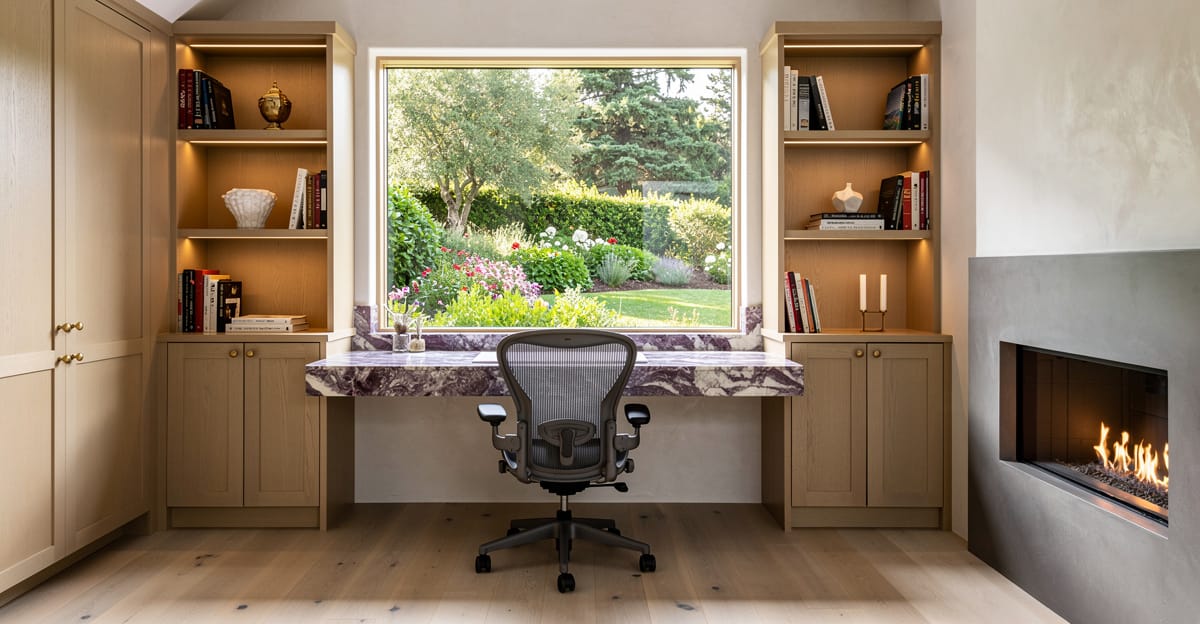
Floor-to-ceiling built-in bookshelves and a custom desk in rift-cut white oak with integrated finger pulls - the look that has completely taken over luxury office design in 2026 - runs $18,000-$42,000 depending on linear footage and material choice. Fluted details on cabinet faces add roughly 15-20% to millwork costs but deliver a dramatic result. We source cabinetry from local custom shops and finish-grade suppliers in the South Bay.
Detached Backyard Office Studio: What It Costs and When It Makes Sense
A detached backyard office studio - a standalone structure purpose-built for work, separated from the main house - costs $120,000 to $320,000 in the Bay Area in 2026. This is the option that provides maximum separation between work and home life, and it is the fastest-growing sub-category we are building.
The critical decision point: if the structure is under 150 square feet of floor area, it may qualify as an accessory structure in most Bay Area cities - no separate ADU permit required, simpler approval path. Once you exceed 150 square feet or add a full bathroom and sleeping area, California state law typically classifies it as a JADU or ADU, which triggers additional review but also gives you future flexibility to rent it as housing. Our ADU team can walk you through both pathways and determine which best serves your long-term goals.
"I had a client in Saratoga who started the conversation wanting a simple backyard shed-office and ended up permitted as a 400-square-foot JADU with a kitchenette," Bar explains. "Two years later she is renting it for $2,800 a month. That decision to go slightly larger turned a pure cost center into a revenue-generating asset. It is worth modeling both scenarios before you set your footprint."
For more on how a detached structure can serve double duty as both a home office and a rentable unit, see our guide to ADU and home additions in the Bay Area.
Garage Conversion to Home Office: The Most Cost-Effective Option
Converting an attached or detached garage into a dedicated home office is the most cost-effective path to adding usable square footage in 2026, running $65,000 to $140,000 fully finished and permitted. The foundation and framing already exist, which eliminates the most expensive structural work in a new addition.
What does the conversion involve? In a typical 2-car garage (roughly 440-500 square feet), we: remove the garage doors and frame in new insulated walls and windows, add a vapor barrier and insulated subfloor over the concrete slab, install acoustic-grade insulation in walls and ceiling, run new electrical circuits, add a mini-split HVAC unit, and finish with drywall, paint, and your chosen flooring. White oak engineered hardwood over the subfloor is the most popular choice in 2026; microcement over the existing slab is a close second for a more industrial aesthetic.
A note on permits: nearly every Bay Area city requires a permit to convert a garage to habitable space, and Santa Clara County Building Department requires energy compliance under California Title 24. This is not optional. Unpermitted garage conversions create serious problems at resale and can complicate your homeowner's insurance. Our team handles the full permit process - we have a strong working relationship with Santa Clara County and the city building departments in Los Gatos, Campbell, San Jose, and across the South Bay.
One caveat: if the garage is your only off-street parking and your city has a minimum parking requirement, you may need to demonstrate that you have a viable alternative parking solution before the city will approve the conversion. This issue comes up more frequently in older neighborhoods of Mountain View and Sunnyvale with smaller lots. We identify these issues at the feasibility stage, before you spend a dollar on design.
2026 Home Office Design Trends in the Bay Area
The most requested home office aesthetic in 2026 is what we call "warm modern library" - a combination of rift-cut white oak millwork, hand-applied plaster walls, warm brass hardware, and rich earthy tones that feels sophisticated but not cold. It is a deliberate departure from the all-white minimalism that dominated Bay Area interiors from 2015-2022.
Here is what our clients in Los Gatos, Saratoga, and Palo Alto are consistently choosing:
- Millwork: Rift-cut white oak built-ins with integrated finger pulls, fluted door faces, and open shelving with plate steel pins. Calacatta Viola marble desk surfaces or waterfall-edge Dekton Kreta for a more durable alternative.
- Walls: Hand-applied plaster in warm white or greige tones - Portola Paints' Roman Clay is our most-specified product by far. The texture adds depth that flat paint simply cannot replicate.
- Flooring: 5-inch wide white oak engineered hardwood in a natural matte finish, or large-format travertine-look porcelain tile from Ceramiche Caesar or Florim.
- Lighting: Integrated LED cove lighting concealed in built-in valances, supplemented by a statement pendant (Visual Comfort or Apparatus Studio) over the desk. Blackout roller shades from Hunter Douglas behind woven wood roman shades for a layered window treatment.
- Hardware: Unlacquered brass throughout - pulls, door levers, outlet covers. It ages beautifully and adds warmth that satin nickel cannot.
- Acoustic panels: Fabric-wrapped panels in Kvadrat or Maharam textile integrated into the built-in design so they are invisible as acoustics and look like design features.
"The biggest shift I have seen in the last two years is clients thinking about their office the same way they think about their kitchen," Bar says. "They want it to be the nicest room in the house, because they spend more time there than anywhere else. The days of 'just put a desk in the spare bedroom' are over for this client base."
For a broader look at how these design trends are showing up across the whole house, see our whole house remodel services page or our guide to 3D design and rendering, which we use on every project to help clients visualize finishes before committing.
Permit Requirements for Home Office Additions in the Bay Area
Any addition to your home's footprint - regardless of size - requires a building permit in every Bay Area city. Period. The permit process for an attached home office addition typically takes 6 to 20 weeks for plan check approval, depending on the city and whether your project triggers design review.
Here is what Santa Clara County Building Department and the individual city planning offices require for a typical attached addition:
- Architectural drawings (floor plan, elevations, sections) prepared or stamped by a licensed professional
- Structural engineering calculations and details
- Title 24 energy compliance documentation (California requires this for any new conditioned space)
- Electrical plans if you are adding circuits or upgrading the panel
- Site plan showing the addition's relationship to property lines, setbacks, and existing structures
In cities like Palo Alto and Saratoga, any addition visible from the street may trigger an additional design review or Architectural and Site Approval (ASA) process, which can add 4-8 weeks to the timeline. In Los Gatos, the planning department generally requires a pre-application meeting for additions over 200 square feet. We handle all of this as part of our design-build process - our clients never have to navigate the permit office alone.
For projects in San Mateo County (Menlo Park, Redwood City, San Mateo), the San Mateo County Building and Planning Department has its own review process, and some cities within the county have additional historic preservation overlays that can affect exterior design. Our team is experienced with both counties.
Learn more about the full permit process for Bay Area additions and remodels on our whole house remodel page.
Home Office Addition ROI: Does It Add Value to Your Bay Area Home?
A dedicated, permitted home office addition adds measurable value to Bay Area homes - our 2026 project data shows an average recoup rate of 68-82% of project cost at resale, with detached studio offices in premium markets (Los Gatos, Saratoga, Palo Alto) routinely recouping 80-90% when marketed well.
The ROI calculus has shifted significantly since 2020. A dedicated home office is now a standard line item that Bay Area real estate agents actively market in listing descriptions. According to data from the National Association of Realtors, homes with a dedicated office sell 12-18 days faster than comparable homes without one in markets where remote work is prevalent - and the Bay Area tech corridor is at the top of that list.
"I tell clients to think of the home office addition the same way they think about a kitchen remodel - you get real value at resale, and you get years of daily benefit before you ever sell," Bar notes. "With a kitchen you are cooking in it. With an office you are working in it 8 hours a day. The quality of that environment has a direct impact on your productivity and your income. That is a different kind of ROI."
If you are evaluating a home office addition as part of a broader renovation, our whole house remodel team can model the combined scope and help you sequence the work to minimize disruption and cost. We also offer full 3D design rendering so you can visualize exactly what the finished addition will look and feel like before construction begins.
Frequently Asked Questions
How much does it cost to add a home office in the Bay Area in 2026?
A dedicated home office addition in the Bay Area costs $85,000 to $320,000 in 2026, depending on scope and finish level. The most common scope - an attached 180-to-250-square-foot addition with premium finishes, soundproofing, and full electrical - runs $130,000 to $195,000 in cities like Los Gatos, Saratoga, and Palo Alto. Garage conversions to office space are the most cost-effective option at $65,000 to $140,000.
Do I need a permit to add a home office in California?
Yes. Any addition to your home's footprint requires a building permit in every Bay Area city. Permit fees range from roughly $3,200 in San Jose to $14,000 in Palo Alto. The permit review process takes 6 to 20 weeks depending on the city and whether your project triggers design review. Converting a garage to habitable office space also requires a permit and Title 24 energy compliance documentation.
How long does a home office addition take to build in the Bay Area?
From first call to move-in, a typical attached home office addition in the Bay Area takes 5 to 8 months: roughly 1 month for design and drawings, 6 to 20 weeks for permit approval, and 8 to 14 weeks for construction. A garage conversion to office is faster - typically 4 to 5 months total, since the foundation and framing are already in place. Detached studio offices can take 6 to 10 months depending on scope and permitting complexity.
Is a detached backyard office considered an ADU in California?
It depends on size and amenities. A detached structure under 150 square feet may qualify as an accessory structure with simpler permitting. Once it exceeds 150 square feet or includes a bathroom and sleeping area, California state law typically classifies it as a JADU or ADU, triggering additional requirements. However, ADU classification also allows future rental use, which can significantly improve the long-term return on investment.
What is the cost per square foot for a home office addition in Los Gatos or Saratoga?
In Los Gatos and Saratoga, attached home office additions run $600 to $750 per square foot for fully finished, permitted space in 2026. The higher per-square-foot cost compared to San Jose or Campbell reflects stricter design review processes, higher permit fees ($4,500 to $10,500 in these cities), and the premium finishes that luxury homeowners in these markets typically choose.
Does a home office addition increase home value in the Bay Area?
What is the cheapest way to add a home office in the Bay Area?
The most cost-effective option is converting an existing attached or detached garage to a dedicated home office, which runs $65,000 to $140,000 fully finished and permitted. The foundation and framing already exist, eliminating the most expensive structural work. Converting a spare bedroom is even less expensive at $28,000 to $55,000, but it does not add square footage and the acoustic isolation is typically inferior to a purpose-built space.
What soundproofing is needed for a home office addition?
For a properly acoustically isolated home office in the Bay Area, we spec double-stud walls with Rockwool Safe'n'Sound insulation, resilient channel on ceilings, acoustic door seals, and laminated glass on exterior-facing windows. This acoustic package adds $8,500 to $18,000 to a standard addition. Without it, background noise from the rest of the house will bleed through on video calls and during focused work sessions.
What are the most popular home office design trends in 2026 for Bay Area homes?
The dominant aesthetic in Bay Area luxury home offices in 2026 is warm modern library: rift-cut white oak floor-to-ceiling built-ins with integrated finger pulls and fluted details, hand-applied plaster walls in warm white (Portola Paints Roman Clay is the most-specified product), Calacatta Viola marble or Dekton Kreta desk surfaces, unlacquered brass hardware, and white oak or travertine-look porcelain flooring. Fabric-wrapped acoustic panels integrated seamlessly into the built-in design are standard in high-end builds.
How do I start planning a home office addition with Barcci Builders?
The process starts with a free on-site consultation where we assess your existing home, discuss your goals, review setback and zoning constraints, and give you a preliminary budget range before you spend anything on design. From there, our in-house design team produces architectural drawings and a detailed scope, we manage the entire permit process, and we build with our own crews. You can reach us directly through our website to schedule that first call.