What Does Energy-Efficient New Construction Mean in California in 2026?
Energy-efficient new construction in California means building a home that meets or exceeds the state's Title 24 Building Energy Efficiency Standards — the most stringent residential energy code in the United States. In 2026, every new home built in the Bay Area must comply with the 2025 Title 24 code cycle (effective January 1, 2026), which mandates all-electric-ready design, rooftop solar, battery storage readiness, advanced envelope insulation, and high-performance HVAC systems.
Here's what the 2026 code cycle changes for anyone planning new construction in the Bay Area:
- All-electric baseline: The 2025 code cycle uses an all-electric baseline for new residential construction. Gas appliances are still technically permitted but require additional efficiency trade-offs that increase construction costs by $12,000–$25,000.
- Mandatory solar + battery readiness: Every new home must include a photovoltaic (PV) system sized to offset annual electricity consumption, plus pre-wiring and panel space for battery energy storage systems (BESS).
- Enhanced envelope performance: Wall insulation requirements have increased to R-21 minimum for 2×6 framing (Climate Zone 4, which covers most of the Bay Area), with R-38 attic insulation and dual-pane low-E windows with U-factors of 0.30 or better.
- Heat pump water heating and HVAC: Heat pump water heaters (HPWH) and heat pump space conditioning are the prescriptive path. Units must meet a Uniform Energy Factor (UEF) of 3.5+ for water heaters and SEER2 ratings of 15+ for cooling.
- Demand response and load management: New homes must include demand-responsive controls for HVAC, water heating, and EV charging circuits, enabling participation in utility demand response programs.
The net effect? A 2026 California new-build home uses roughly 50–55% less energy than a home built to 2019 standards, according to California Energy Commission (CEC) estimates. For Bay Area homeowners paying PG&E rates that now average $0.38–$0.45 per kWh, that translates to $3,500–$6,000 in annual utility savings.
How Much Does Energy-Efficient New Construction Cost Per Square Foot in the Bay Area?
| Build Level | Cost per Sq Ft (2026) | Typical Home Size | Total Build Cost | Energy Performance |
|---|---|---|---|---|
| Title 24 Code Minimum | $550–$650 | 2,400–3,200 sq ft | $1.3M–$2.1M | Meets 2025 code cycle baseline |
| High-Performance (10–20% above code) | $650–$800 | 2,800–4,000 sq ft | $1.8M–$3.2M | Net-zero-ready with battery storage |
| Luxury Net-Zero / Passive House | $800–$950+ | 3,500–5,500 sq ft | $2.8M–$5.2M+ | Net-zero or net-positive annual energy |
These figures include all hard construction costs — foundation, framing, mechanical, electrical, plumbing, finishes, solar PV, and battery pre-wiring. They do not include land acquisition, soft costs (architecture, engineering, permits), or landscaping.
What Are the Title 24 Requirements for New Homes in California in 2026?
The Title 24 requirements for new homes in California in 2026 fall under the 2025 Building Energy Efficiency Standards (Part 6 of Title 24), which took effect January 1, 2026. These standards are enforced through the building permit process — in Santa Clara County, your Title 24 energy compliance report (CF-1R) must be submitted with your building permit application and verified by a certified HERS (Home Energy Rating System) rater before final inspection.
Here are the specific requirements that affect every new home we build in Silicon Valley:
Building Envelope Requirements (Climate Zone 4 — Bay Area)
- Walls: R-21 cavity insulation + R-4 continuous exterior insulation for 2×6 framing, or R-13 + R-10 continuous for 2×4 framing
- Attic/Roof: R-38 minimum attic insulation; R-22 for cathedral/vaulted ceilings with spray foam
- Windows: U-factor ≤ 0.30, Solar Heat Gain Coefficient (SHGC) ≤ 0.23 for west-facing glazing. We typically specify Milgard Trinsic or Marvin Signature series to meet these specs.
- Air sealing: Maximum 3 ACH50 (air changes per hour at 50 Pascals) verified by blower door test. Our target for high-performance builds is 1.5–2.0 ACH50.
- Slab insulation: R-10 horizontal or vertical perimeter insulation for slab-on-grade foundations
Mechanical Systems
- HVAC: Prescriptive path requires heat pump space conditioning with minimum SEER2 15.0 / HSPF2 8.8. We frequently spec Mitsubishi MXZ multi-zone or Daikin Fit systems, which deliver SEER2 ratings of 17–20+.
- Water heating: Heat pump water heater with UEF ≥ 3.5. Rheem ProTerra and A.O. Smith Voltex are our go-to units — both qualify for the federal 30% energy efficiency tax credit under IRA Section 25C.
- Duct systems: Must be within conditioned space or verified to have ≤ 4% total leakage at 25 Pascals
- Ventilation: ASHRAE 62.2 mechanical ventilation required — typically an ERV (Energy Recovery Ventilator) or HRV (Heat Recovery Ventilator) in high-performance builds
Solar, Storage, and Electrification
- Solar PV: Mandatory system sized per CEC's PVWatts methodology, typically 4–7 kW for a 2,500–4,000 sq ft home in Climate Zone 4
- Battery storage readiness: Pre-wired 240V/60A circuit to garage or utility area, plus dedicated breaker space in main panel for future battery installation
- EV charging: One EV-ready parking space with 240V/50A circuit (CALGreen mandatory)
- Electrical panel sizing: 200A minimum service, though we recommend 400A for fully electric homes with EV charging, battery storage, and induction cooking
Permit approval for new construction in Santa Clara County currently takes 8–16 weeks for plan check, with the Title 24 energy compliance review adding 1–3 weeks to that timeline. In our experience, having a HERS rater involved during design — not after — prevents costly plan check corrections that can delay your project by 4–6 weeks.
Best Energy-Efficient Building Materials and Systems for Bay Area Homes in 2026
The best energy-efficient building materials for Bay Area new construction in 2026 balance thermal performance, durability, aesthetics, and local climate suitability. Climate Zone 4 — covering Los Gatos, Saratoga, Cupertino, Sunnyvale, and most of the South Bay — has mild winters and warm, dry summers, which means our material and system choices differ significantly from what works in Sacramento (CZ 12) or Lake Tahoe (CZ 16).
Here's what we're specifying on our 2026 new construction projects, with real brand names and performance data:
Insulation
- Closed-cell spray foam (walls): 2" Demilec or Lapolla at R-14, plus R-8 Rockwool mineral wool cavity fill = R-22 total wall assembly. Cost: $3.50–$5.00/sq ft of wall area.
- Open-cell spray foam (roof deck): For vaulted ceilings, 5.5" of open-cell foam at R-20+ keeps ducts within conditioned space and simplifies Title 24 compliance. Cost: $1.75–$2.75/sq ft.
- Blown cellulose (attic): 12" of blown cellulose at R-44 for flat attics — exceeds R-38 code minimum. Cost-effective at $1.00–$1.50/sq ft.
Windows and Doors
- Marvin Signature Ultimate: Fiberglass-clad, U-0.25, available in custom sizes. Premium choice for luxury builds in Atherton and Woodside.
- Milgard Trinsic: Fiberglass frames, U-0.28, excellent value. Our most-specified window for $650–$800 builds.
- Andersen A-Series: Wood interior with Fibrex exterior, U-0.27. Strong aesthetic match for craftsman and transitional designs.
- Western Window Systems (Series 600): Multi-slide aluminum with thermal break, U-0.29. Ideal for indoor-outdoor living designs popular throughout Silicon Valley.
HVAC Systems — Heat Pump Comparison
| System | Type | SEER2 / HSPF2 | Best For | Installed Cost (2,500–4,000 sq ft home) |
|---|---|---|---|---|
| Mitsubishi MXZ Multi-Zone | Ductless mini-split | 19.0 / 11.0 | Zoned comfort, additions, quiet operation | $28,000–$42,000 |
| Daikin Fit | Ducted inverter heat pump | 17.0 / 9.5 | Whole-house ducted with slim outdoor unit | $22,000–$35,000 |
| Carrier Infinity 26 with Greenspeed | Ducted variable-speed | 20.5 / 11.5 | Premium comfort, large homes | $32,000–$48,000 |
| LG Multi V S | VRF (Variable Refrigerant Flow) | 18.5 / 10.8 | Large custom homes, precise zone control | $38,000–$55,000 |
Solar and Battery Storage
- SunPower Maxeon 7: 24.1% efficiency, 440W panels. Highest output per square foot — critical for Bay Area lots where roof space is limited by design aesthetics.
- REC Alpha Pure-R: 22.6% efficiency, excellent temperature coefficient. Strong value alternative at $0.15–$0.20/W less than SunPower.
- Tesla Powerwall 3: 13.5 kWh usable capacity, integrated inverter, $9,500–$12,000 installed. Most popular battery among our clients.
- Enphase IQ Battery 5P: Modular design (5 kWh per unit), LFP chemistry for longer lifespan. We recommend 2–3 units ($14,000–$20,000 installed) for whole-home backup.
Trending Finish Materials That Complement Energy-Efficient Design
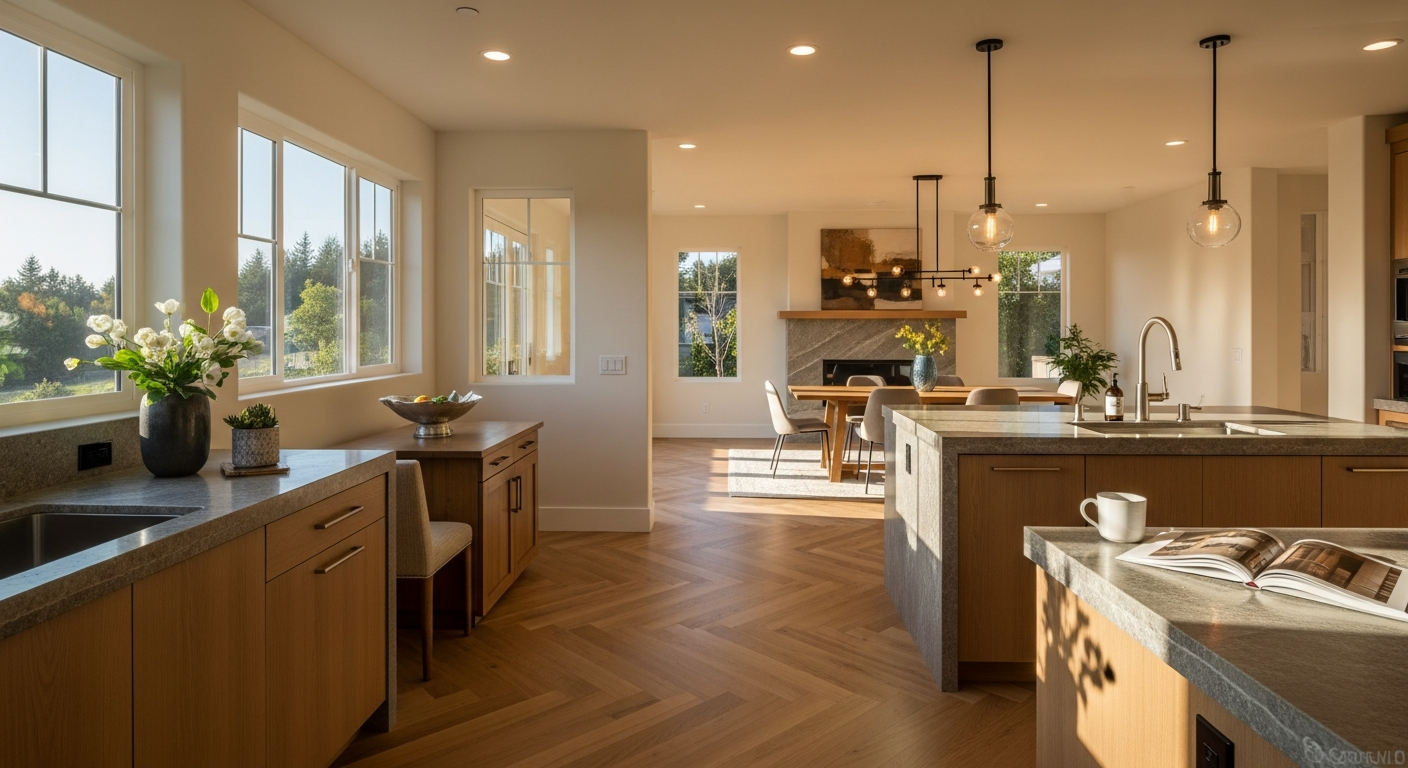
Our 2026 clients are pairing high-performance building science with warm, organic aesthetics — not the sterile white box look. The most requested materials on our current projects include rift-cut white oak for cabinetry and herringbone wood floors, hand-applied plaster walls with warm earthy tones (Portola Paints Roman Clay in Dune and Sahara), Dekton Kreta and Calacatta Viola marble for kitchen surfaces, zellige tile backsplashes, plaster range hoods with fluted details, unlacquered brass hardware and fixtures from Waterworks and Rejuvenation, and cedar cladding or natural stone veneer on exteriors. The marriage of sustainability and design-forward aesthetics is what defines luxury new construction in Silicon Valley right now.
How Long Does It Take to Build an Energy-Efficient Home in the Bay Area?
Phase 1: Design, Engineering, and Permits (4–8 Months)
- Architectural design and energy modeling: 6–12 weeks. We run Title 24 energy modeling concurrently with architectural design using EnergyPro software, testing different envelope assemblies, window configurations, and HVAC systems to find the optimal balance of performance and cost.
- Structural, MEP, and Title 24 engineering: 4–6 weeks. The CF-1R (Certificate of Compliance) and associated documentation must be completed by a certified energy consultant.
- Permit submittal and plan check: 8–16 weeks in Santa Clara County; 10–18 weeks in San Mateo County. Title 24 compliance is reviewed as part of plan check — incomplete or incorrect energy documentation is the #1 reason we see new construction permits kicked back for corrections.
Phase 2: Construction (8–14 Months)
- Site work and foundation: 3–5 weeks
- Framing: 4–8 weeks depending on size and complexity
- Mechanical, electrical, plumbing (rough-in): 4–6 weeks. This phase is more complex for energy-efficient homes due to ERV/HRV ducting, heat pump refrigerant lines, solar conduit runs, battery pre-wiring, and EV charging circuits.
- Insulation and air sealing: 1–2 weeks. Includes blower door test verification — we schedule our HERS rater for a pre-drywall inspection at this stage.
- Drywall, finishes, and trim: 6–10 weeks
- Solar PV and battery installation: 1–2 weeks (concurrent with finish phase)
- Final inspections and HERS verification: 1–2 weeks. The HERS rater conducts final duct leakage testing, verifies refrigerant charge, and confirms solar/battery installation matches the CF-1R.
Phase 3: Final Walkthrough and Commissioning (2–4 Weeks)
The overall timeline for an energy-efficient home is typically 2–4 weeks longer than a conventional build of the same size, primarily due to the additional inspections (HERS verification) and the more complex mechanical rough-in. In our experience, that modest schedule addition pays for itself many times over in performance and comfort.
Tax Credits and Incentives for Energy-Efficient New Construction in California 2026
California homeowners building energy-efficient new homes in 2026 can access $15,000–$45,000+ in combined federal and state tax credits and incentives, significantly offsetting the premium cost of high-performance construction. Here are the programs currently available and how they apply to Bay Area new builds:
Federal Tax Credits (Inflation Reduction Act — IRA)
- Section 45L New Energy Efficient Home Credit: Builders/developers can claim $2,500 per dwelling unit meeting ENERGY STAR standards, or $5,000 per unit meeting DOE Zero Energy Ready Home (ZERH) standards. For custom homes, this credit flows to the homeowner when acting as owner-builder or through their contractor's pricing.
- Section 25C Energy Efficient Home Improvement Credit: 30% credit on qualifying equipment including heat pump HVAC (up to $2,000/year), heat pump water heaters (up to $2,000/year), electrical panel upgrades (up to $600), and insulation/air sealing (up to $1,200). In a typical new build, this can total $4,000–$6,000 in credits.
- Section 25D Residential Clean Energy Credit: 30% credit on solar PV systems and battery storage with no cap through 2032. For a typical $35,000–$55,000 solar + battery installation, that's a $10,500–$16,500 federal tax credit.
California State and Local Incentives
- SGIP (Self-Generation Incentive Program): Rebate of $150–$200/kWh for battery storage systems. For a 13.5 kWh Tesla Powerwall 3, that's $2,025–$2,700 back.
- PG&E NEM 3.0 (Net Billing Tariff): While less favorable than NEM 2.0, solar exports still provide bill credits. Our energy modeling shows net-zero homes in the Bay Area achieving annual electricity costs of $200–$600 under NEM 3.0, versus $4,500–$7,000 for an all-electric home without solar.
- Bay Area Regional Energy Network (BayREN): Rebates for exceeding Title 24 by 10%+ on multifamily projects.
- Property tax exclusion: Active solar energy systems installed on new construction are excluded from property tax reassessment through 2026 under California Revenue and Taxation Code Section 73.
When we model the total cost of ownership for our clients in Los Gatos and surrounding communities, the combination of tax credits, utility savings, and increased resale value means that a net-zero-ready home reaches cost parity with a code-minimum home within 6–9 years — and then saves $4,000–$6,000 annually for the life of the house.
Should You Build Beyond Title 24 Minimum? Net-Zero vs. Code-Compliant New Construction
Here's the honest breakdown of what "beyond code" actually gets you:
Indoor Comfort
This is the benefit most homeowners underestimate. A home built to 1.5 ACH50 air tightness with an ERV system, triple-pane windows, and a variable-speed heat pump delivers a fundamentally different living experience than a code-minimum home. Every room maintains within 1–2°F of the thermostat setpoint. There are no drafts, no hot spots near west-facing windows, and outdoor noise is reduced by 40–50%. Our clients in Mountain View and Sunnyvale — where proximity to freeways and airports creates noise challenges — consistently say the air sealing and window upgrades are the improvements they notice most.
Resale Value
According to a 2023 study by the National Association of Realtors, homes with solar panels sell for 4.1% more on average. Homes with ENERGY STAR or net-zero certification can command 6–10% premiums in eco-conscious markets like Silicon Valley. On a $3M Bay Area home, that's $180,000–$300,000 in additional equity — far exceeding the $45,000–$85,000 incremental cost to build beyond code.
Future-Proofing
California's energy code ratchets tighter every three years. What exceeds code today becomes code in 2029 or 2032. Building 15–20% beyond the 2026 minimum ensures your home won't feel dated or underperforming when the next code cycle arrives — and avoids expensive retrofits down the line.
The bottom line: if your budget allows the 3–5% premium and you plan to stay in your home, building beyond Title 24 minimum is one of the highest-ROI decisions you can make. If budget is tight, I'd prioritize — in order — air sealing, a high-quality heat pump system, and a right-sized solar + battery system over premium finishes. You can always upgrade countertops later. You can't cost-effectively re-insulate walls after drywall is up.
Frequently Asked Questions
How much does it cost to build an energy-efficient home in the Bay Area in 2026?
What is Title 24 and how does it affect new home construction in California?
Title 24 is California's Building Energy Efficiency Standards (Part 6 of Title 24 of the California Code of Regulations), administered by the California Energy Commission. It sets mandatory minimum requirements for insulation, windows, HVAC, water heating, lighting, solar, and air sealing in all new residential and commercial construction. The 2025 code cycle, effective January 1, 2026, requires all-electric-ready design, heat pump HVAC and water heating, rooftop solar PV, battery storage readiness, and enhanced envelope insulation. Compliance is verified through a HERS rater inspection and the CF-1R compliance report, which must be filed with your building permit. In Santa Clara County, incomplete Title 24 documentation is the most common reason permits are delayed during plan check.
Is it worth building a net-zero home in Silicon Valley?
Yes, for most Silicon Valley homeowners planning to stay in their home for 7+ years. A net-zero home produces as much energy as it consumes annually, achieving annual electricity costs of just $200–$600 under PG&E's NEM 3.0 billing versus $4,500–$7,000 for a standard all-electric home. The incremental construction cost is $45,000–$85,000 above Title 24 code minimum, but federal tax credits (30% on solar and battery storage) offset $10,500–$16,500 immediately. Additionally, net-zero homes in Silicon Valley command 6–10% resale premiums according to NAR data — on a $3M home, that's $180,000–$300,000 in additional equity.
What solar panel system size do I need for a new home in Los Gatos?
Title 24 requires a solar PV system sized to offset your home's modeled annual electricity consumption, which typically equates to a 4–7 kW system for a 2,500–4,000 sq ft all-electric home in Los Gatos (Climate Zone 4). However, if you're targeting net-zero performance, our energy modeling consistently shows that 8–12 kW systems are needed to fully offset consumption including EV charging and heat pump operation. At current 2026 pricing, a code-minimum 5 kW system costs $15,000–$20,000 installed, while a 10 kW net-zero system runs $28,000–$38,000 before the 30% federal tax credit.
How long does it take to get a building permit for new construction in Santa Clara County?
Building permit plan check for new residential construction in Santa Clara County currently takes 8–16 weeks in 2026, based on our project experience. This includes structural, mechanical, electrical, plumbing, and Title 24 energy compliance review. Incomplete or incorrect Title 24 documentation (CF-1R reports, HERS documentation) can add 4–6 weeks for resubmittal and re-review. In San Mateo County, timelines are slightly longer at 10–18 weeks. We recommend having your energy consultant and HERS rater engaged during the design phase — not after construction documents are complete — to prevent costly plan check corrections.
What is the best heat pump HVAC system for a new home in the Bay Area?
The best heat pump HVAC system depends on your home's size, layout, and comfort priorities. For most Bay Area new construction in 2026, we recommend ducted inverter heat pumps like the Daikin Fit (SEER2 17.0, installed cost $22,000–$35,000) for whole-house comfort through existing ductwork, or Mitsubishi MXZ multi-zone ductless systems (SEER2 19.0, installed cost $28,000–$42,000) for superior zone control and whisper-quiet operation. For luxury homes over 4,000 sq ft, LG Multi V S VRF systems (SEER2 18.5, installed cost $38,000–$55,000) provide the most precise temperature control. All of these systems far exceed the Title 24 minimum of SEER2 15.0 and qualify for federal tax credits of up to $2,000.