Does an ADU Add Value to Your Home in California?
I'm Bar Benbenisty, founder of Barcci Builders (CA Contractor License #1086047), and ADU construction has been one of the fastest-growing segments of our business since California passed its landmark ADU reform laws. I've watched the market evolve from skepticism — "will an extra unit really help my property?" — to overwhelming demand, especially from homeowners in Los Gatos, Saratoga, and Los Altos who want multigenerational living, rental income, or a long-term investment play.
The short answer is this: a well-built ADU in the Bay Area is one of the highest-ROI home improvements you can make in 2026. But the details matter enormously — size, design quality, permit status, and location all influence how much value you actually capture. Let me walk you through the real numbers.
How Much Value Does an ADU Add to a Home in the Bay Area?
In the Bay Area, a permitted ADU adds between $200,000 and $600,000+ in property value in 2026, with the wide range reflecting differences in unit size, finish quality, and neighborhood. Our 2026 project data shows that the median value increase for a 600–800 sq ft detached ADU in Santa Clara County is approximately $375,000 — which often exceeds the total build cost.
Here's what drives the math: Bay Area real estate trades at $1,000–$2,000+ per square foot in premium neighborhoods like Professorville in Palo Alto, downtown Los Gatos, or the hills of Saratoga. Even though an ADU doesn't appraise at full per-square-foot parity with the main home, appraisers in 2026 are increasingly recognizing permitted ADUs as legitimate living space that commands a premium.
| ADU Type | Typical Size | Build Cost (Bay Area 2026) | Estimated Value Added | Typical ROI |
|---|---|---|---|---|
| Garage Conversion | 350–500 sq ft | $150,000–$250,000 | $175,000–$300,000 | 100–140% |
| Attached ADU (addition) | 400–700 sq ft | $200,000–$375,000 | $250,000–$425,000 | 110–135% |
| Detached ADU (new build) | 600–1,200 sq ft | $300,000–$550,000 | $350,000–$600,000+ | 105–130% |
| Junior ADU (JADU) | 150–500 sq ft | $80,000–$175,000 | $100,000–$200,000 | 110–150% |
These numbers are based on our 2026 completed project data and local appraisal feedback. Homes in Palo Alto, Menlo Park, and Atherton tend to see the highest absolute value increases because baseline property values are already elevated, while cities like Campbell, Sunnyvale, and Mountain View often deliver the highest percentage ROI because build costs are similar but the gap between ADU cost and value added is proportionally larger.
How Much Does It Cost to Build an ADU in California in 2026?
Building an ADU in California costs between $150,000 and $550,000+ in 2026, with most Bay Area homeowners spending $275,000–$425,000 for a well-appointed detached unit of 600–800 square feet. The cost per square foot for ADU construction in Silicon Valley ranges from $350 to $600+, depending on site conditions, material selections, and design complexity.
- Design, Engineering, and Permits: $15,000–$45,000. This includes architectural plans, structural engineering, Title 24 energy compliance, and permit fees. Santa Clara County permit fees for an ADU typically run $8,000–$18,000 depending on the city, though California law caps certain impact fees for ADUs under 750 sq ft.
- Site Work and Foundation: $25,000–$75,000. Grading, utility trenching (sewer, water, electrical), and foundation. Sloped lots common in Los Gatos hills or Saratoga can push this number significantly higher.
- Framing, Roofing, and Exterior: $45,000–$100,000. We're seeing strong demand for cedar cladding, natural stone veneer, and standing-seam metal roofing on detached ADUs in 2026 — materials that match the architectural language of the main home.
- Mechanical (HVAC, Plumbing, Electrical): $35,000–$70,000. Mini-split heat pump systems are standard for ADUs, and California's 2025 energy code pushes induction cooktops and heat-pump water heaters.
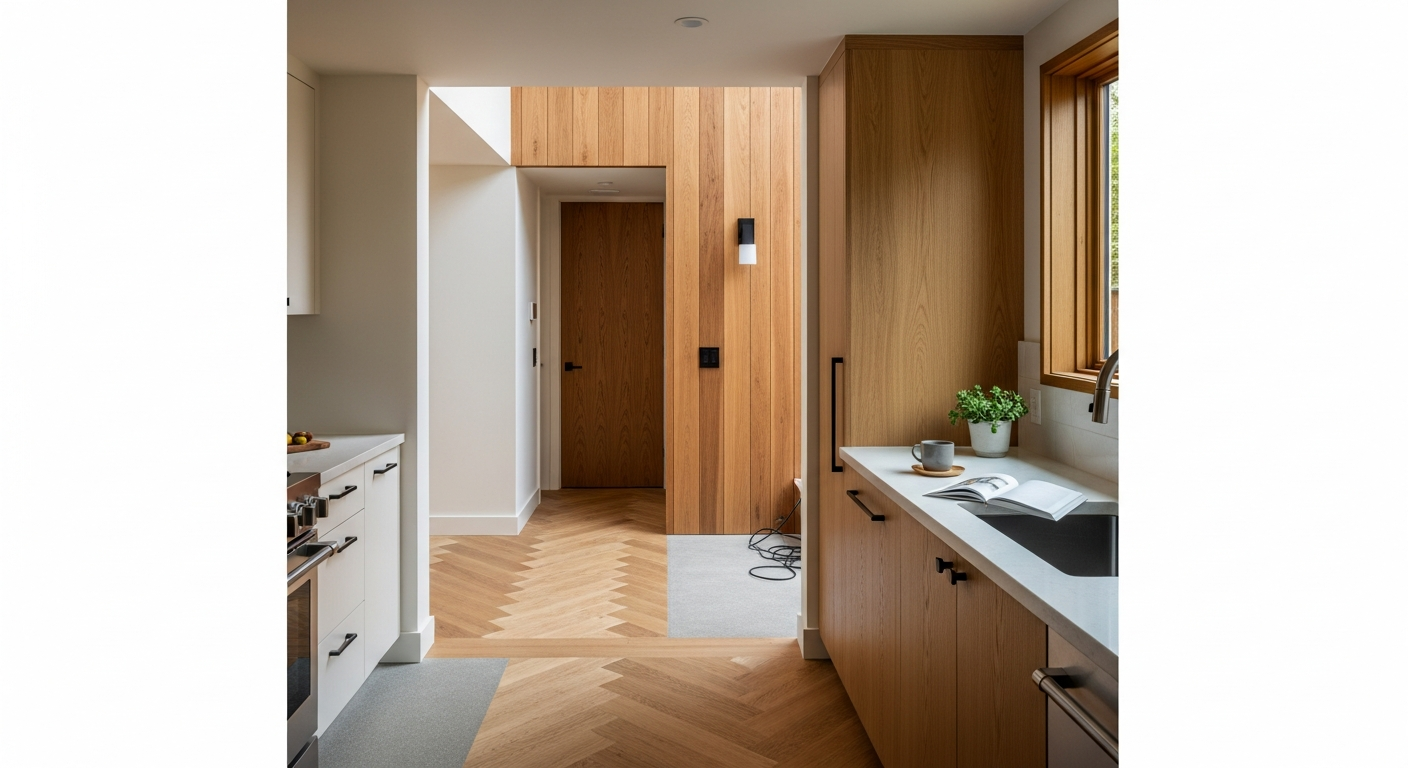
- Interior Finishes: $50,000–$150,000+. This is where the range explodes. A builder-grade ADU with laminate counters and LVP flooring costs a fraction of a unit with quartzite countertops, herringbone white oak floors, custom cabinetry with integrated finger pulls, and zellige tile in the bathroom.
- Landscaping and Site Restoration: $10,000–$35,000. Reconnecting hardscape, planting screening vegetation, and creating a private entry path.
One cost factor Bay Area homeowners underestimate is utility connections. If your property requires a new sewer lateral or a panel upgrade from 100A to 200A service, that alone can add $10,000–$25,000. Our team handles this upfront during the 3D design and rendering phase so there are no surprises during construction.
ADU Rental Income in the Bay Area: How Much Can You Earn in 2026?
A well-finished ADU in the Bay Area generates $2,500–$5,500+ per month in rental income in 2026, making it one of the most compelling investment strategies for California homeowners. Based on current rental market data and feedback from our clients who've leased their completed ADUs, here's what you can realistically expect:
| Location | ADU Size | Monthly Rent (2026) | Annual Gross Income |
|---|---|---|---|
| Los Gatos | 650 sq ft, 1BR/1BA | $3,200–$4,200 | $38,400–$50,400 |
| Palo Alto | 750 sq ft, 1BR/1BA | $3,800–$5,500 | $45,600–$66,000 |
| Cupertino / Sunnyvale | 600 sq ft, Studio/1BA | $2,800–$3,800 | $33,600–$45,600 |
| Campbell / San Jose | 600 sq ft, 1BR/1BA | $2,500–$3,400 | $30,000–$40,800 |
| Menlo Park / Atherton | 800 sq ft, 1BR/1BA | $4,000–$5,500+ | $48,000–$66,000+ |
| San Mateo / Burlingame | 700 sq ft, 1BR/1BA | $3,200–$4,400 | $38,400–$52,800 |
When we model ROI for clients, we look at the cash-on-cash return: if you spend $375,000 building a detached ADU in Cupertino and rent it for $3,500/month ($42,000/year), that's an 11.2% gross annual return on your build investment — before factoring in the $300,000–$400,000 in added property value. Compare that to stock market average returns and you'll see why so many Silicon Valley homeowners are building ADUs as wealth-building tools.
There's also significant demand for furnished short-term and medium-term rentals near tech campuses in Mountain View, Sunnyvale, and Cupertino. Contract workers and visiting teams from Apple, Google, and Meta often need 3–6 month housing, and a well-designed ADU can command a 25–40% premium over standard long-term lease rates.
California ADU Laws and Permit Requirements You Need to Know in 2026
California's ADU laws are among the most permissive in the nation, and 2026 brings continued regulatory support for homeowners who want to build. The cumulative effect of AB 68, SB 9, AB 1033 (which allows ADUs to be sold as condos in some jurisdictions), and the 2025–2026 updates has created an environment where virtually every single-family lot in the Bay Area can accommodate at least one ADU and one Junior ADU (JADU).
Here are the key California ADU rules and permit requirements as of 2026:
- Size Limits: Detached ADUs can be up to 1,200 sq ft (for lots with existing single-family homes). JADUs are capped at 500 sq ft and must be within the existing home footprint.
- Setback Requirements: 4-foot rear and side setbacks for detached ADUs. Converted existing structures (like garages) can maintain zero setback if the existing structure already sits on the property line.
- Parking: No additional parking required for ADUs in most cases — one of the most impactful provisions for Bay Area homeowners with limited lot space.
- Impact Fees: Waived or significantly reduced for ADUs under 750 sq ft. For larger units, impact fees are proportional to the main dwelling.
- Approval Timeline: Cities must approve or deny ADU permit applications within 60 days. Our experience with the Santa Clara County Planning Department and the Town of Los Gatos Building Division shows actual approval timelines of 4–10 weeks in 2026, depending on plan completeness and revisions.
- Owner-Occupancy: California removed the owner-occupancy requirement for ADUs permitted between 2020 and 2025, and as of 2026 most jurisdictions maintain flexibility — but always verify with your local planning department.
- AB 1033 (ADU Sales): Some cities now allow ADUs to be sold separately as condominiums. This is still rolling out across Bay Area jurisdictions, but it has massive implications for property value and investment strategy.
ADU vs. Home Addition: Which Adds More Value in 2026?
An ADU typically delivers a higher ROI than a traditional home addition in the Bay Area, primarily because an ADU generates rental income potential that appraisers and buyers factor into their valuation. However, if your goal is expanding your primary living space — not creating a separate unit — a home addition may be the better investment for your lifestyle.
| Factor | ADU (Detached, 700 sq ft) | Home Addition (700 sq ft) |
|---|---|---|
| Typical Build Cost (Bay Area) | $300,000–$475,000 | $350,000–$525,000 |
| Value Added to Property | $350,000–$550,000 | $300,000–$500,000 |
| Rental Income Potential | $3,000–$4,500/month | None (integrated space) |
| Permit Complexity | Streamlined (60-day mandate) | Standard review (8–16 weeks) |
| Design Flexibility | Standalone structure, flexible use | Must integrate with existing architecture |
| Impact on Main Home | Minimal disruption during build | Significant disruption (shared walls) |
| Best For | Rental income, multigenerational, investment | Growing families, master suite, open floor plan |
Many of our clients in Los Gatos and Saratoga actually do both — they'll pursue a whole-house remodel that reconfigures the main home's layout while simultaneously building a detached ADU in the backyard. This approach maximizes both livability and property value, and when we manage the project as a single scope, the combined timeline is often shorter than doing them sequentially.
One insight I share with every homeowner weighing this decision: if you're planning to sell within 3–5 years, an ADU almost always wins on ROI because of the income capitalization approach appraisers use. If you're staying long-term and need the space integrated into your daily life, a home addition makes more sense. And if you can afford both, that's the best-case scenario for long-term wealth building.
What Makes a High-Value ADU? Design and Material Choices That Matter
The design and finish quality of your ADU directly determines how much value it adds — a generic, builder-grade box might add 15–20% to your property value, while a thoughtfully designed ADU with premium finishes can add 30–35% or more. In the luxury-conscious Bay Area market, buyers pay a significant premium for ADUs that feel like intentional architecture rather than afterthoughts.
Based on what we're designing and building at Barcci Builders in 2026, here are the material and design trends that command the highest value:
- Exterior: Cedar cladding with warm stain or charred (shou sugi ban) finish, natural stone veneer accents, standing-seam metal roofing in dark bronze or matte black. Buyers want the ADU to look like a "guest house," not a shed.
- Kitchen: Compact but fully equipped. Miele or Bosch integrated appliances, quartzite or Dekton Kreta countertops, custom flat-panel cabinetry with integrated finger pulls in rift-cut white oak, and zellige tile backsplash. Induction cooktops are now standard per California's 2025 energy code.
- Bathroom: Curbless walk-in shower with large-format porcelain tile or microcement walls, Kohler or Brizo fixtures in unlacquered brass or matte black, floating vanity with Caesarstone or quartzite top, heated floors. These details signal quality to appraisers and future buyers.
- Flooring: Herringbone white oak floors throughout living areas, warm earthy tones that create visual continuity. We're seeing strong demand for European white oak in wider planks.
- Walls and Ceilings: Hand-applied plaster or limewash finishes instead of standard drywall texture. Exposed wood beams or tongue-and-groove cedar ceilings in the living area. These organic, tactile finishes are defining luxury ADU design in 2026.
- Windows and Doors: Floor-to-ceiling glass, NanaWall or LaCantina folding systems for indoor-outdoor living, Fleetwood or Marvin aluminum-clad windows in black frames. Natural light is the number-one amenity in a small footprint.
- Outdoor Space: A small private patio with landscaping — even 100 sq ft of dedicated outdoor space dramatically increases perceived value and livability.
As someone who's built over 116 projects across the Bay Area, here's my honest advice: don't overbuild the ADU relative to the main house, but don't underbuild it either. An ADU that's clearly lower quality than the primary home cheapens the entire property. An ADU that matches the design language — same exterior palette, similar material quality, cohesive landscaping — elevates everything. We use our 3D design and rendering service to show clients exactly how the ADU will relate to their main home before a single foundation form is set.
Frequently Asked Questions
How much does an ADU increase home value in California in 2026?
How much does it cost to build an ADU in the Bay Area in 2026?
Bay Area ADU construction costs range from $150,000 to $550,000+ in 2026. The most common project — a detached ADU of 600–800 sq ft with quality finishes — typically costs $300,000–$450,000 in Silicon Valley markets like Los Gatos, Cupertino, and Mountain View. Cost per square foot ranges from $350 to $600+ depending on site conditions, materials, and design complexity. Garage conversions are the most affordable option at $150,000–$250,000, while high-end detached ADUs with premium finishes (quartzite counters, custom cabinetry, cedar cladding) can exceed $500,000. Permit fees in Santa Clara County typically add $8,000–$18,000.
Can I sell my ADU separately from my house in California?
Yes, under AB 1033 (signed in 2023 and expanding through 2026), California allows ADUs to be sold as separate condominiums in participating jurisdictions. However, implementation varies by city — each local government must opt in and establish a process. As of 2026, several Bay Area cities are developing their frameworks, but not all have finalized programs. If your city participates, you'd need to create a condominium map, establish a homeowners association (even for just two units), and ensure the ADU meets all independent living standards. This law has enormous implications for property value because it turns your ADU into a separately financeable, sellable asset. Consult your local planning department and a real estate attorney for current status in your jurisdiction.
How long does it take to build an ADU in Silicon Valley?
Do I need a permit to build an ADU in Los Gatos or Santa Clara County?
Yes, you absolutely need a permit to build an ADU in Los Gatos and all Santa Clara County jurisdictions. Building without permits is not only illegal — it can result in fines, forced demolition, and major problems when you try to sell your home. An unpermitted ADU typically hurts property value rather than helping it, because buyers' lenders flag it as a liability. The good news is California law mandates that cities process ADU permit applications within 60 days, and the Town of Los Gatos Building Division has been efficient in our experience. The permit process involves submitting architectural plans, structural engineering, Title 24 energy compliance documentation, and in some cases, a soils report. At Barcci Builders, we manage the entire permit process for our clients, which typically takes 4–10 weeks from submission to approval in 2026.
What is the ROI on building an ADU in the Bay Area?
The ROI on a Bay Area ADU in 2026 ranges from 100% to 150%, making it one of the highest-return home improvements available. This accounts for both property value increase and rental income potential. For example, a $375,000 detached ADU in Cupertino that adds $400,000 in property value and generates $3,500/month in rent delivers an immediate 107% value-added ROI plus an 11.2% annual cash-on-cash return on the build investment. Garage conversions tend to have the highest ROI (120–150%) because of lower build costs, while high-end detached ADUs in premium neighborhoods show 105–130% ROI with the highest absolute dollar returns. These numbers are based on our completed project data and local appraisal feedback from across Silicon Valley.
How much rent can I charge for an ADU in Los Gatos or Palo Alto?
In 2026, a 1-bedroom ADU in Los Gatos rents for $3,200–$4,200 per month, while a comparable unit in Palo Alto commands $3,800–$5,500 per month. Furnished units rented on medium-term leases (3–6 months) to tech professionals can command a 25–40% premium. Key factors that drive rental rates include: separate private entrance, in-unit laundry, full kitchen with quality appliances, dedicated outdoor space, and proximity to downtown or tech campuses. Based on feedback from our clients, ADUs with premium finishes (quartz countertops, high-end fixtures, hardwood floors) consistently rent at the top of the market range and experience shorter vacancy periods.
ADU vs garage conversion: which is better for home value in California?
Both add value, but they serve different strategies. A garage conversion is more affordable ($150,000–$250,000 in the Bay Area) and delivers higher percentage ROI (120–150%), but it adds less total value ($175,000–$300,000) and eliminates covered parking — which can be a concern for buyers in some neighborhoods. A detached ADU costs more ($300,000–$550,000) but adds $350,000–$600,000+ in value, preserves your garage, and typically commands higher rent due to greater privacy and larger size. Our recommendation depends on your lot size and goals: if you have a generous backyard, a detached ADU is almost always the better long-term investment. If your lot is constrained, a garage conversion can deliver excellent returns with a shorter timeline and lower risk.