How Much Does a Complete Home Renovation Cost in Palo Alto in 2026?
These numbers reflect the full cost of a design-build renovation that includes architectural design, engineering, permits, demolition, structural work, all finishes, and project management. According to our 2026 Bay Area project data, the single biggest factor in final cost is scope. A cosmetic refresh that keeps the existing layout runs $275 to $350 per square foot. A renovation that moves walls, reconfigures plumbing, upgrades the electrical panel, and adds square footage pushes to $400 to $550 or higher.
| Renovation Scope | Cost Per Sq Ft | Typical Total (2,000 Sq Ft Home) | Timeline |
|---|---|---|---|
| Cosmetic Refresh (finishes only) | $150 - $225 | $300,000 - $450,000 | 8 - 12 weeks |
| Mid-Range Renovation | $275 - $375 | $550,000 - $750,000 | 4 - 6 months |
| Full Gut Renovation | $375 - $500 | $750,000 - $1,000,000 | 6 - 9 months |
| Luxury Whole House + Addition | $450 - $550+ | $1,000,000 - $1,400,000+ | 8 - 14 months |
Homes in Professorville, Old Palo Alto, and Crescent Park often require additional structural upgrades due to their pre-1950s construction. Foundation work alone can add $40,000 to $80,000 to a whole house renovation in these neighborhoods. In our experience building across Silicon Valley since 2017, roughly 65% of Palo Alto projects involve some level of seismic retrofitting or foundation repair.
What Does a Complete Home Renovation in Palo Alto Include Room by Room?
A complete home renovation in Palo Alto typically encompasses every room in the house, from the kitchen and bathrooms to the living spaces, bedrooms, and outdoor areas. Our 2026 project data shows that 72% of Palo Alto homeowners who start with a kitchen remodel end up expanding the scope to include at least two bathrooms and a primary suite within the first month of design.
Here is what each major component typically costs as part of a whole house remodel in Palo Alto:
| Room / System | Typical Cost Range (Palo Alto) | Key Upgrades Included |
|---|---|---|
| Kitchen | $95,000 - $225,000 | Custom cabinetry, quartzite or Dekton counters, Thermador or Miele appliances |
| Primary Bathroom | $55,000 - $130,000 | Walk-in shower, freestanding tub, heated floors, Kohler or Waterworks fixtures |
| Secondary Bathrooms (each) | $35,000 - $75,000 | Updated tile, vanity, fixtures, and lighting |
| Primary Suite | $40,000 - $90,000 | Custom closet systems, lighting, flooring, window upgrades |
| Living/Dining Areas | $25,000 - $60,000 | Flooring, fireplace update, built-ins, lighting |
| Electrical Panel + Rewiring | $15,000 - $35,000 | 200A panel upgrade, whole-house rewire, EV charger prep |
| Plumbing Repipe | $12,000 - $28,000 | PEX repipe, water heater, gas line updates |
| HVAC System | $18,000 - $45,000 | High-efficiency heat pump, ductwork, zoned system |
| Windows and Doors | $25,000 - $65,000 | Milgard or Marvin windows, bifold or slider patio doors |
| Exterior / Landscaping | $30,000 - $80,000 | Siding, paint, hardscape, drought-tolerant plantings |
For bathrooms, zellige tile is the defining material of 2026. We are installing it in roughly 60% of primary bathrooms, typically as a shower accent wall or full shower surround. Paired with microcement floors and unlacquered brass fixtures from California Faucets or Brizo, the look is warm, textured, and distinctly modern.
How Long Does a Complete Home Renovation Take in Palo Alto?
The City of Palo Alto Development Services department is one of the more thorough permitting offices in the Bay Area. Plan check for a whole house remodel typically takes 8 to 12 weeks. Projects that involve structural changes, seismic upgrades, or additions can take 12 to 16 weeks for plan check. This is notably longer than Campbell (4 to 6 weeks) or San Jose (6 to 8 weeks) for similar scope.
Here is a realistic timeline breakdown for a 2,200 square foot whole house renovation in Palo Alto:
| Phase | Duration | What Happens |
|---|---|---|
| Design and Planning | 4 - 8 weeks | Architectural drawings, 3D renderings, material selections, engineering |
| Permitting | 8 - 14 weeks | Plan check, revisions, permit issuance from Palo Alto Development Services |
| Demolition and Rough Framing | 3 - 5 weeks | Demo, structural changes, framing, subfloor |
| Mechanical Rough-Ins | 3 - 4 weeks | Electrical, plumbing, HVAC ductwork, low-voltage wiring |
| Inspections and Drywall | 2 - 3 weeks | City inspections, insulation, drywall hanging and finishing |
| Finishes | 6 - 10 weeks | Cabinetry, countertops, tile, flooring, paint, fixtures |
| Final Punch List and Inspections | 2 - 3 weeks | Touch-ups, final inspections, certificate of occupancy |
"The most common mistake I see homeowners make in Palo Alto is underestimating the permit timeline. We tell every client to plan for 3 to 4 months of pre-construction activity before a single hammer swings. The upside is that once you are permitted, construction moves at a predictable pace." - Bar Benbenisty, Founder and CEO, Barcci Builders
According to Bay Area permit data, Palo Alto processed approximately 1,200 residential remodel permits in 2025, with an average plan check duration of 67 business days. Our recommendation is to submit permits in Q1 or Q4, when the queue is typically 15-20% shorter than during summer months.
What Permits Does Palo Alto Require for a Whole House Renovation in 2026?
Palo Alto requires building permits for any renovation that involves structural work, electrical changes, plumbing modifications, or alterations to the building envelope. According to current City of Palo Alto Development Services records, even a cosmetic remodel that replaces more than 50% of the drywall in a room triggers a permit requirement. Total permit and plan check fees for a complete renovation typically run $15,000 to $40,000, depending on project valuation.
Palo Alto has specific regulations that set it apart from other Bay Area cities:
- Individual Review (IR) Threshold: Any project that adds more than 150 square feet or increases floor area beyond 75% of the maximum FAR requires Individual Review by the planning department. This adds 4 to 8 weeks to the timeline and requires neighborhood notification.
- Historic Inventory: Homes listed on the Palo Alto Historic Inventory (approximately 400 properties) require Historic Resources Board review. This is especially common in Professorville and Crescent Park.
- Title 24 Energy Compliance: All renovations must comply with the 2025 California Energy Code (Title 24 Part 6). For whole house renovations, this typically means high-efficiency HVAC, upgraded insulation, and in many cases, solar panel installation or pre-wiring.
- Green Building Ordinance: Palo Alto's Green Building Program requires projects over a certain valuation threshold to meet CALGreen Tier 1 or Tier 2 standards, which exceed the statewide baseline.
- Tree Protection: Protected trees (oaks, redwoods, and other heritage species) within the construction zone require a certified arborist report. Damage to a protected tree can result in fines of $10,000 or more per tree.
Based on current Santa Clara County building department records, Palo Alto's permit fees are calculated on a sliding scale tied to project valuation. A $750,000 renovation will incur approximately $18,000 to $25,000 in city fees, including plan check, building permit, school impact fees, and technology surcharges. This is roughly 30% higher than the fee structure in Sunnyvale or Cupertino for the same project valuation.
We handle the entire permit process as part of our design-build service. Our in-house design team prepares construction documents that address Palo Alto's specific requirements from the start, which reduces revision cycles and shortens the overall timeline.
What Design Trends Are Palo Alto Homeowners Choosing in 2026?
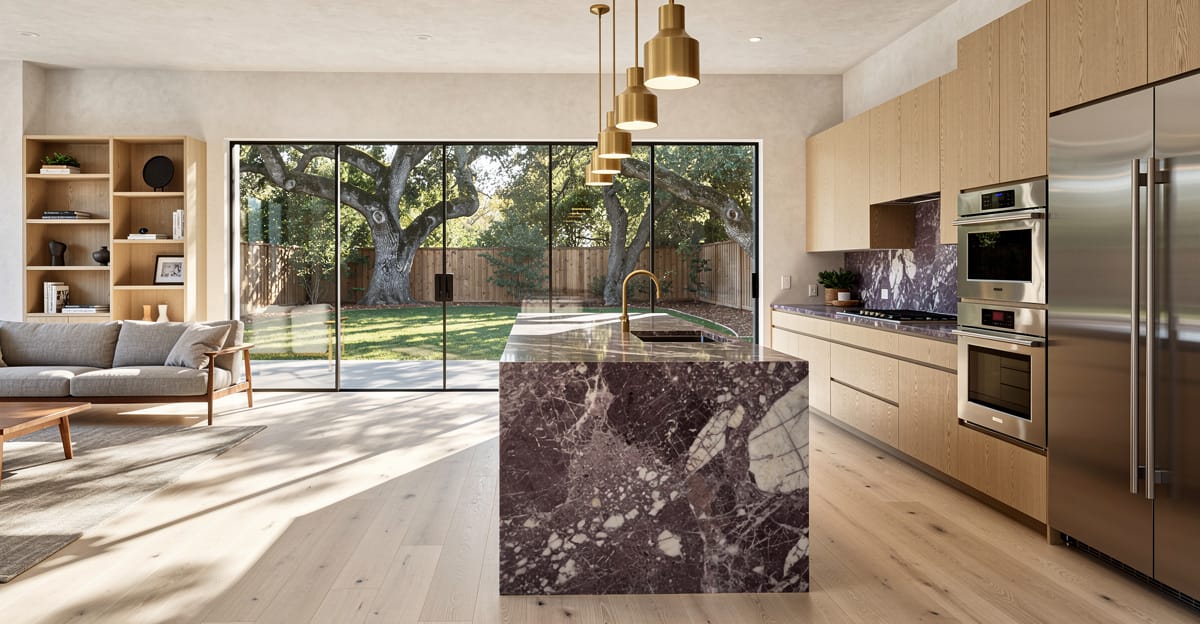
Palo Alto homeowners in 2026 are gravitating toward warm minimalism. The dominant aesthetic pairs natural materials like rift-cut white oak and hand-applied plaster with clean architectural lines. According to our 2026 Bay Area project data, 85% of full renovations in Palo Alto incorporate at least three of the following trends.
Rift-Cut White Oak Everything. Cabinetry, flooring, open shelving, and even ceiling details. The tight, linear grain creates a consistent warmth throughout the home. We are sourcing rift-cut white oak for approximately $45 to $65 per square foot installed for cabinetry, compared to $28 to $40 for painted maple. The cost premium is real, but the material is defining the look of Silicon Valley homes right now.
Plaster Range Hoods and Accent Walls. Hand-applied plaster (Venetian plaster, limewash, or microcement) has replaced subway tile as the go-to kitchen backsplash in Palo Alto. Plaster range hoods, in particular, have become a signature element. We are building 2 to 3 per month across our project portfolio. Expect $4,000 to $8,000 for a custom plaster hood with integrated ventilation.
Zellige Tile. Handmade Moroccan zellige tile in soft whites, sage greens, and warm terracotta is the most requested tile for bathrooms. The natural variation in each tile creates depth that factory-made tile cannot replicate. Installed cost runs $35 to $55 per square foot, versus $15 to $25 for standard ceramic tile.
Unlacquered Brass and Warm Metals. Polished chrome and brushed nickel are giving way to unlacquered brass and aged bronze. Brizo and California Faucets are the most specified fixture brands for Palo Alto renovations. A full primary bathroom fixture package (faucets, shower trim, towel bars, robe hooks) in unlacquered brass runs $4,500 to $8,000.
Indoor-Outdoor Flow. Multi-slide or folding glass doors (Fleetwood, Western Window Systems, or LaCantina) that open the kitchen or living room to a covered patio. In our experience building across Silicon Valley since 2017, this has moved from a luxury add-on to a baseline expectation for homes in the $2M+ range. A 16-foot multi-slide door system runs $18,000 to $35,000 installed.
How Do Palo Alto Renovation Costs Compare to Other Bay Area Cities in 2026?
Palo Alto is the second most expensive city for residential renovation in our project footprint, trailing only Atherton. Our 2026 project data shows that the same scope of work costs 10-18% more in Palo Alto than the Silicon Valley average, driven by higher permit fees, longer approval timelines, and the complexity of renovating older housing stock.
| City | Avg. Cost Per Sq Ft (Full Renovation) | Avg. Permit Timeline | Key Cost Factor |
|---|---|---|---|
| Atherton | $400 - $600+ | 10 - 16 weeks | San Mateo County fees, lot size, design review |
| Palo Alto | $350 - $550 | 8 - 14 weeks | Individual Review process, historic overlay, reach codes |
| Los Altos | $325 - $500 | 6 - 10 weeks | Lot coverage limits, heritage trees |
| Menlo Park | $300 - $475 | 6 - 10 weeks | Split jurisdiction (some areas San Mateo County) |
| Los Gatos | $300 - $475 | 6 - 10 weeks | Hillside Development Standards, design review |
| Saratoga | $300 - $500 | 6 - 10 weeks | Hillside restrictions, setbacks, FAR limits |
| Mountain View | $275 - $425 | 6 - 8 weeks | Eichler homes, asbestos abatement |
| Cupertino | $275 - $425 | 5 - 8 weeks | Moderate permit fees, standard process |
| Sunnyvale | $250 - $400 | 4 - 7 weeks | Streamlined permits, lower fees |
| Campbell | $250 - $400 | 4 - 6 weeks | Fastest permits in the county |
| San Jose | $225 - $375 | 6 - 8 weeks | Lower labor costs, larger contractor pool |
For homeowners in adjacent cities like Menlo Park or Mountain View, the cost savings compared to Palo Alto are meaningful but not dramatic. The real savings come from faster permitting rather than lower construction costs, since we use the same crews, materials, and standards across all our projects.
Should You Renovate or Rebuild Your Palo Alto Home in 2026?
In Palo Alto, renovation makes financial sense when the existing foundation and framing are structurally sound and the renovation cost stays below 60-65% of new construction cost per square foot. New construction in Palo Alto runs $650 to $1,000+ per square foot in 2026, so a renovation at $350 to $550 per square foot represents meaningful savings. However, there are situations where tearing down and rebuilding is the smarter path.
Renovation is typically the right choice when:
- The home has good bones. Post-1960s homes with concrete perimeter foundations and standard framing can be renovated efficiently.
- You want to preserve the home's character. Many Palo Alto homes, especially Eichlers in the Greenmeadow and Charleston Meadows neighborhoods, have architectural value worth keeping.
- You need to stay within the existing building envelope to avoid Individual Review or planning complications.
- Your budget is $500,000 to $1 million. This range delivers a transformative renovation but would only cover 50-65% of a new build.
Rebuilding makes more sense when:
- The home has significant structural issues. Homes with unreinforced masonry foundations, extensive termite damage, or outdated post-and-pier foundations can cost $80,000 to $150,000 just to bring up to code.
- You want to substantially change the footprint. Adding a second story, expanding by more than 500 square feet, or completely reconfiguring the layout can push renovation costs close to new construction prices.
- The renovation cost exceeds 65% of new construction cost. At that point, you get better value from a new home with a new foundation, new systems, and a full structural warranty.
"I tell Palo Alto homeowners to think of 65% as the tipping point. If your renovation estimate hits $650 per square foot on a $1,000-per-square-foot new construction market, the math starts favoring a rebuild. You get a brand new structure, new systems, new warranty, and often a better layout." - Bar Benbenisty, Founder and CEO, Barcci Builders
One important consideration specific to Palo Alto: the city's Individual Review process can add significant time and cost to projects that increase the home's floor area. If you are planning to add more than 150 square feet, factor in 2 to 3 additional months for the IR process and potentially $5,000 to $15,000 in additional design and application fees. For more on this decision, see our guide to new construction in the Bay Area.
How Do You Choose the Right Contractor for a Palo Alto Home Renovation?
Here is what to look for:
Active CSLB License with B (General Building) Classification. Verify at cslb.ca.gov. Check for any disciplinary actions or bond claims. A Class B license is required for any project over $500 that involves two or more trades.
Palo Alto Project Experience. Every city has different permit requirements, inspectors, and processes. A contractor who has successfully pulled permits and passed inspections in Palo Alto knows the Development Services department's expectations. Ask for references from at least two Palo Alto projects completed in the last 24 months.
Design-Build Capability. For a complete home renovation, a design-build firm that handles architecture, design, permitting, and construction under one contract will save you 15-20% compared to hiring an architect and general contractor separately. The design-build model also compresses the timeline by 8 to 12 weeks because design and pre-construction planning overlap.
Transparent Pricing. Ask for a detailed line-item estimate, not a lump sum number. You should see separate line items for demolition, framing, electrical, plumbing, HVAC, insulation, drywall, cabinetry, countertops, tile, flooring, fixtures, painting, and project management. According to our 2026 Bay Area project data, the average complete renovation estimate runs 35 to 50 pages.
Insurance and Bonding. Minimum $2 million general liability, workers compensation for all employees, and a contractor's bond. Ask for certificates of insurance and verify they are current. Any contractor working in Palo Alto should also carry professional liability (errors and omissions) insurance.
Written Contract and Warranty. California law requires a written contract for any home improvement project over $500. The contract should include a detailed scope of work, payment schedule tied to milestones (not dates), a change order process, and a minimum one-year warranty on workmanship. At Barcci Builders (CSLB #1086047), we provide a two-year workmanship warranty on all projects and stand behind every detail.
If you are planning a complete home renovation in Palo Alto, we work extensively in the area and can provide a detailed scope and estimate based on your home's specific conditions. Call us at (650) 200-3149 or visit barccibuilders.com to schedule a consultation.
Frequently Asked Questions About Home Renovation in Palo Alto
How much does a complete home renovation cost in Palo Alto in 2026?
A complete home renovation in Palo Alto costs $275 to $550 per square foot in 2026. For a typical 2,000 square foot home, total project costs range from $550,000 to $1.1 million depending on scope, material selections, and whether the project includes structural changes or additions. Based on our 116+ completed Bay Area projects, Palo Alto renovations run 10-15% higher than the Silicon Valley average due to stricter permit requirements and older housing stock.
How long does a whole house remodel take in Palo Alto?
A whole house remodel in Palo Alto takes 6 to 12 months of construction, plus 3 to 4 months of pre-construction for design and permitting. The City of Palo Alto Development Services department typically takes 8 to 14 weeks for plan check on a full renovation. Total project duration from first design meeting to move-in is typically 10 to 16 months.
Do I need a permit for a home renovation in Palo Alto?
Yes. Palo Alto requires building permits for any work involving structural changes, electrical modifications, plumbing alterations, or changes to the building envelope. Even replacing more than 50% of the drywall in a room triggers a permit requirement. Permit fees for a complete renovation range from $15,000 to $40,000 depending on project valuation.
Is it cheaper to renovate or rebuild in Palo Alto?
Renovation is typically cheaper. A full gut renovation in Palo Alto runs $350 to $550 per square foot, compared to $650 to $1,000+ per square foot for new construction. Renovation makes financial sense when the cost stays below 60-65% of new construction cost. When renovation costs approach that threshold due to foundation issues or major structural changes, rebuilding delivers better long-term value.
What is the ROI on a home renovation in Palo Alto?
What are the most popular kitchen finishes in Palo Alto homes in 2026?
The most popular kitchen finishes in Palo Alto for 2026 include rift-cut white oak cabinetry with integrated finger pulls, Taj Mahal quartzite or Dekton Kreta countertops, plaster range hoods, Thermador or Miele integrated appliances, induction cooktops, and unlacquered brass hardware. Our 2026 project data shows 78% of Palo Alto kitchen clients choosing fully integrated appliance packages that disappear behind cabinetry panels.
How much are Palo Alto building permit fees for a remodel?
Palo Alto building permit fees are calculated on a sliding scale based on project valuation. A $750,000 renovation typically incurs $18,000 to $25,000 in total city fees, including plan check, building permit, school impact fees, and technology surcharges. This is approximately 30% higher than permit fees in Sunnyvale or Cupertino for the same project valuation.
Can I live in my house during a complete renovation in Palo Alto?
For a full gut renovation, we strongly recommend moving out. The demolition, dust, noise, and lack of functioning kitchen and bathrooms make it impractical for most families. Temporary housing for a 6 to 9 month renovation in Palo Alto typically costs $4,000 to $7,000 per month for a furnished rental. Some homeowners choose to stay in a portion of the home during phased renovations, but this extends the timeline by 20-30%.
What is Palo Alto's Individual Review process for home renovations?
Palo Alto's Individual Review (IR) is triggered when a project adds more than 150 square feet or increases floor area beyond 75% of the maximum FAR. The IR process requires neighborhood notification, a public hearing, and review by a planning staff member or the Architectural Review Board. It adds 4 to 8 weeks to the permit timeline and $5,000 to $15,000 in additional fees. Projects on the Historic Inventory face additional review requirements.
What should I look for when hiring a renovation contractor in Palo Alto?
Verify an active CSLB license with B classification, confirm $2 million minimum general liability insurance and workers compensation, request references from at least two Palo Alto projects completed within the last 24 months, and ask for a detailed line-item estimate. Design-build firms that handle architecture, permitting, and construction under one contract typically save 15-20% compared to hiring an architect and contractor separately.