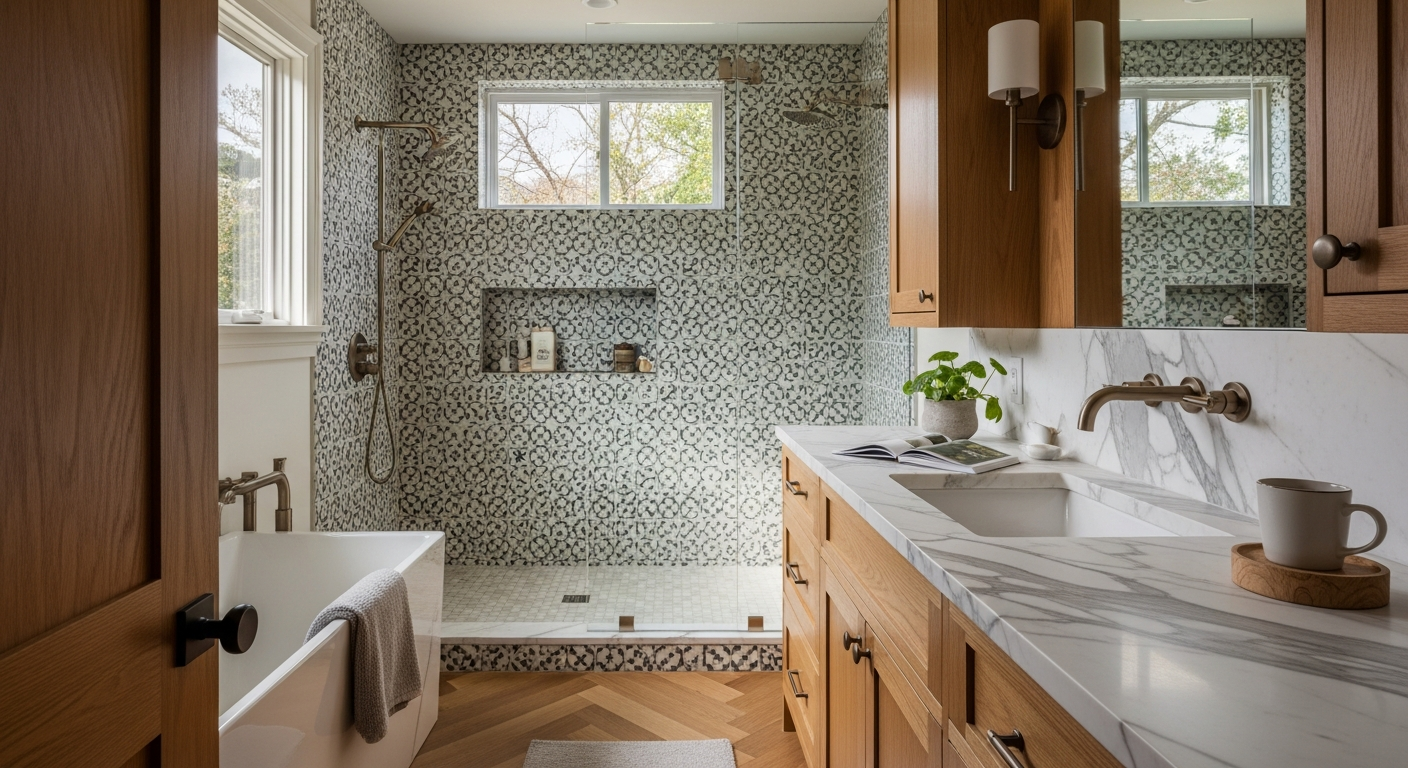
What Are the Biggest Bathroom Tile Trends for 2026?
The biggest bathroom tile trends for 2026 center on handcrafted texture, seamless surfaces, and natural stone—moving decisively away from the large-format porcelain and subway tile combinations that dominated Bay Area bathrooms for the last decade. Based on our 116+ completed projects across Silicon Valley, the three materials we're specifying most often in 2026 are zellige tile, microcement (also called micro-topping or tadelakt-style plaster), and natural stone like Calacatta Viola marble and honed quartzite.
I'm Bar Benbenisty, founder of Barcci Builders (CA Contractor License #1086047), and over the past 18 months I've watched the requests from homeowners in Los Gatos, Saratoga, Palo Alto, and across the Peninsula shift dramatically. Clients are no longer asking for "clean and modern." They're asking for "warm, organic, and one-of-a-kind." That single shift explains almost every tile trend on this list.
Here's a quick snapshot of what's trending up—and what's trending down—in Bay Area bathroom design this year:
| Trending Up in 2026 | Trending Down in 2026 |
|---|---|
| Zellige tile in earthy tones (sage, terracotta, bone) | White subway tile with white grout |
| Microcement / tadelakt wet walls | Large-format rectified porcelain (24×48) |
| Calacatta Viola and bookmatched marble slabs | Marble-look porcelain tile |
| Honed and leathered quartzite | Polished granite |
| Herringbone and chevron layouts | Straight-stack standard layouts |
| Unlacquered brass fixtures and trim | Chrome and brushed nickel |
| Hand-applied plaster walls and ceilings | Painted drywall with standard texture |
| Fluted stone or tile wainscoting | Flat frameless glass only |
Below, I'll break down each major trend, share real cost data from our Bay Area projects, and give you honest advice on which materials are worth the investment—and which ones require more maintenance than most homeowners expect.
Why Is Zellige Tile So Popular for Bathrooms in 2026?
Zellige tile is popular in 2026 because it delivers the handcrafted, imperfect warmth that today's homeowners crave—no two tiles are identical, creating a luminous, undulating surface that feels artisanal and alive. Originally from Morocco, zellige is a glazed terracotta tile hand-cut into small squares (typically 2×2" or 4×4") with slight variations in color, thickness, and glaze depth.
In our Los Altos and Menlo Park bathroom renovations, zellige has become the single most requested wall tile. Our 2026 project data shows that roughly 40% of our bathroom remodel clients are now specifying zellige for at least one surface—typically the shower walls, a tub surround, or a vanity backsplash.
Color Trends for Zellige in 2026
The color palette has evolved significantly. While white zellige had its moment in 2022–2023, the 2026 palette is distinctly warmer and earthier:
- Sage green — The most requested zellige color in our Bay Area projects right now, often paired with unlacquered brass fixtures and rift-cut white oak vanities.
- Terracotta and clay — A natural, warm blush that pairs beautifully with microcement floors and natural stone accents.
- Bone and cream — For clients who want the handcrafted look without bold color, bone offers depth without the flatness of pure white.
- Deep blue and midnight — Used as a dramatic powder room statement, often floor-to-ceiling.
What Does Zellige Tile Cost in the Bay Area?
Zellige tile material costs range from $15 to $45 per square foot depending on the source and quality, with premium Moroccan imports from suppliers like Clé Tile or Mosaic House at the higher end. However, the real cost driver is installation. Because each tile varies in thickness and size, zellige requires skilled hand-setting and takes roughly 2–3 times longer to install than standard ceramic tile. Based on our 2026 Bay Area project data, fully installed zellige (material + labor) runs $35 to $80 per square foot.
As someone who's completed over 116 remodels across the Bay Area, the single biggest mistake I see homeowners make with zellige is underestimating installation labor. A 60-square-foot shower in zellige might add $1,500–$2,500 in labor compared to the same shower in standard ceramic. Budget accordingly.
Is Microcement a Good Choice for Bay Area Bathroom Walls and Floors?
Microcement is an excellent choice for Bay Area bathroom walls and floors when you want a seamless, grout-free surface that reads as modern and spa-like. Also known as micro-topping, microcement is a thin (2–3mm) polymer-modified cement coating applied by hand over existing substrates, then sealed with a waterproof topcoat. The result is a monolithic surface with subtle trowel marks and organic texture—no grout lines, no tile edges, and a visual warmth that polished concrete simply can't match.
In 2026, we're seeing microcement specified for entire wet rooms—walls, floor, and ceiling in a single continuous surface—as well as for vanity backsplashes and tub surrounds. It's particularly popular in the modern organic and Japandi-style bathrooms we're building across Cupertino, Mountain View, and the Old Mountain View and Professorville neighborhoods.
Microcement vs. Tile: Key Differences
| Factor | Microcement | Ceramic/Porcelain Tile |
|---|---|---|
| Appearance | Seamless, monolithic, handcrafted texture | Grid pattern with grout lines |
| Grout maintenance | None — no grout lines | Requires regular sealing and cleaning |
| Material + labor cost (Bay Area) | $25–$55 per sq ft installed | $15–$40 per sq ft installed (standard tile) |
| Waterproofing | Requires proper sealer; resealing every 3–5 years | Inherently waterproof; relies on grout/membrane |
| Repair | Scratches and chips can be patched and resealed | Individual tiles can be replaced |
| Design versatility | Any color; can wrap curves, niches, and benches seamlessly | Wide variety of shapes, sizes, and patterns |
| Timeline for a typical shower | 5–7 days (multiple coat/cure cycles) | 3–5 days for setting + grouting |
Honest Advice on Microcement Durability
I want to be straightforward here: microcement is not a set-it-and-forget-it material. The sealer is the actual waterproofing layer, and it must be maintained. In our experience, Bay Area clients who commit to resealing every 3–5 years (a half-day job costing $500–$1,000 for a standard bathroom) have surfaces that look stunning for 15+ years. Clients who neglect the sealer see staining and surface wear within 5–7 years, particularly on floors.
If you're drawn to the seamless look but want less maintenance, consider Dekton by Cosentino in large-format slabs (such as Dekton Kreta or Dekton Lunar) — they give a similar monolithic feel with virtually zero maintenance. We're specifying Dekton frequently for shower walls and floors in our 2026 projects.
What Natural Stone Tiles Are Best for Luxury Bathrooms in 2026?
The best natural stone tiles for luxury bathrooms in 2026 are Calacatta Viola marble, honed Taj Mahal quartzite, and fluted travertine—all prized for their warmth, movement, and one-of-a-kind veining. Natural stone has surged back into demand among our Silicon Valley clients, driven by a desire for materials that feel genuine and unreplicable in a world increasingly saturated with manufactured look-alikes.
Calacatta Viola Marble
This is the stone of the moment. Calacatta Viola features dramatic violet and gold veining over a warm white base, and it's being used for bookmatched shower walls, vanity tops, and even full bathroom slab walls in our Atherton and Hillsborough projects. Slab material runs $75–$150+ per square foot depending on quality and veining intensity. With fabrication and installation, expect a total investment of $120–$220 per square foot for bookmatched slab walls in the Bay Area.
Honed and Leathered Quartzite
For clients who love the look of marble but need better durability in a high-use family bathroom, honed quartzite is the go-to alternative. Taj Mahal quartzite (soft gold veining on a warm white base) and Mont Blanc quartzite are our most specified options. Quartzite is significantly harder and more stain-resistant than marble, making it a practical choice for shower floors and bench tops. Material costs for premium quartzite slabs range from $55–$120 per square foot in the Bay Area.
Fluted and Reeded Stone Details
One of the most distinctive bathroom tile trends in 2026 is the use of fluted stone—vertically grooved panels of marble, travertine, or limestone used as wainscoting, shower niches, or vanity fronts. This adds a tactile, architectural dimension that flat tile simply can't achieve. We're CNC-milling fluted details into Crema Marfil limestone and Silver Travertine for clients in Downtown Los Gatos and Willow Glen, typically at a fabrication premium of $30–$50 per square foot over flat slabs.
Travertine's Comeback
Travertine—dismissed as dated during the all-white design era—is back in a major way. The 2026 iteration favors unfilled, tumbled travertine in vein-cut formats, used as flooring and lower wall panels. It aligns perfectly with the warm, earthy tones dominating Bay Area bathroom design: think walnut vanities, unlacquered brass hardware, and hand-applied plaster ceilings.
How Much Does a Bathroom Tile Remodel Cost in the Bay Area in 2026?
A bathroom tile remodel in the Bay Area costs between $18,000 and $85,000+ in 2026, depending on bathroom size, tile material, scope of work, and whether you're retiling surfaces only or doing a full gut renovation that includes plumbing, electrical, and layout changes. Our 2026 project data from 116+ completed Bay Area renovations breaks down as follows:
| Project Scope | Typical Cost Range (Bay Area 2026) | Timeline |
|---|---|---|
| Tile refresh only (swap tile on existing layout, no plumbing changes) | $18,000–$35,000 | 3–5 weeks |
| Mid-range full bathroom remodel (new tile, new vanity, fixtures, lighting) | $45,000–$85,000 | 8–12 weeks |
| Luxury primary bathroom remodel (slab stone, custom vanity, heated floors, frameless glass) | $85,000–$175,000+ | 12–18 weeks |
| Wet room conversion with microcement or full-slab stone | $60,000–$120,000 | 10–16 weeks |
These ranges include design, materials, labor, and permits. Permit approval in Santa Clara County currently takes 4–8 weeks, and we strongly recommend submitting permit applications before finalizing your tile selections, since lead times on specialty materials like imported zellige or bookmatched marble slabs can run 6–12 weeks.
Where Does the Money Actually Go?
Homeowners are often surprised to learn that tile material is typically only 15–25% of the total bathroom remodel budget. Labor, waterproofing, backer board, heated-floor systems (we install Schlüter DITRA-HEAT in roughly 65% of our primary bath projects), plumbing rough-in, and finish carpentry consume the lion's share. Here's my honest take: splurge on the tile you love for the surfaces you see every day—the shower walls and floor, the vanity backsplash—and use a complementary but less expensive tile for less visible areas like the inside of linen closets or behind the toilet.
For a detailed 3D design rendering that lets you visualize your tile selections before committing, our team creates photorealistic renderings for every project—it's become indispensable for tile layout decisions, especially with zellige patterns and bookmatched stone.
What Other Bathroom Tile and Surface Trends Should Bay Area Homeowners Know About in 2026?
Beyond zellige, microcement, and natural stone, several additional bathroom tile trends in 2026 are reshaping how we design bathrooms across Silicon Valley. These are the trends our clients are requesting consistently—not Instagram fads, but shifts we're building into actual homes in Los Gatos, San Jose, and throughout the Peninsula.
Hand-Applied Plaster Walls and Ceilings
While not technically "tile," hand-applied plaster (Roman clay, lime wash, or Venetian plaster) is replacing tile on upper bathroom walls and ceilings in roughly 30% of our 2026 projects. It adds organic warmth and depth, and pairs exceptionally well with zellige wainscoting below. Brands like Portola Paints (Roman Clay) and Limestrong are our go-to specifications. Installed cost for plaster walls in a standard bathroom runs $8–$18 per square foot in the Bay Area.
Herringbone and Chevron Floor Layouts
Herringbone remains the dominant floor layout for 2026 bathrooms, whether in natural stone (honed marble or travertine) or porcelain. The pattern adds visual interest and direction to small bathroom floors, making spaces feel larger. We're also seeing chevron-cut wood-look porcelain specified for ensuite bathrooms where clients want the warmth of wood without moisture risk.
Organic and Curved Shapes
Arched shower niches, curved tub surrounds, and rounded tile edges are part of the broader organic modern movement. Scallop-shaped (or "fish scale") tile is trending for accent walls and niches, typically in matte glazes. Fan-shaped and picket tiles are also appearing in powder rooms across Campbell and San Jose.
Warm Earthy Color Palettes
The sterile all-white bathroom is definitively over in the Bay Area luxury market. Our 2026 projects feature warm earthy tones: mushroom, sage, terracotta, warm taupe, and creamy off-whites. Grout colors are shifting too—clients are choosing toned grout (warm gray, sand, even charcoal) instead of bright white, which both reduces maintenance and adds to the organic aesthetic.
Integrated Fixtures and Minimal Hardware
This trend intersects with tile because it changes how tile meets fixtures. Integrated finger pulls on shower niches (no visible hardware), wall-mounted faucets that emerge directly from tile surfaces, and fluted tile borders that frame mirrors are all details we're executing regularly. These require precise tile layout planning during the 3D design phase—you can't improvise them on-site.
How to Choose the Right Bathroom Tile for Your Bay Area Home
Choosing the right bathroom tile starts with understanding your priorities: aesthetics, maintenance tolerance, budget, and longevity. After designing and building over 116 bathrooms across the Bay Area, here's the framework I walk every client through at Barcci Builders.
Step 1: Define Your Lifestyle and Maintenance Tolerance
If you have young kids and want minimal upkeep, microcement and natural marble are not your best friends. Instead, consider large-format porcelain (Dekton Kreta, for example) or honed quartzite. If you're designing a primary suite with lower traffic and you value beauty above all else, Calacatta Viola marble or hand-set zellige will deliver the emotional impact you're looking for.
Step 2: Prioritize the "Hero" Surfaces
Every bathroom has 2–3 surfaces that dominate your visual experience: the shower wall, the floor, and the vanity area. Invest your premium tile budget here. For secondary surfaces (toilet alcove, linen closet interior, utility areas), a complementary but less expensive material keeps costs in check without sacrificing design quality.
Step 3: Get Material Samples in Your Actual Bathroom
Tile showrooms have controlled lighting that flatters every sample. Your bathroom has a north-facing window and an LED vanity light. Always bring samples home. We provide full-size tile and stone samples to every client before specification, and our photorealistic 3D renderings show materials under realistic lighting conditions.
Step 4: Plan for Lead Times
In 2026, lead times for specialty bathroom tile in the Bay Area are significant. Imported zellige from Morocco: 8–12 weeks. Bookmatched marble slabs from Italy: 10–16 weeks. Custom Dekton slabs from Cosentino: 4–6 weeks. Stock porcelain from local distributors: 1–2 weeks. We always advise clients to finalize tile selections before submitting for permits so materials arrive by the time demolition is complete.
Step 5: Work With a Contractor Who Understands Tile Installation
Not all tile is installed the same way. Zellige requires a different skillset than large-format porcelain. Microcement requires a specialized applicator—not a standard tile setter. Bookmatched marble slabs need template-precise fabrication. At Barcci Builders, our bathroom renovation team includes artisans who specialize in each of these materials, which is why we can confidently offer them as options rather than steering every client toward the easiest installation.
The best bathroom tile is the one that matches your lifestyle, inspires you every morning, and is installed by someone who truly understands the material. If you're planning a bathroom remodel anywhere in the Bay Area—from Woodside to Sunnyvale—our team would love to help you navigate these choices with a complimentary design consultation.
Frequently Asked Questions
How much does zellige tile cost to install in a Bay Area bathroom?
Fully installed zellige tile in the Bay Area costs between $35 and $80 per square foot in 2026, including material and labor. The material itself ranges from $15 to $45 per square foot depending on quality and source (premium suppliers like Clé Tile and Mosaic House are at the higher end). The labor premium is significant because zellige's handmade irregularities require skilled hand-setting that takes 2–3 times longer than standard ceramic tile installation. Based on our 2026 project data at Barcci Builders, a typical 60-square-foot shower done in zellige runs $2,100–$4,800 for the tile and installation combined.
Is microcement waterproof enough for a shower?
Yes, microcement is waterproof enough for showers when properly sealed, but the sealer—not the cement itself—is the waterproofing layer. A professional-grade polyurethane or epoxy sealer is applied in multiple coats over the cured microcement, creating a water-impervious barrier. The critical maintenance requirement is resealing every 3–5 years, which costs approximately $500–$1,000 for a standard bathroom in the Bay Area. When properly maintained, microcement shower walls and floors perform reliably for 15+ years. We recommend microcement only when applied by a certified specialist—standard tile setters do not have the training for this material.
What is the best tile for a bathroom remodel in Los Gatos in 2026?
The best tile for a bathroom remodel in Los Gatos in 2026 depends on your priorities. For luxury and visual impact, Calacatta Viola marble or bookmatched quartzite slabs are the top choices among our Los Gatos clients. For a handcrafted, organic look at a mid-range budget, zellige tile in sage, terracotta, or bone is the most popular option. For durability and low maintenance, large-format Dekton slabs (such as Dekton Kreta or Dekton Lunar) or honed quartzite tile offer beautiful aesthetics with virtually zero upkeep. At Barcci Builders, roughly 40% of our 2026 Los Gatos bathroom projects feature zellige, 25% use natural stone slabs, and the remaining 35% use a combination of porcelain and engineered surfaces.
Are white subway tiles out of style for bathrooms in 2026?
White subway tiles are not completely out of style, but they are no longer considered a premium or on-trend choice for Bay Area bathroom remodels in 2026. The market has shifted decisively toward handcrafted textures (zellige, hand-applied plaster), natural stone, and warmer earth-tone palettes. In our 116+ completed projects, we've seen requests for white subway tile drop by roughly 70% since 2022. If you love the subway tile format, consider upgrading to a zellige or handmade ceramic version in bone, cream, or sage—it captures a similar layout with significantly more visual depth and character.
How long does a full bathroom tile remodel take in Silicon Valley?
A full bathroom tile remodel in Silicon Valley takes 8–18 weeks from demolition to final walkthrough in 2026, depending on scope. A tile-only refresh (no plumbing or layout changes) takes 3–5 weeks. A mid-range full bathroom remodel with new tile, vanity, fixtures, and lighting takes 8–12 weeks. A luxury primary bathroom with slab stone, custom cabinetry, heated floors, and specialty materials takes 12–18 weeks. Add 4–8 weeks for permit approval in Santa Clara County or San Mateo County before construction begins. Our team at Barcci Builders recommends submitting permits and ordering specialty tile simultaneously to minimize schedule delays.
Zellige tile vs. ceramic tile: which is better for bathroom walls?
Zellige tile is better for bathroom walls when you want handcrafted character, visual warmth, and a one-of-a-kind surface. Each zellige tile has unique color variation and slight dimensional irregularity, creating a luminous, textured wall that standard ceramic simply cannot replicate. However, ceramic tile is better when you prioritize budget, uniformity, and faster installation. Zellige costs $35–$80 per square foot installed in the Bay Area (vs. $15–$35 for standard ceramic), and installation takes 2–3 times longer. For most of our 2026 Bay Area clients, zellige is the preferred choice for primary and guest bathrooms, while standard ceramic is reserved for secondary spaces and rental properties.
What color grout should I use with zellige tile in 2026?
In 2026, the most popular grout colors for zellige tile are warm gray, sand, and charcoal—bright white grout is being avoided because it creates high contrast that fights the organic, handcrafted quality of zellige. Our standard recommendation at Barcci Builders is to use a sanded grout in a tone that closely matches or is slightly darker than the dominant tile color. For sage zellige, a warm medium gray. For bone or cream, a sand-colored grout. For terracotta, a warm taupe. We always prepare a grout sample board with the actual tile before finalizing the selection. Epoxy-based grout is preferred for zellige in wet areas because it resists staining and doesn't require separate sealing.
Do I need a permit to retile my bathroom in Santa Clara County?
A cosmetic retile (replacing tile on existing walls and floors without changing plumbing, electrical, or structural elements) generally does not require a building permit in Santa Clara County. However, if your project involves moving or adding plumbing fixtures, altering electrical wiring, removing walls, or changing the bathroom layout, a permit is required. Full bathroom remodels that include plumbing and electrical work always require permits in both Santa Clara County and San Mateo County. Permit approval currently takes 4–8 weeks in the Bay Area as of 2026. At Barcci Builders (CA Lic #1086047), we pull all required permits on every qualifying project to protect our clients' property value and ensure code compliance.