Attached vs Detached ADU: The Core Difference Every California Homeowner Should Understand
An attached ADU shares at least one wall with the main house; a detached ADU is a fully standalone structure on the same parcel. Based on our 116+ completed ADU projects across the Bay Area, the choice between the two is the single most consequential decision a homeowner makes - it drives cost, rental income potential, privacy, permitting complexity, and long-term resale value in ways most homeowners don't fully anticipate before breaking ground.
Attached ADU Cost in the Bay Area 2026: What to Budget
Attached ADUs in the Bay Area typically cost between $180,000 and $310,000 in 2026, depending on size, finish level, and how much structural work the main house requires. Our 2026 project data shows an average of $285 to $420 per square foot for attached ADU construction in Santa Clara County and San Mateo County - a range driven primarily by the complexity of integrating the new unit into an existing structure.
The appeal of the attached ADU is that you can share the home's existing foundation, roof system, and sometimes its mechanical systems (HVAC, electrical panel). That reduces hard costs compared to a detached unit that must be entirely self-contained. But don't underestimate the hidden costs: penetrating an existing exterior wall, rerouting plumbing to meet a new kitchen or bathroom, upgrading an older panel to handle additional load, and bringing the attached structure up to current energy code (Title 24) often add $25,000 to $65,000 to a project that initially seemed simple.
| Attached ADU Size | Budget Finish ($/sqft) | Luxury Finish ($/sqft) | Typical Total Cost |
|---|---|---|---|
| 400 sqft (studio) | $285 | $380 | $114,000 - $152,000 |
| 600 sqft (1 bed/1 bath) | $295 | $400 | $177,000 - $240,000 |
| 800 sqft (2 bed/1 bath) | $305 | $420 | $244,000 - $336,000 |
| 1,000 sqft (2 bed/2 bath) | $320 | $445 | $320,000 - $445,000 |
In higher-cost cities like Palo Alto, Los Altos, and Saratoga, expect costs to run 10-15% above these figures due to higher labor rates and more stringent municipal design review requirements.
"The most common budget surprise I see with attached ADUs is the electrical panel upgrade," I tell clients. "A 1970s or 1980s home almost always needs a new 200A or 400A service to support a full additional dwelling unit. That alone can cost $8,000 to $18,000 before you've touched the new space."
Detached ADU Cost in the Bay Area 2026: The Full Picture
Detached ADUs cost more upfront - typically $220,000 to $420,000+ in the Bay Area in 2026 - but they offer advantages that make them the right choice for most privacy-conscious homeowners and landlords. Our 2026 project data shows detached ADUs averaging $340 to $480 per square foot in Santa Clara County, with the higher end applying to two-story structures and units requiring significant grading or utility extensions.
The cost premium for a detached ADU comes from building a complete, self-sufficient structure: its own foundation (typically a T-foundation or post-tension slab), its own roof, its own utility laterals (separate water meter optional but often required by lenders), and a full envelope that meets California's 2022 Title 24 energy standards. That means double-pane windows rated at U-0.30 or better, R-21+ wall insulation, and often solar-ready conduit runs to satisfy the California Energy Code.
| Detached ADU Size | Budget Finish ($/sqft) | Luxury Finish ($/sqft) | Typical Total Cost |
|---|---|---|---|
| 400 sqft (studio) | $340 | $440 | $136,000 - $176,000 |
| 600 sqft (1 bed/1 bath) | $350 | $460 | $210,000 - $276,000 |
| 800 sqft (2 bed/1 bath) | $360 | $475 | $288,000 - $380,000 |
| 1,000 sqft (2 bed/2 bath) | $375 | $490 | $375,000 - $490,000 |
For homeowners in Los Gatos, Campbell, and Mountain View, detached ADUs in the 800-1,000 sqft range have become the dominant choice. The detached unit commands 15-25% higher monthly rents than a comparable attached unit, according to our post-project rental surveys, because tenants pay a premium for true separation from the owner's residence.
"When a homeowner asks me which type costs more, I always say: detached ADUs cost more to build but earn more to rent. The payback period difference often narrows to under two years when you factor in the rental income gap," - Bar Benbenisty, Owner, Barcci Builders.
Permit Requirements for Attached vs Detached ADUs in Santa Clara County and San Mateo County
Both attached and detached ADUs require building permits in every Bay Area jurisdiction, but the permit pathway and fees differ in meaningful ways. Based on our 116+ completed ADU projects, permit fees for attached ADUs average $4,500 to $9,500 in Santa Clara County, while detached ADUs run $7,500 to $16,000 due to the additional structural inspections, separate utility permits, and sometimes grading permits required for a freestanding structure.
Under California's current ADU law, both types are entitled to ministerial approval - meaning the city cannot deny a code-compliant ADU application based on discretionary design review. This protection applies equally to attached and detached units. However, the practical timeline differs: attached ADU permits in cities like San Jose, Cupertino, and Sunnyvale typically receive approval in 4-8 weeks, while detached ADUs - which require structural engineering calculations, foundation plans, and often a separate grading review - run 8-14 weeks in our experience.
Key permit differences by type:
- Attached ADU: Structural engineering focused on opening existing walls, shear transfer, and load paths. Mechanical/plumbing plans show shared or branched systems. Fire separation walls between the ADU and main dwelling (typically 1-hour rated) are almost always required.
- Detached ADU: Full structural engineering package for a new foundation. Separate utility connections (gas, electric, possibly water/sewer) permitted individually. Grading permit required if the site has more than 12 inches of grade change. Fire sprinklers required in San Mateo County for new detached ADUs over 500 sqft.
In San Mateo County (covering Menlo Park and Redwood City), the San Mateo County Building Department has additional requirements for detached ADUs near property lines: a detached ADU within 4 feet of a side or rear property line must use non-combustible or fire-rated exterior materials on the exposed wall - a detail that catches many homeowners off guard and adds $3,000 to $8,000 to exterior finish costs.
Privacy, Livability, and Rental Income: Which ADU Type Wins?
Rental income: In 2026, detached ADUs in the South Bay are renting for $2,400 to $4,200 per month (studio to 2-bed), compared to $2,000 to $3,600 for comparable attached units in the same neighborhoods. The privacy premium is real and measurable. A 600 sqft detached studio in the Willow Glen neighborhood of San Jose commands about $2,600/month; a 600 sqft attached unit steps away from the main house entrance rents for $2,100-$2,300.
Owner-occupant livability: Attached ADUs work beautifully when the goal is housing an aging parent, a college student, or a family member who benefits from proximity and access to the main home. The shared wall - often a concern for noise - is manageable with proper acoustic insulation (we specify 3.5-inch Rockwool Safe'n'Sound in all shared walls, which reduces sound transmission to STC 52 or better). The problem arises when the tenant is a stranger: sound travels, schedules clash, and the owner-tenant relationship suffers when you're literally separated by drywall.
Resale value: Both types add significant value. Our experience and regional appraisal data suggest detached ADUs add $300,000 to $550,000 to home value in markets like Palo Alto and Los Altos, while attached ADUs add $180,000 to $380,000. The detached unit's advantage: it can be separately metered, has its own address in some jurisdictions, and is perceived as a more autonomous asset by future buyers.
Design Trends for ADUs in 2026: What Bay Area Homeowners Are Choosing
Across our 2026 ADU projects, the design vocabulary has shifted dramatically toward warm, material-rich interiors that maximize the sense of space in compact footprints. The era of the plain-box ADU is over - homeowners and tenants alike expect finishes that rival the main house.
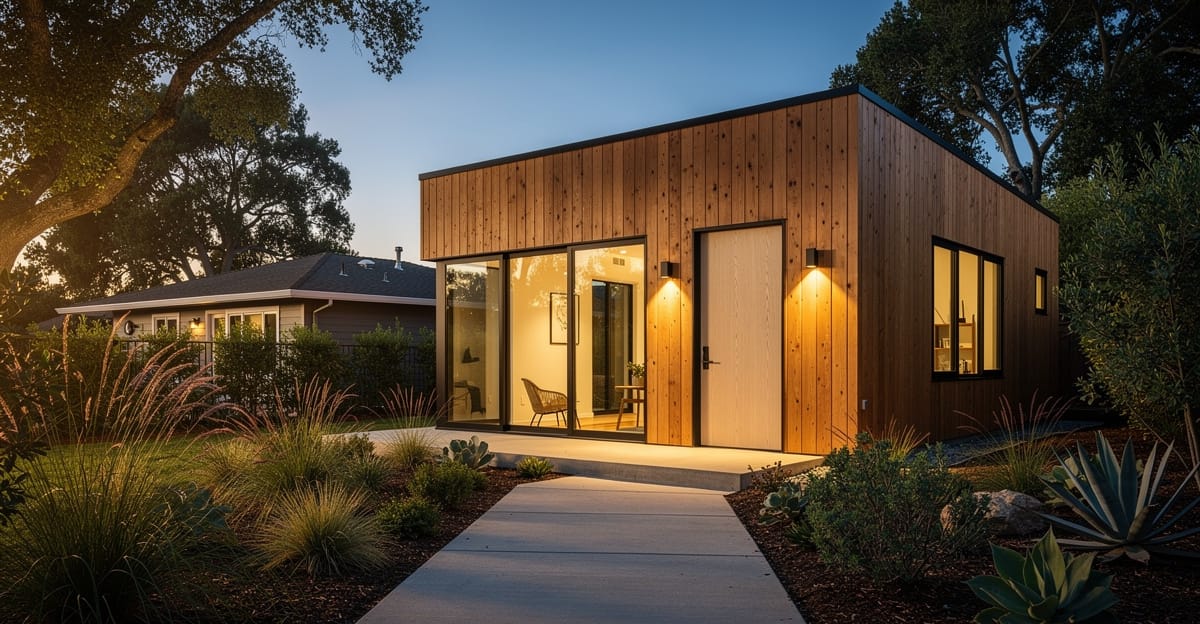
For ADU home additions we're completing in 2026, the most requested exterior finishes are vertical cedar cladding with a charred or natural finish, fiber cement board in warm grey tones, and board-and-batten in off-white or warm sand. These materials hold up in the Bay Area's microclimate extremes and require minimal maintenance. Black-framed windows (Marvin Elevate or Andersen 100 series) are nearly universal.
Inside, the 2026 trends we're seeing most frequently:
- Kitchens: Rift-cut white oak cabinets with integrated finger pulls, Dekton Kreta or Calacatta Viola marble countertops, induction cooktops (now virtually standard in all-electric ADUs required under California's reach codes in many cities), and Kohler or Brizo fixtures in unlacquered brass.
- Bathrooms: Zellige tile accent walls, large-format Porcelanosa or Marazzi floor tile, Kohler Archer or Toto Aquia IV toilets, and hand-applied plaster or microcement on ceiling surfaces for texture in tight spaces.
- Living areas: White oak or engineered hardwood throughout (Legno Bastone or Carlisle Wide Plank), fluted wood accent walls, and concealed sliding barn doors to separate sleeping areas in studio configurations.
For our 3D design and rendering process, we model every ADU in full detail before construction begins - this is especially critical for detached units where the relationship to the main house, yard, and neighbors needs to be visualized in three dimensions before a single permit is pulled.
"The design shift I'm most excited about in 2026 is the move toward ADUs that look intentional - not like an afterthought. When the cedar on the ADU echoes the trim on the main house, and the landscaping ties the two structures together, you've created something that adds real value to the entire property." - Bar Benbenisty, Barcci Builders.
Attached vs Detached ADU: Which Is Right for Your Bay Area Property?
The right choice depends on four factors: your lot size and configuration, your primary goal (rental income vs family use), your existing home's structural condition, and your budget. Based on our 116+ completed ADU projects, here is the decision framework we walk every client through before design begins.
Choose an attached ADU if:
- Your lot is under 5,000 sqft and backyard space is limited
- Your primary goal is housing a family member who needs occasional access to the main home
- Your existing home has a large garage or underutilized ground-floor space that can be converted without major structural work
- Your budget is under $250,000
- You're in a city with tight setback requirements that make detached siting difficult
Choose a detached ADU if:
- Your lot has a usable backyard of 1,500 sqft or more
- Your primary goal is generating maximum rental income from an unrelated tenant
- You value complete acoustic and visual separation from your tenants
- You want the ADU to function as a true second home - for guests, short-term rentals (where permitted), or eventually for a family member who values full independence
- You're planning for long-term resale and want to maximize the value added to your property
For homeowners in larger-lot cities like Saratoga, Los Gatos, and Los Altos, detached ADUs are almost always the right call. The lots support it, the neighborhoods command the higher rents, and the resale premium for a fully detached unit in these markets is substantial. For urban infill neighborhoods in San Jose and Campbell where lots run 5,000-7,000 sqft, attached ADUs - particularly garage conversions with a second-story addition - are often the most efficient use of space and budget.
If you're still weighing both options, our team offers a free site evaluation that looks at your specific lot, setbacks, existing structure, and goals. We'll tell you honestly which type makes more sense - and why.
How to Start Your ADU Project in the Bay Area: The Barcci Builders Process
Starting an ADU project the right way means doing the feasibility work before you fall in love with a design. Based on our 116+ completed ADU projects, the homeowners who have the smoothest experiences are the ones who spend the first 2-3 weeks on due diligence before any design dollars are committed.
Here's how we structure the process at Barcci Builders:
- Site feasibility: We review your assessor's parcel map, current zoning, setback requirements, and utility service capacity. This takes 1-2 weeks and surfaces any showstoppers before you invest in design.
- Design and engineering: Our 3D design and rendering team produces permit-ready drawings and structural engineering. Attached ADUs typically require 6-10 weeks of design; detached ADUs run 8-14 weeks due to the additional structural engineering package.
- Permit submission and approval: We submit to the relevant building department (Santa Clara County Planning, individual city planning departments, San Mateo County Building Department depending on your location) and manage the back-and-forth with plan checkers.
- Construction: Attached ADUs typically build out in 4-6 months; detached ADUs run 6-10 months depending on complexity, foundation type, and utility work required.
- Certificate of occupancy and rental prep: We walk you through final inspections, utility activation, and if desired, connect you with property management resources for tenant placement.
Our ADU home additions service covers every step of this process under one roof - architecture, engineering, permits, construction, and finish selections. If you're comparing attached vs detached options for your specific property in the South Bay or Peninsula, reach out for a consultation.
Frequently Asked Questions
How much does an attached ADU cost in California in 2026?
An attached ADU in the Bay Area costs between $180,000 and $310,000 in 2026, or roughly $285 to $420 per square foot. Size, finish level, and the complexity of integrating the unit into the existing home are the biggest cost drivers. Panel upgrades, fire-rated wall assemblies, and plumbing rerouting commonly add $25,000 to $65,000 beyond the base construction cost.
How much does a detached ADU cost in the Bay Area in 2026?
Detached ADUs in the Bay Area cost between $220,000 and $490,000 in 2026, averaging $340 to $480 per square foot in Santa Clara County. The higher cost reflects a fully self-contained structure with its own foundation, roof, utility connections, and complete building envelope meeting 2022 California Title 24 energy standards.
Do I need a permit for an attached or detached ADU in California?
Yes - both attached and detached ADUs require building permits in every California jurisdiction. Under current state law (AB 2221, SB 897), cities must provide ministerial approval for code-compliant ADU applications. Permit fees average $4,500 to $9,500 for attached ADUs and $7,500 to $16,000 for detached ADUs in Santa Clara County.
Which type of ADU rents for more - attached or detached?
Detached ADUs consistently rent for 15-25% more than comparable attached units. In 2026, a 600 sqft detached ADU in the South Bay rents for approximately $2,400 to $2,800 per month, compared to $2,000 to $2,300 for a comparable attached unit. Tenants pay a premium for true separation from the owner's residence.
Can I build a detached ADU in my backyard in San Jose?
Yes. San Jose allows detached ADUs on any single-family or multi-family lot, subject to setback requirements (typically 4 feet from rear and side property lines), maximum height of 16-20 feet (1 or 2 stories), and a maximum size of 1,200 sqft or 50% of the main dwelling's square footage, whichever is less. San Jose has streamlined its ADU permitting since 2020.
What is the difference between an attached ADU and a JADU?
A JADU (Junior ADU) is a specific type of attached unit, always within the existing walls of the main house, limited to 500 sqft, and must share a bathroom or have a private bathroom. An attached ADU can be larger (up to 1,200 sqft), can include an addition to the home, and has no requirement to share any facilities with the main dwelling. JADUs are permitted faster and at lower cost but offer less privacy and rental income potential.
How long does it take to build a detached ADU in the Bay Area?
From the start of design to certificate of occupancy, a detached ADU in the Bay Area takes 12 to 18 months total. Design and engineering takes 8-14 weeks; permit approval runs 8-14 weeks in most South Bay cities; construction takes 6-10 months. Attached ADUs are slightly faster: design runs 6-10 weeks, permits 4-8 weeks, and construction 4-6 months.
Does an ADU increase my property taxes in California?
Under Proposition 13, adding an ADU triggers a reassessment only for the newly constructed portion - not the entire property. You pay additional property tax only on the assessed value of the ADU itself, typically $2,000 to $4,500 per year for a 600-800 sqft unit in Santa Clara County. The main home's assessed value is not affected.
What is the maximum size of an ADU in California in 2026?
California state law sets the maximum size of a detached ADU at 1,200 sqft. Attached ADUs are limited to 50% of the primary dwelling's living area or 1,200 sqft, whichever is less - but cities cannot impose a limit below 850 sqft (or 1,000 sqft if the unit has more than one bedroom). Local cities may allow larger units under their own ordinances.
Can I build both an attached and detached ADU on the same property?
Yes. California state law allows one ADU (attached or detached) plus one JADU on most single-family parcels. Multi-family properties can have even more units. So a homeowner could theoretically build a 500 sqft JADU within the main home and a 1,200 sqft detached ADU in the backyard on the same parcel, subject to lot coverage and setback limits.