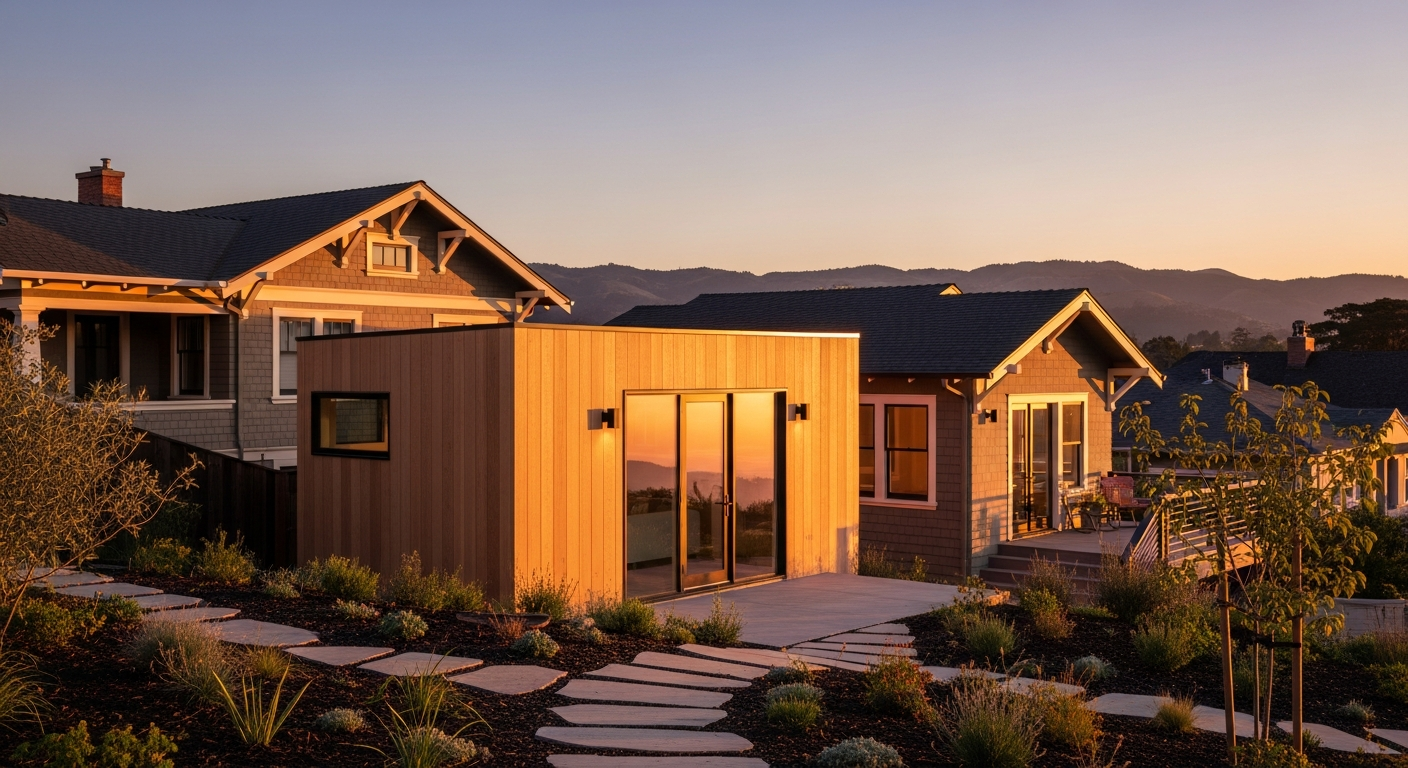
What Is the Difference Between an ADU and a JADU in California in 2026?
An ADU (Accessory Dwelling Unit) is a self-contained residential unit built on a single-family or multifamily lot, while a JADU (Junior Accessory Dwelling Unit) is a smaller unit created within the existing footprint of a primary residence. The core difference: an ADU is essentially a new home on your property, and a JADU is a converted room inside your existing home. Under California law as of 2026, ADUs can be up to 1,200 square feet and built as detached, attached, or converted structures, while JADUs are capped at 500 square feet and must be carved out of an existing home's walls.
"As someone who has completed over 116 remodels across the Bay Area, I see homeowners confuse ADUs and JADUs constantly. The simplest way to think about it: an ADU is a new home on your lot. A JADU is a converted room inside your existing home. That single distinction changes the budget by $100,000 or more." - Bar Benbenisty, Founder and CEO, Barcci Builders
Our 2026 project data shows that approximately 72% of Bay Area homeowners who contact us about accessory dwelling units end up choosing a detached ADU over a JADU, primarily because of the higher rental income potential. However, JADUs are the smarter financial play for homeowners on a tight budget or those with an underused bedroom, home office, or attached garage they can convert for $40,000 to $80,000 rather than spending $180,000 to $400,000+ on a new detached structure.
Under AB 68, AB 881, and SB 9, California has progressively loosened ADU and JADU regulations. As of 2026, most Bay Area cities - including Los Gatos, Saratoga, San Jose, Cupertino, Sunnyvale, Mountain View, and Palo Alto - cannot deny a code-compliant ADU or JADU application. This is a significant shift from even five years ago, when many cities effectively blocked ADU construction through restrictive zoning or slow permitting. If you are weighing your options, understanding the ADU and JADU building process is the first step toward making the right investment for your property.
How Do ADU and JADU Size Limits and Setback Rules Compare in 2026?
California state law sets clear size and placement rules for both ADUs and JADUs, and local Bay Area jurisdictions cannot impose stricter limits than what the state allows. The maximum ADU size is 850 square feet for a studio or one-bedroom unit and 1,200 square feet for a two-bedroom or larger unit. JADUs are capped at 500 square feet. In our experience building across Silicon Valley since 2017, understanding these rules before you design saves weeks of permit revisions and thousands of dollars in architectural fees.
| Feature | ADU | JADU |
|---|---|---|
| Maximum size | 850 sq ft (studio/1BR) or 1,200 sq ft (2+ BR) | 500 sq ft |
| Minimum lot size | None required (state law) | None required (state law) |
| Location on property | Detached, attached, or converted structure | Within existing home or attached garage only |
| Rear/side setback | 4 ft minimum (statewide) | No additional setback (within existing walls) |
| Height limit | 16 to 25 ft depending on zoning and proximity to transit | Same as primary structure |
| Parking required | None (eliminated statewide) | None (eliminated statewide) |
| Kitchen requirement | Full kitchen required | Efficiency kitchen (120V appliances, sink, counter, storage) |
| Bathroom | Full bathroom required | Full bathroom required |
| Separate entrance | Required | Required (interior or exterior door) |
| Fire sprinklers | Required only if primary home has them | Not required |
| Owner occupancy | Not required (state preemption) | Owner must occupy primary home or JADU |
| Utility connections | Independent meters allowed or shared | Must share at least one utility with primary |
One critical distinction that trips up homeowners in cities like Campbell, Los Altos, and Monte Sereno: JADUs do not trigger new utility connection fees. According to Bay Area permit data, new water and sewer connections for a detached ADU in Santa Clara County run $8,000 to $18,000 depending on the city. A JADU avoids these fees entirely because it shares the primary home's connections.
The 4-foot setback rule for detached ADUs is a statewide minimum under AB 68, and no city can require more than 4 feet for rear and side yards. For homeowners in areas with narrow lots - common in neighborhoods like Willow Glen in San Jose or Old Mountain View - this 4-foot rule makes detached ADUs feasible on lots that would have been too small under pre-2020 regulations.
How Much Does It Cost to Build an ADU vs a JADU in the Bay Area in 2026?
A detached ADU in the Bay Area costs between $180,000 and $400,000+ to build in 2026, while a JADU conversion typically runs $40,000 to $80,000. According to our 2026 Bay Area project data, the average detached ADU we build in Santa Clara County costs $275,000 to $350,000, which includes design, permits, site work, foundation, framing, full mechanical systems, and interior finishes.
| Cost Category | Detached ADU (800-1,200 sq ft) | JADU Conversion (200-500 sq ft) |
|---|---|---|
| Design and architecture | $12,000 - $25,000 | $3,000 - $8,000 |
| Permits and city fees | $8,000 - $22,000 | $2,000 - $6,000 |
| Site work and foundation | $25,000 - $55,000 | $0 - $5,000 |
| Framing and structure | $30,000 - $65,000 | $5,000 - $15,000 |
| Plumbing rough and finish | $15,000 - $30,000 | $5,000 - $12,000 |
| Electrical rough and finish | $10,000 - $22,000 | $3,000 - $8,000 |
| HVAC system | $8,000 - $18,000 | $2,000 - $6,000 |
| Interior finishes (cabinets, counters, flooring, tile) | $40,000 - $90,000 | $10,000 - $25,000 |
| Exterior cladding and landscaping | $15,000 - $35,000 | $0 - $5,000 |
| Total Project Cost | $180,000 - $400,000+ | $40,000 - $80,000 |
On a per-square-foot basis, detached ADUs in our portfolio average $300 to $450 per square foot, while JADUs average $100 to $200 per square foot. The per-square-foot cost for JADUs is lower primarily because you are working within an existing structure. There is no foundation to pour, no new roof to frame, no exterior walls to build, and no utility connections to trench.
Material selections drive significant cost variation within each category. A JADU with Caesarstone quartz countertops, Kohler fixtures, and engineered hardwood flooring will land near the top of the $40,000 to $80,000 range, while a basic conversion with laminate countertops and vinyl flooring can stay under $50,000. For detached ADUs, the most popular exterior finish among our 2026 Bay Area clients is cedar cladding ($18 to $28 per square foot installed), followed by Hardie board siding ($12 to $18 per square foot) and hand-applied stucco ($14 to $22 per square foot).
"As someone who has completed over 116 remodels across the Bay Area, I tell clients that a JADU is the most underrated housing investment in California right now. You can create a fully functional rental unit for under $80,000 in most cases. At current Bay Area rents, that is a 2 to 4 year payback period." - Bar Benbenisty, Founder and CEO, Barcci Builders
For homeowners in Palo Alto, Menlo Park, Atherton, or Hillsborough, detached ADU costs tend to run 10 to 20% higher than the Santa Clara County average due to more stringent local design review requirements and higher-end finish expectations. In our experience, projects in these communities typically include Miele or Bosch compact appliances, walnut or rift-cut white oak cabinetry, and natural stone surfaces - pushing total project costs toward the $350,000 to $450,000 range.
What Permits Do You Need for an ADU vs JADU in Santa Clara County?
Both ADUs and JADUs require building permits in every Bay Area jurisdiction, but the permit process is significantly simpler and cheaper for JADUs. Based on current Santa Clara County building department records, ADU permits require full plan review including structural, mechanical, electrical, and plumbing plan checks, while JADUs often qualify for an expedited or simplified review process.
Here is what the permit process looks like for each unit type in 2026:
ADU permit requirements in Santa Clara County:
- Plan review timeline: 4 to 8 weeks (California mandates a 60-day maximum)
- Required plans: architectural, structural, MEP (mechanical, electrical, plumbing), Title 24 energy calculations
- Permit fees: $4,000 to $12,000 depending on the city
- Impact fees: Exempt for ADUs under 750 sq ft. Units over 750 sq ft may be subject to school impact fees ($2 to $5 per sq ft)
- Utility connection fees: $8,000 to $18,000 for separate water and sewer connections
- Total permit-related costs: $12,000 to $30,000
JADU permit requirements in Santa Clara County:
- Plan review timeline: 2 to 4 weeks
- Required plans: floor plan, basic structural (if modifying load-bearing walls), electrical layout, plumbing layout
- Permit fees: $1,500 to $4,000
- Impact fees: Exempt
- Utility connection fees: None (shared with primary home)
- Total permit-related costs: $1,500 to $5,000
Under California Government Code Section 65852.22, cities must approve or deny JADU applications within 60 days. In practice, the Town of Los Gatos Building Division processes JADU permits in 2 to 3 weeks for straightforward conversions, while the City of San Jose Planning Department averages 3 to 5 weeks. Palo Alto Development Services and the San Mateo County Building Department report similar timelines for JADU permits.
One important regulatory note for 2026: California's SB 9 allows lot splits on single-family zoned properties, and you can build ADUs on each resulting parcel. When combined with JADU provisions, a single-family lot could theoretically support the primary home, a JADU inside it, and a detached ADU - creating three housing units on one parcel. According to Bay Area permit data, fewer than 8% of homeowners are taking advantage of this stacking strategy, but it represents significant untapped potential for properties in cities like San Jose, Sunnyvale, and Campbell where lot sizes are generous enough to support multiple units.
How Much Rental Income Can You Earn from an ADU vs JADU in the Bay Area?
| Financial Metric | Detached ADU (800-1,200 sq ft) | JADU (300-500 sq ft) |
|---|---|---|
| Monthly rent range | $2,800 - $4,500 | $1,500 - $2,500 |
| Average monthly rent | $3,400 | $1,900 |
| Annual gross income | $33,600 - $54,000 | $18,000 - $30,000 |
| Average build cost | $310,000 | $60,000 |
| Simple payback period | 6 - 9 years | 2 - 4 years |
| Estimated cap rate | 7 - 12% | 25 - 40% |
| Property value increase | $150,000 - $350,000 | $50,000 - $120,000 |
| Annual property tax increase (est.) | $3,000 - $3,500 | $600 - $700 |
The rental income advantage of a full ADU is straightforward: larger units command higher rents. But the ROI story favors JADUs. A $60,000 JADU renting at $1,900 per month generates $22,800 annually - a 38% gross return on investment. A $310,000 ADU renting at $3,400 per month generates $40,800 annually - a 13% gross return. Both figures are outstanding by real estate investment standards, but JADUs offer substantially faster capital recovery.
Location matters enormously for rental rates. Our 2026 project data shows that ADUs in Palo Alto and Mountain View command the highest rents in our portfolio at $3,800 to $4,500 per month for a two-bedroom unit, driven by proximity to Stanford, Google, and Apple campuses. ADUs in Campbell, Los Gatos, and Saratoga typically rent for $2,800 to $3,800, while San Jose neighborhoods like Willow Glen, Rose Garden, and Almaden Valley see $2,500 to $3,500.
Beyond rental income, both ADUs and JADUs increase your property's market value. According to our 2026 Bay Area project data, a permitted detached ADU adds $150,000 to $350,000 to a home's sale price. Under Proposition 13 protections, however, your property tax increase is based only on the construction cost, not the market value increase. This means a $300,000 ADU that adds $350,000 in market value creates an immediate $50,000 equity gain while costing only about $3,000 to $3,500 per year in additional property taxes through the Santa Clara County Assessor's Office.
Can You Build Both an ADU and a JADU on the Same Property in California?
Yes. California law explicitly allows homeowners to build one ADU and one JADU on a single-family residential lot. This stacking provision - established under AB 68 and reinforced in subsequent legislation - is one of the most powerful and underutilized housing strategies available to Bay Area homeowners in 2026.
- Primary home: 4 bedrooms, 2,500 sq ft on a 12,000 sq ft lot
- JADU: 450 sq ft carved from an attached garage. Cost: $55,000 to $70,000
- Detached ADU: 1,000 sq ft in the backyard. Cost: $280,000 to $350,000
- Total investment: $335,000 to $420,000
- Combined monthly rental income: $5,500 to $7,200
- Annual rental income: $66,000 to $86,400
- Combined payback period: 4 to 6 years
"As someone who has completed over 116 remodels across the Bay Area, I believe the ADU-plus-JADU strategy is the single best real estate investment a Bay Area homeowner can make right now. You are essentially building a small apartment complex on your existing lot with no zone change, no subdivision, and no commercial permitting. On a property in Los Gatos or Saratoga, you can generate $70,000 to $85,000 a year in rental income." - Bar Benbenisty, Founder and CEO, Barcci Builders
The practical requirements for building both on one lot are manageable. The JADU must be within the existing walls of the primary home or attached garage. The ADU can be detached, built anywhere on the lot that meets the 4-foot rear and side setback. You need enough space for the ADU footprint plus those required setbacks, and you need to maintain at least one compliant parking space for the primary home (though ADU and JADU parking requirements have been eliminated statewide).
In cities like San Jose, Sunnyvale, and Mountain View, lot sizes of 6,000 to 8,000 square feet can comfortably accommodate both units. In Los Altos, Saratoga, and Los Gatos, where lots commonly range from 10,000 to 40,000+ square feet, the space constraint is rarely an issue. From a permitting standpoint, you can submit both applications simultaneously. The Town of Los Gatos Building Division and Santa Clara County Planning both accept concurrent ADU and JADU applications, which can save 4 to 8 weeks compared to sequential permitting.
What Are the Best ADU and JADU Design Trends in the Bay Area for 2026?
The most popular ADU design in our 2026 Bay Area portfolio is a 1,000 to 1,200 square foot detached unit with an open-plan living and kitchen area, one or two bedrooms, one full bathroom, and stacked washer-dryer. For JADUs, the dominant layout is a studio or one-bedroom conversion with an efficiency kitchen, full bathroom, and private entrance.
According to our 2026 Bay Area project data, 65% of ADU clients choose rift-cut white oak cabinetry with integrated finger pulls, and 48% select cedar cladding for the exterior. These warm, natural material choices reflect a broader shift away from the cool gray aesthetic that dominated Bay Area design five years ago. Here are the trending finishes we install most frequently:
Exterior finishes: Cedar cladding ($18 to $28 per sq ft installed), standing seam metal roof accents, aluminum-clad windows from Milgard or Andersen, hand-applied stucco in warm earth tones, fluted concrete or breeze block accent walls
Interior finishes: Rift-cut white oak cabinetry with integrated finger pulls, Caesarstone or Cambria quartz countertops, zellige tile backsplash in cream or sage tones, microcement bathroom walls and floors, Kohler or Hansgrohe fixtures in matte black or unlacquered brass, engineered white oak flooring
Appliance packages: For full ADUs, compact 24-inch Bosch or Fisher and Paykel appliance packages are the most popular choice, offering full cooking and refrigeration capability in a smaller footprint. A typical ADU appliance package - 24-inch refrigerator, 24-inch induction cooktop or range, 24-inch dishwasher, and ventilation - runs $4,500 to $8,000 for mid-range brands and $8,000 to $14,000 for premium options like Miele or Thermador. For JADUs, the efficiency kitchen requirement means you can use plug-in induction cooktops and countertop convection ovens instead of a full range, keeping the kitchen build-out cost to $3,000 to $6,000.
Our 3D design rendering service helps clients visualize both ADU and JADU layouts before construction begins. This step, which typically costs $2,500 to $5,000, prevents costly design changes during construction and ensures the unit flows well within the available footprint. For detached ADUs, we also coordinate landscaping and exterior design to create a cohesive connection between the primary home, the ADU, and the outdoor living space - a detail that adds measurably to both livability and rental appeal in neighborhoods like Downtown Los Gatos and Professorville in Palo Alto.
How Do You Decide Between an ADU and a JADU for Your Bay Area Property?
The right choice depends on four factors: your budget, your rental income goals, your property's physical constraints, and whether you plan to occupy one of the units yourself. In our experience building across Silicon Valley since 2017, here is the decision framework we walk every client through.
Choose a JADU if:
- Your budget is under $100,000
- You have a spare bedroom, home office, or attached garage you are not fully using
- You want the fastest path to rental income (3 to 6 months from permit to occupancy)
- You or a family member will live in either the primary home or the JADU (owner-occupancy is required)
- You want to minimize disruption to your yard and outdoor living space
- You are testing the rental market before committing to a larger ADU project
Choose a detached ADU if:
- Your budget is $200,000 to $400,000+
- You want to maximize rental income ($2,800 to $4,500 per month)
- You want complete privacy and separation between units
- You do not want owner-occupancy restrictions on your rental
- You have adequate yard space (400+ sq ft of buildable area after setbacks)
- You plan to use the unit for aging parents, adult children, or guests alongside future rental potential
Choose both (ADU + JADU) if:
- You want to maximize your property's income potential ($5,500 to $7,200 per month combined)
- Your lot is large enough for a detached ADU while still having interior space for a JADU conversion
- You are prepared to invest $300,000 to $450,000 for a 4 to 6 year payback
- You understand the owner-occupancy requirement applies only to the JADU, not the ADU
No matter which path you choose, the first step is a site assessment. Our team evaluates your lot dimensions, existing structure, utility locations, and local zoning to determine exactly what is feasible - and what will generate the strongest return. If you are considering an ADU or JADU for your Bay Area property, we offer a free initial consultation that typically takes 60 to 90 minutes at your home. We will walk your lot, review your floor plan, discuss your goals, and give you a realistic cost and timeline range before you commit to anything.
Frequently Asked Questions About ADUs and JADUs in California
What is the maximum size of a JADU in California in 2026?
The maximum size of a JADU (Junior Accessory Dwelling Unit) in California is 500 square feet, as defined by California Government Code Section 65852.22. This limit applies statewide and cannot be further reduced by local jurisdictions. The JADU must be created within the existing walls of the primary residence or an attached garage.
Do you need a separate entrance for a JADU in California?
Can a JADU have a full kitchen in California?
JADUs in California are required to have an efficiency kitchen, which includes a sink, cooking appliances that do not require electrical service greater than 120 volts, a food preparation counter, and storage cabinets. A full range with a 240-volt connection and dedicated vent hood is not required. Most of our JADU clients install a plug-in induction cooktop, a countertop convection oven, and a compact refrigerator for $3,000 to $6,000 total.
How much does it cost to convert a garage to a JADU in the Bay Area?
Converting an attached garage to a JADU in the Bay Area costs $45,000 to $80,000 in 2026. According to our 2026 Bay Area project data, the average garage-to-JADU conversion runs $55,000 to $65,000, covering insulation, drywall, flooring, an efficiency kitchen, a full bathroom, electrical upgrades, and a separate entrance. The cost is lower than a detached ADU because the shell - walls, roof, and foundation - already exists.
Can you build an ADU and a JADU on the same lot in California?
Does a JADU need fire sprinklers in California?
No. California Building Code specifically exempts JADUs from fire sprinkler requirements, regardless of whether the primary residence has sprinklers. This is a meaningful cost advantage. For detached ADUs, fire sprinklers are required only if the primary home already has them. Adding a fire sprinkler system to a detached ADU typically costs $3,000 to $6,000.
Is owner occupancy required for a JADU in California in 2026?
Yes. California law requires the property owner to occupy either the primary residence or the JADU when a JADU is present on the property. This owner-occupancy requirement applies specifically to JADUs under Government Code Section 65852.22. Standard ADUs are not subject to owner-occupancy requirements under current state law, though enforcement details vary by jurisdiction.
How long does it take to build a JADU in the Bay Area?
A JADU conversion in the Bay Area typically takes 8 to 14 weeks from permit approval to occupancy. In our experience building across Silicon Valley since 2017, the timeline breaks down as: permitting (2 to 4 weeks), demolition and rough-in (2 to 3 weeks), finishes and final inspections (3 to 6 weeks). By comparison, a detached ADU takes 6 to 10 months on average including design, permitting, and construction.
How much does a JADU increase property value in California?
What is the difference between an ADU and a JADU for property tax purposes in California?
Both ADUs and JADUs trigger a reassessment of improvement value (not land value) under Proposition 13. The Santa Clara County Assessor's Office adds the construction cost to your property's assessed value. For a JADU costing $60,000, expect roughly $600 to $700 per year in additional property taxes. For a detached ADU costing $300,000, expect approximately $3,000 to $3,500 per year. The underlying land value and existing home assessment remain unchanged.