How Much Does It Cost to Build an ADU in Sunnyvale in 2026?
A new ADU in Sunnyvale, California typically costs between $285,000 and $500,000+ in 2026, depending on unit size, whether it's attached or detached, foundation type, and finish level. Based on our 116+ completed Bay Area projects at Barcci Builders, the average all-in cost for a turnkey 600–800 sq ft detached ADU in Sunnyvale lands between $350,000 and $425,000 — and that includes design, permits, utility connections, and construction.
Those numbers may feel high compared to national averages, but they reflect the reality of building in Silicon Valley: elevated labor costs, Santa Clara County permit fees, strict Title 24 energy requirements, and soil conditions that can require engineered foundations. Here's how costs typically break down:
| Cost Category | Percentage of Budget | Typical Range (600 sq ft ADU) |
|---|---|---|
| Design & Engineering | 8–12% | $22,000–$50,000 |
| Permits & Fees | 5–8% | $15,000–$35,000 |
| Site Work & Foundation | 12–18% | $35,000–$75,000 |
| Framing & Structure | 15–20% | $45,000–$85,000 |
| MEP (Mechanical, Electrical, Plumbing) | 15–20% | $45,000–$80,000 |
| Interior Finishes | 18–25% | $55,000–$110,000 |
| Exterior & Landscaping | 5–10% | $15,000–$45,000 |
As someone who's completed ADU projects across Sunnyvale, Cupertino, and Mountain View, I can tell you: the single biggest variable in ADU cost isn't the size of the unit — it's the site conditions and finish level. A flat lot with easy utility access can save $30,000–$50,000 compared to a sloped lot that requires retaining walls and a sewer lateral extension.
The cost per square foot for a Sunnyvale ADU in 2026 ranges from $400 to $650+ depending on finishes. A mid-range build with quartz countertops, LVP flooring, and standard appliances runs around $450–$500/sq ft. A high-end build with Thermador appliances, wide-plank rift-cut white oak floors, and Dekton countertops can push past $600/sq ft.
What Is the ADU Permit Process in Sunnyvale, California?
The ADU permit process in Sunnyvale requires submitting a building permit application to the City of Sunnyvale Community Development Department, and as of 2026, the city must approve or deny compliant ADU applications within 60 days per California Government Code Section 65852.2. In practice, our 2026 project data shows Sunnyvale ADU permits currently take 6–10 weeks from submission to approval, assuming a complete application with no plan corrections.
Here's the step-by-step process we follow for every Sunnyvale ADU project:
- Step 1 — Feasibility Assessment (1–2 weeks): We review your lot size, zoning (R-0, R-1, R-2, or R-3), existing structures, setback requirements, and utility access. Sunnyvale allows ADUs on any residentially zoned lot, including lots with multi-family housing.
- Step 2 — Architectural Design & Engineering (4–8 weeks): Our 3D design and rendering team creates full construction drawings, structural engineering, Title 24 energy calculations, and a site plan. For Sunnyvale specifically, you'll also need a drainage plan if your lot is in a flood zone or near Stevens Creek or Sunnyvale East/West channels.
- Step 3 — Permit Submission: Applications go to the Sunnyvale Building Division. You'll submit architectural plans, structural calculations, Title 24 compliance docs, a soils report (often required for detached ADUs), and a sewer lateral connection plan reviewed by the Sunnyvale Environmental Services Department.
- Step 4 — Plan Review (6–10 weeks): The city routes your plans through Building, Fire (Sunnyvale Department of Public Safety), and sometimes Public Works. Plan check corrections are common — about 70% of first submissions receive at least one round of comments based on our experience.
- Step 5 — Permit Issuance & Construction (4–7 months): Once approved, construction begins. A typical 600–800 sq ft detached ADU takes 4–6 months to build. Attached ADUs and garage conversions can be faster at 3–5 months.
- Step 6 — Final Inspections & Certificate of Occupancy: Sunnyvale requires inspections at foundation, framing, rough MEP, insulation, and final stages. Once you pass final inspection, the city issues a Certificate of Occupancy.
One important Sunnyvale-specific detail: the city has been proactive about ADU development and published a pre-approved ADU plan program. If you use one of the city's pre-approved plans, you can reduce plan review time significantly — sometimes to as little as 2–3 weeks. However, these pre-approved plans are fairly generic. Most of our clients in neighborhoods like Lakewood, Birdland, and the Heritage District prefer custom designs that match their existing home's architecture.
What Are Sunnyvale's ADU Rules and Setback Requirements in 2026?
Sunnyvale follows California's statewide ADU laws (AB 68, AB 881, SB 9, and the 2024 ADU reform package) while adding a few city-specific requirements. The most important rule to know: Sunnyvale allows one ADU and one Junior ADU (JADU) on any single-family lot, regardless of lot size, as long as state minimum setback and size standards are met.
Here are the key Sunnyvale ADU development standards for 2026:
| Regulation | Detached ADU | Attached ADU | JADU |
|---|---|---|---|
| Maximum Size | 1,200 sq ft (2+ BR) or 850 sq ft (studio/1 BR) | 1,200 sq ft or 50% of primary home, whichever is less | 500 sq ft |
| Rear Setback | 4 ft minimum | 4 ft minimum | N/A (within existing structure) |
| Side Setback | 4 ft minimum | 4 ft minimum | N/A |
| Height Limit | 16 ft (single story) / 18 ft (if within ½ mile of transit) | 25 ft or primary home height | Primary home height |
| Parking | None required | None required | None required |
| Owner Occupancy | Not required for ADUs | Not required | Required (owner must live in primary or JADU) |
| Impact Fees | Exempt if under 750 sq ft | Exempt if under 750 sq ft | Exempt |
A few Sunnyvale-specific nuances that trip up homeowners:
- Lot coverage: While state law prohibits cities from applying lot coverage limits that would prevent an 800 sq ft ADU, Sunnyvale's zoning code still calculates lot coverage for the primary home. If you're also planning a primary home addition or whole-house remodel, the combined project must comply.
- Heritage Resources: If your home is in Sunnyvale's Heritage Resources Inventory (some homes in the Murphy Avenue Historic District and surrounding blocks), you may face design review requirements that add 2–4 weeks to your timeline.
- Sewer capacity: Sunnyvale requires a sewer lateral capacity analysis for most new ADUs. If your existing lateral is undersized (common in homes built before 1970), you'll need to upgrade it — an additional cost of $5,000–$15,000.
- Short-term rentals: Sunnyvale prohibits using ADUs as short-term rentals (less than 30 days). Your ADU must be rented for 30+ days or used as a residence for family members.
Based on our experience building ADUs across Sunnyvale and neighboring cities like Santa Clara and Los Altos, Sunnyvale is one of the more ADU-friendly cities in the South Bay. The permitting staff is knowledgeable, the pre-approved plan program shows genuine commitment, and the 60-day processing timeline is generally honored.
Should You Build a Detached ADU, Attached ADU, or Garage Conversion in Sunnyvale?
The best ADU type for your Sunnyvale property depends on your lot layout, budget, and long-term goals. A detached ADU provides the most privacy and typically yields the highest rental income ($2,800–$4,200/month in Sunnyvale in 2026), but it's also the most expensive option. A garage conversion is the most affordable path to a finished ADU, typically costing 40–50% less than a detached new build.
Here's how the three main ADU types compare for a typical Sunnyvale lot:
| Factor | Detached ADU | Attached ADU | Garage Conversion |
|---|---|---|---|
| Typical Cost (2026) | $320,000–$500,000+ | $250,000–$400,000 | $150,000–$280,000 |
| Construction Timeline | 5–7 months | 4–6 months | 3–5 months |
| Privacy Level | Highest | Moderate | Moderate to Low |
| Rental Income Potential | $2,800–$4,200/mo | $2,400–$3,800/mo | $2,200–$3,400/mo |
| Property Value Increase | $250,000–$450,000 | $200,000–$375,000 | $150,000–$300,000 |
| Permits Complexity | Moderate | Moderate | Lowest |
| Yard Impact | Significant | Minimal | None (but lose garage) |
For Sunnyvale neighborhoods with larger lots — think the areas south of El Camino Real near Fremont Avenue, or the neighborhoods near Baylands Park — a detached ADU makes the most sense. You have the footprint, and a well-designed detached unit with its own entrance feels like a genuine standalone home.
For smaller lots in central Sunnyvale — the blocks near Downtown Murphy Avenue, the Raynor Activity Center area, or the older neighborhoods near Fair Oaks Park — a garage conversion or above-garage ADU is often the smartest play. You preserve your yard space while converting underutilized square footage.
One increasingly popular option we're building in 2026 is a two-story detached ADU on lots within half a mile of major transit (Caltrain, VTA light rail). California's updated height allowances let you go up to 18 feet near transit, which means you can build a compact two-story unit with living space below and a bedroom above — maximizing square footage on a minimal footprint.
What ADU Design Trends Are Sunnyvale Homeowners Choosing in 2026?
Sunnyvale homeowners in 2026 are moving away from the sterile, all-white modern box ADU and gravitating toward designs that feel like thoughtfully designed small homes with warm, organic materiality. Based on the ADU projects we're designing and building right now at Barcci Builders, here are the strongest trends:
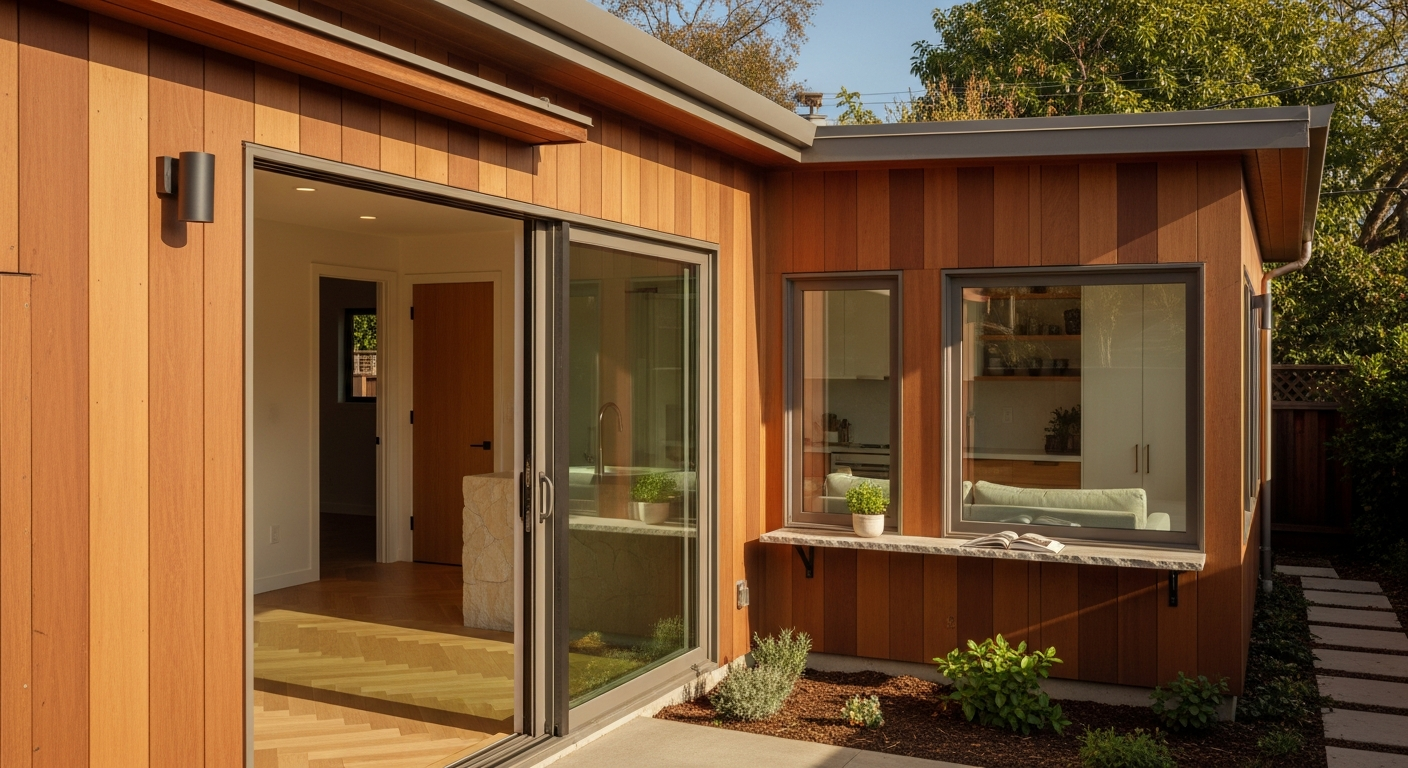
- Cedar and natural wood cladding: The most popular exterior finish for detached ADUs in 2026 is western red cedar siding — either horizontal shiplap or vertical board-and-batten. It weathers beautifully in the Bay Area climate and pairs well with both mid-century modern and contemporary farmhouse architecture, which are the two dominant home styles in Sunnyvale.
- Dekton and quartzite countertops: Quartz is still popular, but the trend is shifting toward ultra-compact surfaces like Dekton Kreta and Dekton Eter for their thinner profiles and superior heat resistance. For higher-end ADUs, we're seeing Calacatta Viola quartzite as a statement kitchen surface.
- Warm earthy tones: Wall colors are shifting from cool grays to warm putties, terracottas, and sage greens. Several of our Sunnyvale clients have opted for hand-applied plaster or microcement accent walls in their ADU living areas — a trend that's migrated from luxury main-home remodels.
- Zellige tile in kitchens and baths: The handmade Moroccan zellige tile has replaced subway tile as the go-to backsplash and shower surround. Its subtle color variations add dimension to small spaces, which is critical in an ADU where every detail is visible.
- Induction cooktops: California's building code now requires electric-ready kitchens, and the majority of our 2026 ADU clients are going all-electric with induction cooktops. Brands like Bosch and Fisher & Paykel offer excellent 24-inch and 30-inch induction units sized perfectly for ADU kitchens.
- Integrated finger-pull cabinetry: No hardware, no handles — just a routed channel along the top or bottom edge of each cabinet door. It creates a seamless, furniture-like look that makes small ADU kitchens feel more spacious.
- Unlacquered brass fixtures: Living finishes that develop a patina over time are replacing polished chrome. Unlacquered brass from brands like Waterworks and California Faucets adds warmth and character.
The overarching theme? ADUs in 2026 don't feel like afterthoughts or guest houses anymore. Sunnyvale homeowners are investing in the same material quality and design intention they'd put into their primary home's kitchen remodel or bathroom renovation. When you're building a unit that rents for $3,500/month or adds $350,000+ to your property value, spending an extra $20,000 on premium finishes generates a meaningful return.
How Long Does It Take to Build an ADU in Sunnyvale From Start to Finish?
- Design and engineering: 4–8 weeks. Custom designs take longer than pre-approved city plans, but the result is a unit that fits your lot and your aesthetic perfectly.
- Permit submission and plan review: 6–10 weeks. This is the city's processing time. If you receive plan corrections (about 70% of projects do on first submittal), add 2–4 weeks for resubmission and re-review.
- Construction — Detached ADU: 5–7 months (20–28 weeks). This includes site prep, foundation, framing, roofing, MEP rough-in, insulation, drywall, finishes, and landscaping.
- Construction — Garage Conversion: 3–5 months (12–20 weeks). Since the shell already exists, you skip foundation and framing for most of the structure.
- Final inspections: 1–2 weeks for the city to schedule and conduct final inspections, followed by Certificate of Occupancy issuance.
The biggest timeline risk in Sunnyvale isn't usually the city — it's utility coordination. If your ADU requires a new electrical panel (most do) and your existing service is only 100 amps, you'll need a panel upgrade and potentially a transformer upgrade through SVP (Silicon Valley Power, Sunnyvale's municipal utility). SVP transformer and service upgrades can take 8–16 weeks to schedule, and this needs to happen during construction. We always initiate SVP applications during the permit phase to run these timelines in parallel.
Similarly, if you need a new or upgraded sewer lateral, you'll coordinate with the City of Sunnyvale Environmental Services Department for a connection permit and potentially a capacity assessment — another 4–6 weeks if not started early.
My advice to every Sunnyvale homeowner considering an ADU: start the process 12–14 months before you want the unit ready. That gives you comfortable buffer for design iterations, permit reviews, and the inevitable surprises that come with any construction project. Rushing an ADU timeline almost always leads to design compromises or costly change orders.
Is Building an ADU in Sunnyvale a Good Investment in 2026?
Let's run the numbers on a typical scenario:
- Build cost: $375,000 for a 700 sq ft detached ADU with mid-to-high-end finishes
- Monthly rental income: $3,400 (conservative estimate for a modern 1-bedroom ADU in Sunnyvale)
- Annual gross income: $40,800
- Annual expenses (maintenance, insurance, vacancy): ~$5,000
- Annual net income: ~$35,800
- Cash-on-cash return: ~9.5% annually
- Property value increase: $300,000–$400,000 (based on 2025–2026 Sunnyvale comps where homes with ADUs sold at significant premiums)
That means you could recoup your construction cost through a combination of rental income and property appreciation within 3–5 years — and then every year after that is pure return.
Sunnyvale is particularly well-positioned for ADU investment because of its proximity to major tech employers (Apple, Google, LinkedIn, Juniper Networks), excellent school ratings, and access to Caltrain and VTA light rail. The rental demand for well-designed, modern small homes in Sunnyvale is intense and shows no signs of slowing.
If you're weighing whether to build an ADU or invest that $375,000 elsewhere, consider this: few investments give you a 9%+ annual cash return, a six-figure appreciation boost, and a tangible asset on your own property that you can also use for family. That's the power of ADU construction in Sunnyvale in 2026.
Frequently Asked Questions
How much does it cost to build a 600 sq ft ADU in Sunnyvale, CA?
How long does it take to get an ADU permit approved in Sunnyvale?
What is the maximum ADU size allowed in Sunnyvale in 2026?
Sunnyvale allows detached ADUs up to 1,200 sq ft for units with two or more bedrooms, and up to 850 sq ft for studios and one-bedroom units. Attached ADUs can be up to 1,200 sq ft or 50% of the primary home's floor area, whichever is less. Junior ADUs (JADUs) are limited to 500 sq ft and must be created within the existing primary dwelling or attached garage. These size limits follow California state ADU law, and Sunnyvale cannot impose stricter limits.
Do I need to live on the property to build an ADU in Sunnyvale?
No. As of 2026, Sunnyvale does not require owner occupancy for standard ADUs. You can build an ADU on your property and rent both the primary home and the ADU to tenants. However, if you build a Junior ADU (JADU), California law requires the property owner to live in either the primary residence or the JADU. This owner-occupancy exemption for standard ADUs was established by California AB 881 and applies statewide.
Can I build an ADU and a JADU on the same property in Sunnyvale?
Yes. California law allows one ADU and one JADU on any single-family lot in Sunnyvale. The ADU can be detached or attached (up to 1,200 sq ft), and the JADU must be within the existing primary home or attached garage (up to 500 sq ft). This means you could potentially have three rentable units on a single-family lot: the primary home, the ADU, and the JADU. The JADU requires the owner to live in either the primary home or the JADU.
Does Sunnyvale charge impact fees for ADUs in 2026?
ADUs under 750 sq ft are exempt from all impact fees in Sunnyvale. For ADUs 750 sq ft and larger, impact fees are charged proportionally based on the size of the ADU relative to the primary home. Based on our recent projects, impact fees for a 1,000 sq ft ADU in Sunnyvale typically range from $5,000–$12,000. School fees (currently about $4.79/sq ft for residential construction in the Sunnyvale School District and Fremont Union High School District) apply to most ADUs regardless of size, adding $2,800–$5,700 for a typical unit.
What are the setback requirements for an ADU in Sunnyvale?
Sunnyvale requires a minimum 4-foot setback from the rear and side property lines for both attached and detached ADUs. There is no front setback requirement specific to ADUs, but the unit must be located behind the front wall of the primary home. These setbacks follow California state minimums. Notably, if you're converting an existing legal structure (like a garage) that already has non-conforming setbacks, you can maintain those existing setbacks as long as the conversion doesn't expand the structure's footprint.