How Much Does It Cost to Build an ADU in Santa Clara County in 2026?
The cost per square foot for an ADU in Silicon Valley ranges from $350 to $650+ in 2026, which is significantly higher than national averages due to Bay Area labor costs, seismic engineering requirements, and the premium cost of materials in this market. Garage conversions sit at the lower end because they leverage existing foundation and framing, while ground-up detached units with separate utility connections command the highest budgets.
| ADU Type | Typical Size | 2026 Cost Range (Santa Clara County) | Cost Per Sq Ft | Timeline |
|---|---|---|---|---|
| Garage Conversion | 350–500 sq ft | $125,000–$225,000 | $350–$450 | 3–5 months |
| Attached ADU (addition) | 400–800 sq ft | $200,000–$400,000 | $400–$550 | 5–8 months |
| Detached ADU (new build) | 400–1,200 sq ft | $250,000–$500,000+ | $450–$650 | 6–10 months |
| Junior ADU (JADU) | 150–500 sq ft | $75,000–$150,000 | $300–$400 | 2–4 months |
Key cost drivers that push your ADU toward the higher end include hillside lots (common in Los Gatos and the Monte Sereno foothills), premium finishes like Calacatta Viola marble countertops or rift-cut white oak cabinetry, high-end appliances from brands like Miele or Thermador, and sites requiring significant utility trenching or sewer lateral upgrades.
What Are the ADU Rules in Santa Clara County for 2026?
Santa Clara County follows California's statewide ADU laws (AB 68, AB 881, SB 9, AB 1033, and the 2024–2025 legislative updates), which require all cities to allow at least one ADU on any residential lot. However, individual cities within the county — Los Gatos, Cupertino, San José, Palo Alto, Sunnyvale, and others — each have their own local overlay requirements that affect design review, setbacks, and permitting timelines.
Here are the core statewide rules that apply across all Santa Clara County jurisdictions in 2026:
- Maximum size: Up to 1,200 sq ft for a detached ADU; 800 sq ft for an attached ADU (though many cities have adopted the 1,200 sq ft maximum for both)
- Height limit: 16 feet for detached ADUs (up to 18 feet with a pitched roof in some jurisdictions); up to 25 feet if built above a garage
- Setbacks: Minimum 4-foot side and rear setbacks for detached ADUs; no setback required for garage conversions that don't expand the footprint
- Parking: No additional parking required for any ADU in Santa Clara County (eliminated by state law)
- Owner-occupancy: Not required for ADUs permitted through 2029 per AB 976
- Impact fees: Waived for ADUs under 750 sq ft; reduced fees for units 750–1,200 sq ft
- Lot coverage: State law allows at least 800 sq ft regardless of lot coverage limits
- ADU + JADU combo: You can legally build one ADU plus one Junior ADU on a single-family lot
The most impactful recent legislation for Santa Clara County homeowners is AB 1033, which allows cities to permit ADUs to be sold as condominiums — separately from the primary residence. As of mid-2026, the City of San José is among the earliest adopters exploring this pathway, while cities like Los Gatos and Saratoga have not yet opted in. This is an evolving area that could dramatically change the financial calculus of building an ADU in Silicon Valley.
One important note: while the county's unincorporated areas are regulated by the Santa Clara County Planning Department, most homeowners in the Bay Area live in incorporated cities, each with its own building department. When I tell clients that "ADU rules in Santa Clara County" aren't monolithic, I mean it — permit approval in Palo Alto looks very different from the process in San José.
ADU Rules by City: How Los Gatos, Cupertino, Palo Alto, and Other Silicon Valley Cities Differ
| City | Design Review Required? | Max ADU Size | Permit Timeline (2026) | Notable Local Rules |
|---|---|---|---|---|
| Los Gatos | Yes (Architecture & Site Review for some) | 1,200 sq ft | 6–12 weeks | Hillside development standards may apply; heritage tree ordinance |
| Saratoga | Yes (limited for ADUs) | 1,200 sq ft | 6–10 weeks | Strict tree preservation; some lots have deed restrictions |
| Cupertino | Ministerial (no discretionary review) | 1,200 sq ft | 4–8 weeks | Relatively streamlined process; ADU-friendly |
| Los Altos | Limited | 1,200 sq ft | 6–10 weeks | R1 zones with large lots; generous building envelopes |
| Palo Alto | Ministerial for compliant ADUs | 1,200 sq ft | 6–12 weeks | Individual review zones (Professorville, etc.); utility lateral requirements |
| San José | Ministerial | 1,200 sq ft | 4–8 weeks | Largest city — highest ADU production; exploring AB 1033 condo pathway |
| Sunnyvale | Ministerial | 1,200 sq ft | 4–8 weeks | Streamlined online portal; no design review for standard ADUs |
| Mountain View | Ministerial | 1,200 sq ft | 4–8 weeks | Old Mountain View neighborhood has specific lot constraints |
| Campbell | Ministerial | 1,200 sq ft | 4–8 weeks | Downtown Campbell lots are compact; garage conversions popular |
| Monte Sereno | Yes | 1,200 sq ft | 8–14 weeks | Large estate lots; hillside regulations; tree ordinance |
A few patterns stand out from our experience. Cities like Sunnyvale, San José, and Mountain View have embraced streamlined, ministerial approval — meaning if your plans comply with the standards, the city must approve them without subjective design review. This is a massive advantage and can cut months off your timeline.
By contrast, Los Gatos and Saratoga, while fully compliant with state law, tend to have more detailed review processes, especially for properties in hillside zones, near heritage trees, or within historic areas. In Los Gatos, the Architecture and Site Review process for an ADU near the hillside overlay can add 4–8 weeks to your permitting timeline.
Our advice: engage a design-build contractor who has permitted ADUs in your specific city before. At Barcci Builders, our 3D design-rendering service includes a preliminary zoning analysis that identifies setback constraints, tree issues, and utility requirements before we ever submit to the city — saving our clients from costly plan revisions.
How Long Does It Take to Build an ADU in the Bay Area in 2026?
From initial design consultation to move-in, a typical ADU in the Bay Area takes 8–14 months in 2026. That breaks down into three distinct phases: design and engineering (6–10 weeks), permitting (4–12 weeks depending on the city), and construction (3–10 months depending on the ADU type and complexity).
- Weeks 1–4: Site assessment, feasibility study, conceptual design, and 3D renderings
- Weeks 5–8: Architectural drawings, structural engineering, Title 24 energy calculations, and soils report (if required)
- Weeks 9–16: Permit submittal, plan check, revisions (if any), and permit issuance
- Weeks 17–20: Site preparation, foundation, and underground utilities
- Weeks 21–28: Framing, rough mechanical/electrical/plumbing, insulation, drywall
- Weeks 29–34: Finish work — cabinetry, countertops, flooring, fixtures, painting
- Weeks 35–38: Final inspections, punch list, landscaping restoration, move-in
The biggest variables that affect your timeline are permit review speed and site complexity. A straightforward garage conversion in Campbell might go from design to completion in 5 months, while a detached hillside ADU in Saratoga with retaining walls and a dedicated sewer lateral could take 12+ months.
Permit approval in Santa Clara County currently takes 4–12 weeks depending on the jurisdiction, with San José and Sunnyvale on the faster end and Los Gatos and Monte Sereno on the longer end. One thing that consistently accelerates the process: submitting a complete plan set the first time. Based on our experience, about 60% of delays come from incomplete initial submittals — missing Title 24 calculations, inadequate drainage plans, or structural details that don't match the architectural drawings.
That's why we handle design and engineering in-house through our ADU and home addition service, ensuring every discipline is coordinated before the city ever sees the plans.
What Design Trends Are Shaping ADUs in Silicon Valley in 2026?
The era of the boxy white ADU is over. In 2026, Bay Area homeowners are demanding ADUs that feel like intentionally designed living spaces — not afterthoughts. Based on the ADUs our team has designed and built in Los Gatos, Palo Alto, Cupertino, and across Silicon Valley, here are the trends dominating this year.
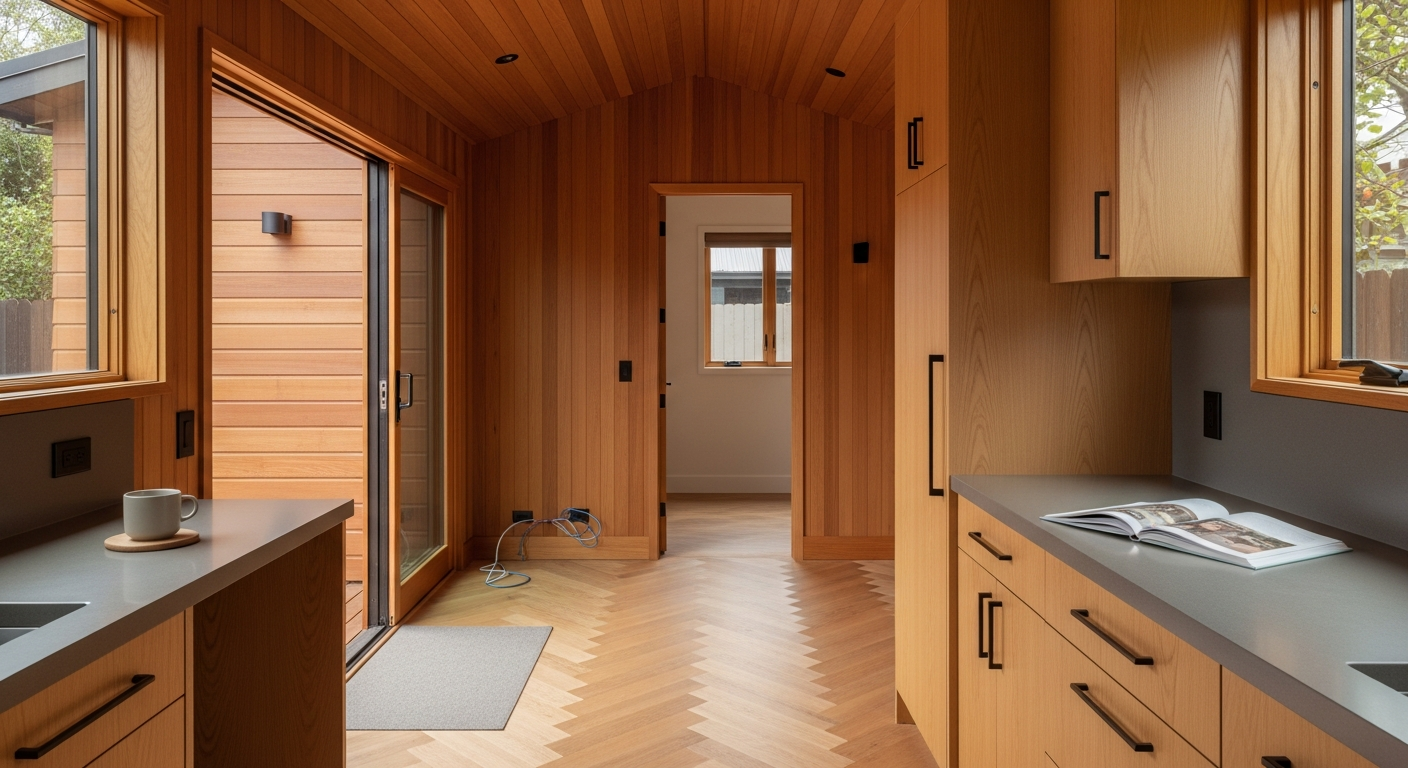
Warm, natural materials are in. The sterile all-white kitchen and bathroom look has given way to warm earthy tones, rift-cut white oak cabinetry, microcement floors, and hand-applied plaster walls. In our recent Los Gatos ADU, we used Dekton Kreta countertops paired with unlacquered brass hardware and zellige tile backsplash — the result is a space that feels like a boutique hotel, not a rental unit.
Cedar cladding and natural stone veneer are the exterior finishes of choice for detached ADUs that need to complement a main home while still having their own identity. We're seeing strong demand for board-and-batten cedar siding with a clear or semi-transparent stain, combined with standing-seam metal roofing in dark bronze or charcoal.
Other design trends we're building into ADUs right now include:
- Fluted details: Fluted cabinet fronts, fluted plaster range hoods, and fluted glass partitions add tactile depth to small spaces
- Integrated finger pulls: Eliminating visible hardware for a sleek, continuous look — especially effective in compact ADU kitchens where every inch matters
- Induction cooktops: Required in many new California builds due to electrification mandates, and preferred by clients who appreciate the precision and safety; Miele and Thermador induction units are our most-requested
- Herringbone wood floors: White oak in a herringbone pattern immediately elevates a small ADU, making it feel far more custom than standard plank flooring
- Plaster range hoods and organic shapes: Even in an ADU kitchenette, a sculptural plaster hood becomes a focal point
The key insight I share with every client: an ADU with thoughtful design and premium finishes generates significantly more rental income — or resale value — than a builder-grade box. Our project data shows that ADUs with curated, design-forward interiors in neighborhoods like Willow Glen, Downtown Los Gatos, and Old Mountain View command 15–25% higher rents than comparable units with standard finishes.
How to Start Building an ADU in Santa Clara County: A Step-by-Step Guide
Step 1: Property Feasibility Assessment (Week 1)
Before sketching a single line, we review your property's zoning designation, lot size, existing lot coverage, utility connections, tree survey, and any deed restrictions or HOA covenants. This 30-minute analysis eliminates surprises. For example, many properties in Los Altos and Saratoga have easements or heritage trees that dictate exactly where an ADU can — and cannot — go.
Step 2: Conceptual Design and 3D Renderings (Weeks 2–4)
Our in-house design team creates floor plans and photorealistic 3D renderings so you can see your ADU before a single permit is pulled. This is where we dial in the layout, finishes, and how the ADU relates to your main home and yard. Clients can walk through material selections — Cambria or Caesarstone quartz, Kohler or Brizo fixtures, tile profiles and wood species — with real samples alongside the digital model.
Step 3: Construction Documents and Engineering (Weeks 5–8)
We produce a complete permit set including architectural plans, structural engineering (seismic detailing per California Building Code), mechanical/electrical/plumbing plans, Title 24 energy compliance, and a stormwater management plan if required. On hillside lots in Los Gatos or Monte Sereno, a geotechnical (soils) report is typically required — we coordinate this early to avoid delays.
Step 4: Permit Submittal and Plan Check (Weeks 9–16)
We submit to your city's building department and manage all plan check correspondence. Permit approval in Santa Clara County currently takes 4–12 weeks. Our team handles all corrections and resubmittals — because we've permitted ADUs in most Santa Clara County cities, we know each jurisdiction's common comments and address them proactively.
Step 5: Construction (Weeks 17–34+)
Once permitted, construction begins with site prep and foundation. A typical detached ADU takes 4–7 months to build. We schedule inspections in sequence — foundation, framing, rough mechanical, insulation, drywall, final — and maintain a detailed client portal so you can track progress in real time.
Step 6: Final Inspections and Certificate of Occupancy (Week 35+)
After final city inspections, you receive a Certificate of Occupancy and your ADU is legally habitable. We conduct a thorough walkthrough, complete any punch-list items, and restore landscaping around the construction zone through our landscaping and exterior service.
Ready to explore what's possible on your property? Our team serves homeowners throughout Santa Clara County and the Peninsula — from San José to Palo Alto and everywhere in between.
Is an ADU a Good Investment in the Bay Area in 2026?
Here's the math on a typical scenario: a homeowner in Cupertino builds a 600 sq ft detached ADU for $300,000 all-in. The unit rents for $3,200 per month ($38,400 annually). That's a gross rental yield of approximately 12.8% — far exceeding most alternative investments. Meanwhile, an appraiser values the property $300,000–$350,000 higher, meaning the homeowner effectively breaks even on equity from day one while generating positive cash flow.
Several factors make 2026 an especially strong year to build an ADU in Silicon Valley:
- Rental demand remains intense: Santa Clara County's vacancy rate for studio and one-bedroom units remains below 4%, and tech sector employment continues to drive demand for well-located housing
- AB 1033 condo potential: If your city adopts the ADU-as-condo pathway, you could eventually sell the ADU separately — a game-changer for long-term investment strategy
- Impact fee waivers: Units under 750 sq ft are exempt from development impact fees, saving $10,000–$30,000
- No owner-occupancy requirement through 2029: You can rent both your main home and your ADU, giving maximum flexibility for relocation or Airbnb strategies (check your city's short-term rental rules)
The bottom line: whether you're building for rental income, family, a home office, or long-term property value, an ADU in Santa Clara County is a smart move in 2026. The key is building it right — with a design that maximizes livability per square foot and construction quality that passes the test of time. That's exactly what our team delivers through our ADU design-build service.
Frequently Asked Questions
How much does it cost to build an ADU in Santa Clara County in 2026?
A new ADU in Santa Clara County costs between $125,000 and $500,000+ in 2026, depending on the type and scope. Garage conversions typically run $125,000–$225,000, attached ADUs cost $200,000–$400,000, and detached ground-up ADUs range from $250,000–$500,000+. Based on data from our 116+ completed Bay Area projects at Barcci Builders, the average cost per square foot is $350–$650, with the median total cost for a 500 sq ft detached ADU coming in around $285,000 including design, permits, and construction.
What is the maximum ADU size allowed in Santa Clara County?
The maximum ADU size in Santa Clara County is 1,200 square feet for a detached ADU under California state law. Attached ADUs can be up to 800 square feet in some jurisdictions, though many cities in the county (including San José, Cupertino, and Sunnyvale) have adopted the 1,200 sq ft maximum for both attached and detached units. Junior ADUs (JADUs) are limited to 500 square feet and must be created within the existing footprint of the primary home.
Do I need a permit to build an ADU in Los Gatos, CA?
Can I build a detached ADU and a JADU on the same property in San José?
Yes. California state law allows you to build one ADU plus one Junior ADU (JADU) on a single-family residential lot. In San José, this means you could build a detached 1,200 sq ft ADU in your backyard and convert a portion of your primary home (up to 500 sq ft) into a JADU with a separate entrance, kitchenette, and bathroom. This is one of the most powerful strategies for maximizing rental income on a single-family lot in Silicon Valley.
How long does it take to get an ADU permit approved in Cupertino?
ADU permit approval in Cupertino currently takes approximately 4–8 weeks from initial submittal in 2026, assuming a complete and compliant plan set. Cupertino has adopted a streamlined ministerial approval process for ADUs, making it one of the faster jurisdictions in Santa Clara County. The most common reason for delays is an incomplete initial submittal — missing Title 24 energy calculations, incomplete structural details, or insufficient site drainage plans. Working with a design-build firm experienced in Cupertino's requirements can eliminate most resubmittal cycles.
Do I need to live on the property to build an ADU in Santa Clara County?
No. Under AB 976 (effective 2025), California has eliminated the owner-occupancy requirement for ADUs through at least 2029. This means you do not need to live on the property to build or rent out an ADU in any Santa Clara County city. You can rent both the primary home and the ADU to separate tenants, giving maximum flexibility for investors and homeowners who may relocate.
What is the ROI on building an ADU in the Bay Area?
Can I sell my ADU separately from my house in California in 2026?
Potentially yes, under AB 1033 (signed into law in 2023). This law allows individual cities to opt in to a program that permits ADUs to be sold as condominiums, separate from the primary residence. As of mid-2026, adoption varies by city. San José is among the earliest Santa Clara County cities exploring this pathway. Cities like Los Gatos and Saratoga have not yet opted in. If your city allows it, selling an ADU separately could be a significant financial opportunity — but the legal and HOA implications are complex, so consult a real estate attorney familiar with the program.