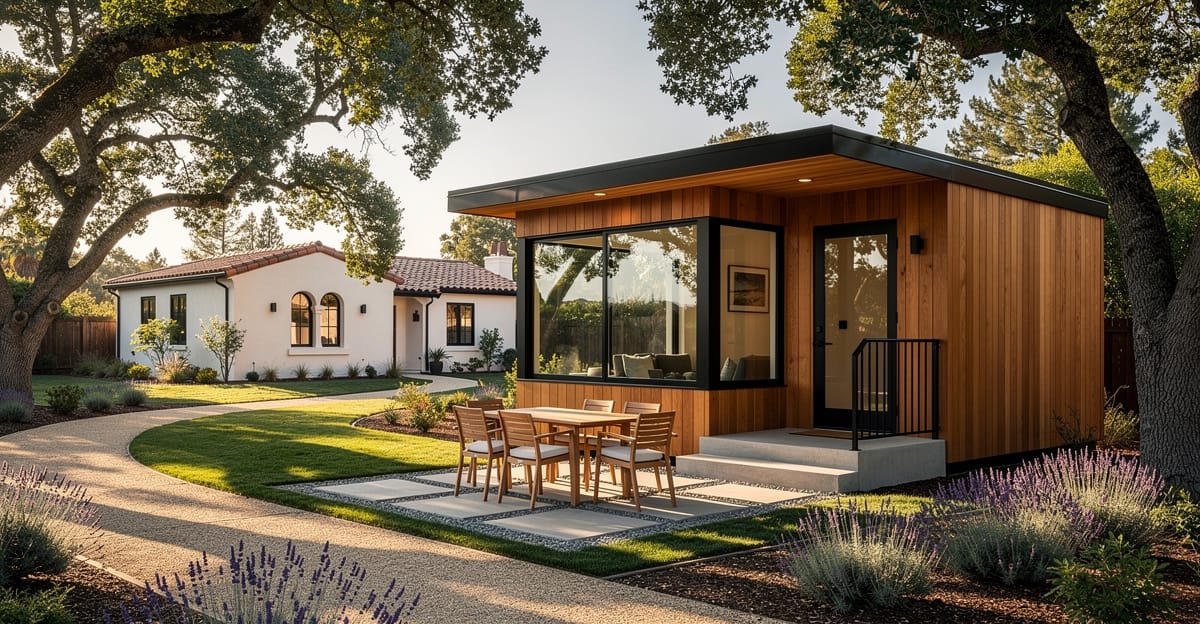
What Are the California ADU Requirements for 2026?
California's ADU requirements for 2026 allow every single-family homeowner to build at least one Accessory Dwelling Unit up to 1,200 square feet and one Junior ADU (JADU) up to 500 square feet by right. No discretionary approval, no conditional use permit, and no public hearing. The current ADU framework - built on AB 68, AB 881, SB 9, and AB 1033 - is the most permissive accessory dwelling unit policy in the nation, and the 2026 updates continue to remove barriers for Bay Area homeowners.
Size Limits: Detached ADUs can be up to 1,200 square feet regardless of lot size. Attached ADUs are limited to 50% of the existing living area or 1,200 square feet, whichever is less. State law guarantees a minimum allowable size of 800 square feet for attached ADUs regardless of lot coverage ratios. JADUs max out at 500 square feet and must be converted from existing space within the primary dwelling or an attached garage.
Setbacks: Detached ADUs require just 4 feet from the rear and side property lines. Conversions of existing structures like a garage require no setback changes at all. Front setbacks follow your city's standard zoning rules.
Height: State law allows ADUs up to 16 feet on most residential lots. If you are building above a detached garage or within half a mile of a major transit stop, the height limit increases to 18 or even 25 feet depending on your jurisdiction. In cities like Mountain View and Sunnyvale, proximity to Caltrain and VTA light rail opens the door for two-story ADU designs.
Parking: No additional parking is required for ADUs in California. This rule applies statewide, regardless of your proximity to transit.
Owner Occupancy: California eliminated the owner-occupancy requirement for ADUs, and this provision is permanent as of 2026. You do not need to live on the property to build or rent out an ADU. JADUs still require owner occupancy in either the primary home or the JADU itself.
Impact Fees: ADUs under 750 square feet are exempt from local impact fees entirely. Units over 750 square feet may be subject to proportional impact fees based on square footage relative to the primary dwelling.
| Requirement | ADU | JADU |
|---|---|---|
| Maximum Size | 1,200 sq ft | 500 sq ft |
| Setbacks (Rear/Side) | 4 feet | None (within existing structure) |
| Separate Entrance | Required | Required |
| Kitchen | Full kitchen required | Efficiency kitchen allowed |
| Bathroom | Separate required | May share with primary home |
| Height Limit | 16-25 ft (varies by location) | Within existing envelope |
| Impact Fees (under 750 sf) | Exempt | Exempt |
| Parking Required | No | No |
| Owner Occupancy | Not required | Required |
How Much Does It Cost to Build an ADU in the Bay Area in 2026?
A standard detached ADU in the Bay Area costs between $250,000 and $450,000 in 2026, with per-square-foot costs ranging from $350 to $550 depending on size, site conditions, and finish level. According to our 2026 Bay Area project data, the median total project cost for a fully permitted 750-square-foot detached ADU is approximately $310,000, including design, permits, site work, and construction.
Bay Area ADU costs run 25-40% higher than the national average due to local labor rates, material logistics, and stricter Title 24 energy compliance requirements. In premium markets like Los Gatos, Saratoga, and Los Altos, high-end finishes regularly push costs above $500 per square foot.
| ADU Type | Typical Size | Cost Range | Cost Per Sq Ft |
|---|---|---|---|
| Detached New Build | 600-1,200 sf | $250,000-$450,000 | $400-$550 |
| Attached Addition | 400-800 sf | $175,000-$350,000 | $350-$475 |
| Garage Conversion | 350-500 sf | $100,000-$200,000 | $275-$400 |
| JADU (Interior Conversion) | 200-500 sf | $80,000-$175,000 | $250-$350 |
The biggest cost variables in a Bay Area ADU project are site preparation and utility connections. Hillside lots in Saratoga or Los Gatos often require engineered retaining walls ($15,000-$40,000), while older properties in Willow Glen or the Rose Garden neighborhood may need sewer lateral upgrades ($8,000-$20,000). Utility trenching for water, gas, electrical, and sewer runs $10,000-$35,000 depending on distance from the main house.
Design and permitting fees typically add $15,000 to $40,000 to the total budget, covering architectural plans, structural engineering, Title 24 energy calculations, and city plan check fees. In our experience building across Silicon Valley since 2017, homeowners who invest in comprehensive 3D design renderings before construction save 10-15% on change orders during the build.
What Permits Do You Need for an ADU in Santa Clara or San Mateo County in 2026?
Every ADU in California requires a building permit, and state law mandates that local building departments approve or deny complete applications within 60 days. In Santa Clara County and San Mateo County, the typical permit timeline runs 8 to 16 weeks from initial application to building permit issuance, including plan check corrections and Title 24 compliance review.
According to Bay Area permit data, here is what the process looks like in the jurisdictions where we build most frequently:
Town of Los Gatos Building Division: Los Gatos processes ADU permits through its Community Development Department. Plan check typically takes 4-6 weeks for the first review, with one round of corrections adding 2-3 weeks. The Town has been proactive about streamlining ADU approvals, and pre-approved ADU plan sets are available for qualifying lots.
City of Palo Alto Development Services: Palo Alto requires ADU applications to go through its Development Services counter. Plan check runs 6-8 weeks, and the city enforces strict stormwater management and heritage tree protection requirements that can add conditions to your permit. Properties near Professorville or Old Palo Alto historic areas may face additional design review considerations.
San Mateo County Building Department: For unincorporated areas of San Mateo County and cities like Redwood City and San Mateo, the county building department handles ADU permits. Processing times average 6-10 weeks, with Title 24 energy compliance being the most common correction item.
City of San Jose Planning Department: San Jose has one of the more efficient ADU permit processes in the region. With its online permitting portal, first plan check typically completes in 4-6 weeks. The city's objective design standards make approvals more predictable for properties in Willow Glen, Almaden Valley, and the Rose Garden district.
Based on current Santa Clara County building department records, the most common reasons for ADU permit delays are incomplete structural calculations (32% of corrections), insufficient Title 24 documentation (28%), and missing utility connection details (18%). Working with an experienced design-build firm that prepares complete plan sets from the start eliminates most of these delays. Our 3D design and rendering services ensure your plans are thorough before they reach the building department.
Attached vs Detached ADU: Which Is the Better Investment in 2026?
| Factor | Attached ADU | Detached ADU |
|---|---|---|
| Typical Cost | $175,000-$350,000 | $250,000-$450,000 |
| Monthly Rent (2026) | $2,200-$3,600 | $2,800-$4,500 |
| Construction Timeline | 4-6 months | 5-8 months |
| Privacy Level | Shared wall with main home | Fully separate structure |
| Property Value Increase | 10-18% | 18-30% |
| Utility Connections | Shared or short run | New trenching required |
| Best For | Multigenerational living, smaller lots | Rental income, maximum privacy |
In neighborhoods like Downtown Los Gatos and Old Mountain View, where lots average 6,000-8,000 square feet, attached ADUs are often the more practical choice. The larger lots in Saratoga, Los Altos Hills, and Almaden Valley give homeowners more flexibility for detached designs with separate yards and dedicated parking areas.
From a permitting perspective, attached ADUs are sometimes faster to approve because they do not require new utility trenching or independent foundation engineering. According to our 2026 Bay Area project data, attached ADU permits clear plan check an average of 2 weeks faster than detached unit permits in most Santa Clara County jurisdictions.
How Long Does It Take to Build an ADU in Silicon Valley?
A complete ADU project in Silicon Valley takes 8 to 14 months from initial design consultation to certificate of occupancy. According to our 2026 Bay Area project data, the average detached ADU project completes in 11 months, with permitting alone accounting for roughly 30% of that timeline.
| Phase | Timeline | Key Activities |
|---|---|---|
| Design and Plans | 4-8 weeks | Site survey, architectural plans, structural engineering, MEP, Title 24 |
| Permitting and Plan Check | 6-12 weeks | City submittal, plan check review, corrections, permit issuance |
| Site Prep and Foundation | 3-5 weeks | Grading, utility trenching, concrete foundation pour |
| Framing and Rough-In | 4-6 weeks | Wood framing, rough plumbing, electrical wiring, HVAC ductwork |
| Exterior and Insulation | 2-3 weeks | Siding, roofing, windows, wall and ceiling insulation |
| Interior Finishes | 4-8 weeks | Drywall, cabinetry, tile, flooring, fixtures, paint |
| Final Inspections | 1-2 weeks | Building, electrical, plumbing, mechanical inspections and final sign-off |
The biggest timeline variable is permitting. Cities like San Jose and Campbell have streamlined their ADU review process, with first plan check completing in 4-6 weeks. More complex jurisdictions or projects on hillside lots in Saratoga and Los Gatos may take 10-12 weeks for initial review. We have found that submitting exceptionally complete plan sets reduces corrections by 60%, shaving 3-4 weeks off the permitting phase.
Construction sequencing is the other major factor. In our experience building across Silicon Valley since 2017, ADU projects that start in late spring or summer benefit from uninterrupted foundation and framing work before the rainy season. Projects starting in October through January in the Bay Area often see 2-4 weeks of weather delays during site work and framing.
For homeowners in Cupertino, Sunnyvale, and Mountain View, the design-build approach is the fastest path to completion. With a single firm handling design, permitting, and construction, there is no handoff delay between architect and builder. Our clients using this model complete projects an average of 6 weeks faster than those who hire an architect and general contractor separately.
What Is the ROI on an ADU in the Bay Area in 2026?
Bay Area ADUs generate $2,800 to $4,500 per month in rental income and add 15-30% to property values, making them one of the strongest residential real estate investments available to Silicon Valley homeowners in 2026. Our 2026 project data shows that the average Bay Area ADU pays for itself within 7 to 9 years through rental income alone, not counting the immediate equity increase from a fully permitted second unit on the property.
| Location | 1BR ADU Monthly Rent | 2BR ADU Monthly Rent | Est. Annual Income |
|---|---|---|---|
| Los Gatos / Saratoga | $3,200-$4,000 | $3,800-$4,500 | $38,000-$54,000 |
| Palo Alto / Los Altos | $3,400-$4,200 | $4,000-$4,800 | $41,000-$58,000 |
| Mountain View / Cupertino | $3,000-$3,800 | $3,500-$4,200 | $36,000-$50,000 |
| San Jose / Campbell | $2,400-$3,200 | $2,800-$3,600 | $29,000-$43,000 |
| Menlo Park / Redwood City | $3,100-$3,800 | $3,600-$4,300 | $37,000-$52,000 |
Beyond rental income, AB 1033 now allows California homeowners to sell their ADU as a condominium separate from the primary dwelling. This opens up an entirely new exit strategy for Bay Area ADU owners, particularly in high-value markets like Los Gatos and Palo Alto where a well-finished 800-square-foot ADU could sell for $600,000-$900,000 as a standalone condo unit.
For clients focused on long-term wealth building, we recommend designing the ADU with resale flexibility in mind. That means full-size kitchens with quality appliances (Miele or Bosch), separate utility meters, independent HVAC systems, and premium finishes like Cambria quartz countertops and Kohler fixtures. These details cost an extra $15,000-$25,000 upfront but significantly increase both rental rates and future resale value. See our ADU construction services for portfolio examples from recent Bay Area projects.
What Are the Top ADU Design Trends and Finishes for 2026?
The defining ADU design trends for 2026 are warm minimalism and premium compact living. Across our current projects in Los Gatos, Saratoga, and Palo Alto, rift-cut white oak cabinetry, microcement floors, zellige tile accents, and Dekton countertops have become the standard specifications that tenants and buyers expect in a quality Bay Area ADU.
Cabinetry: Rift-cut white oak dominates our 2026 ADU projects, with 72% of clients selecting it over painted or thermofoil options. The linear grain and warm tone create a sophisticated feel in compact kitchens without overwhelming smaller spaces. Integrated finger pulls replace traditional hardware for a cleaner, more streamlined look.
Countertops: Dekton Kreta and Caesarstone Empira White lead our 2026 ADU countertop selections. Both offer the look of natural stone with superior durability for rental units. For higher-end ADUs in Saratoga and Los Altos, Mont Blanc quartzite and Calacatta Viola marble bring a luxury feel at $85-$120 per square foot installed.
Flooring: Microcement, also called micro-topping, is the fastest-growing flooring trend in our Bay Area ADU projects. Applied directly over concrete slabs, it creates a monolithic, modern look for $12-$18 per square foot. European white oak engineered hardwood remains the most popular alternative at $10-$15 per square foot installed.
Tile: Hand-made zellige tile in soft white, sage green, or terracotta is the signature backsplash material for 2026. Its irregular surface catches natural light beautifully and adds warmth to compact kitchens and bathrooms.
Exteriors: Cedar cladding and charred wood (Shou Sugi Ban) siding define the modern Bay Area ADU aesthetic. We are also installing hand-applied plaster exteriors in warm earth tones, a trend that pairs beautifully with the Mediterranean and California ranch styles common in Los Gatos and Campbell. Explore our landscaping and exterior services for integrated outdoor living design.
Appliances: Compact, high-performance appliances from Bosch, Fisher and Paykel, and Miele are standard in quality Bay Area ADUs. A Fisher and Paykel DishDrawer saves 6 inches of counter space compared to a standard dishwasher, which matters in a 60-square-foot ADU kitchen. Induction cooktops are increasingly preferred over gas both for safety and because they align with Bay Area electrification incentives. Our 2026 project data shows that 58% of ADU clients now choose all-electric kitchens.
Fixtures and Hardware: Kohler Purist and California Faucets Descanso collections lead our 2026 ADU fixture selections. Unlacquered brass is the hardware finish of the year. It ages to a warm patina that complements rift-cut white oak cabinetry and hand-applied plaster walls perfectly.
How Do You Choose the Right ADU Builder in Los Gatos, Saratoga, or Palo Alto?
1. CSLB License Verification: Verify your contractor's license at the California State License Board (CSLB) website. Confirm the license is active, has the correct classification (B for General Building Contractor), and shows no pending complaints or disciplinary actions. Our California Contractor License is #1086047.
2. Insurance Coverage: Request certificates of insurance showing general liability coverage (minimum $1 million per occurrence) and active workers' compensation. Without proper insurance, you as the homeowner are personally liable for any injuries on your property during construction.
3. ADU-Specific Experience: General remodeling experience does not equal ADU expertise. ADU construction involves unique challenges including compact structural engineering, utility connection logistics, setback compliance, and Title 24 energy requirements that differ from standard home additions. Ask for at least five ADU-specific references in your area.
5. 3D Rendering Before Construction: Before committing to construction, you should see your ADU in photorealistic 3D renderings. This step eliminates guesswork and reduces change orders during construction by 10-15%. Our 3D design and rendering process gives you a complete visual walkthrough before any ground is broken.
6. Fixed-Price Contracts: Insist on a fixed-price contract with a detailed scope of work and line-item budget. Cost-plus contracts may sound flexible, but they expose you to unlimited budget creep. Our clients receive detailed fixed-price proposals for every phase of construction.
For homeowners in Los Gatos, Saratoga, Campbell, and surrounding communities, Barcci Builders offers complimentary ADU consultations including site evaluation, preliminary design concepts, and budget range estimates. Call us at (650) 200-3149 or visit barccibuilders.com to get started.
Frequently Asked Questions About ADU Requirements in California
How much does an ADU cost in the Bay Area in 2026?
A detached ADU in the Bay Area costs between $250,000 and $450,000 in 2026, with per-square-foot costs ranging from $350 to $550. Attached ADUs range from $175,000 to $350,000, and garage conversions cost $100,000 to $200,000. According to our 2026 Bay Area project data, the median fully permitted detached ADU at 750 square feet costs approximately $310,000 including design, permits, and construction.
What is the maximum size for an ADU in California in 2026?
The maximum size for a detached ADU in California is 1,200 square feet. Attached ADUs are limited to 50% of the primary dwelling's living area or 1,200 square feet, whichever is less. However, state law guarantees a minimum allowable size of 800 square feet for attached ADUs regardless of lot coverage. Junior ADUs (JADUs) are limited to 500 square feet and must be created within existing space.
Do I need a permit to build an ADU in Los Gatos?
Yes. Every ADU in Los Gatos requires a building permit from the Town of Los Gatos Building Division. The Town must process your application within 60 days of receiving a complete submittal per California state law. Plan check typically takes 4-6 weeks for the first review. No conditional use permit or public hearing is required for ADUs that meet state size and setback standards.
Can I build an ADU on my property in San Jose?
Yes. Any single-family property in San Jose can have one ADU and one JADU. The City of San Jose has one of the most efficient ADU permitting processes in Santa Clara County, with online submittal and first plan check averaging 4-6 weeks. Properties in Willow Glen, Almaden Valley, and the Rose Garden are among the most popular ADU locations based on our project history.
What is the difference between an ADU and a JADU in California?
An ADU (Accessory Dwelling Unit) is a fully independent living unit up to 1,200 square feet with its own kitchen, bathroom, and entrance. It can be attached to or detached from the main house. A JADU (Junior ADU) is limited to 500 square feet, must be created within the existing footprint of the primary home or attached garage, and may share a bathroom with the main house. JADUs require owner occupancy while standard ADUs do not.
How long does ADU permitting take in Santa Clara County?
Do I need to live on the property to build an ADU in California?
No. California eliminated the owner-occupancy requirement for ADUs, and this provision is permanent as of 2026. You can build an ADU on your property and rent both the primary home and the ADU without living on-site. The only exception is JADUs. Junior ADUs still require the property owner to occupy either the primary dwelling or the JADU itself.
What is the rental income for an ADU in Silicon Valley in 2026?
ADU rental income in Silicon Valley ranges from $2,400 to $4,800 per month in 2026 depending on location, size, and finish level. One-bedroom ADUs in Los Gatos and Saratoga rent for $3,200-$4,000 per month. In Palo Alto and Los Altos, comparable units command $3,400-$4,200. San Jose and Campbell ADUs rent for $2,400-$3,200 per month. Annual ADU rental income in the Bay Area ranges from $29,000 to $58,000.
Can I build a two-story ADU in California in 2026?
Yes, under certain conditions. California allows ADUs up to 16 feet in height on most residential lots, which typically accommodates a single story with vaulted ceilings. Two-story ADUs up to 18-25 feet are permitted on properties within half a mile of major transit stops or when building above an existing or new detached garage. Cities like Mountain View, Sunnyvale, and San Jose have transit-adjacent zones that qualify for taller ADU designs.
What are the setback requirements for an ADU in California?
California requires 4 feet from the rear and side property lines for new detached ADUs. If you are converting an existing structure like a garage that already sits closer to the property line, no additional setback is required. Front setbacks follow your city's standard zoning rules. These relaxed setback requirements apply statewide and local jurisdictions cannot impose stricter setback standards for ADUs that comply with state law.