How Much Rental Income Does a Bay Area ADU Generate in 2026?
These numbers make ADUs one of the most compelling real estate investments available to Bay Area homeowners right now. Unlike a stock portfolio or a rental property across town, an ADU sits on land you already own, requires no additional mortgage qualification (though construction financing is available), and benefits from some of the highest rent-per-square-foot rates in the country.
How Much Rent Can You Charge for an ADU in Los Gatos, Saratoga, and Other Bay Area Cities?
| City / Area | Studio / 1-Bed ADU (400–600 sq ft) | 2-Bed ADU (600–1,000 sq ft) | Furnished / Corporate Rate |
|---|---|---|---|
| Los Gatos | $2,800–$3,400/mo | $3,600–$4,500/mo | $4,200–$5,500/mo |
| Saratoga | $2,900–$3,500/mo | $3,800–$4,800/mo | $4,500–$5,800/mo |
| Los Altos | $2,800–$3,400/mo | $3,600–$4,600/mo | $4,300–$5,600/mo |
| Palo Alto | $3,000–$3,600/mo | $3,800–$5,000/mo | $4,800–$6,200/mo |
| Cupertino | $2,600–$3,200/mo | $3,400–$4,200/mo | $4,000–$5,200/mo |
| Mountain View | $2,600–$3,200/mo | $3,200–$4,200/mo | $3,800–$5,000/mo |
| Menlo Park | $2,800–$3,400/mo | $3,600–$4,600/mo | $4,400–$5,500/mo |
| Campbell | $2,400–$3,000/mo | $3,000–$3,800/mo | $3,600–$4,600/mo |
| San Jose (avg) | $2,200–$2,800/mo | $2,800–$3,600/mo | $3,200–$4,200/mo |
| Sunnyvale | $2,500–$3,100/mo | $3,200–$4,000/mo | $3,800–$5,000/mo |
A few patterns stand out. Cities in the Los Gatos Union School District and Los Altos consistently command premium rents because tenants — often young professionals and tech workers — are willing to pay more for access to top-rated schools, walkable downtowns, and proximity to Apple, Google, and Netflix campuses. In Cupertino, demand from Apple employees alone keeps ADU vacancy rates near zero.
The furnished and corporate housing column is especially important. Many of our clients in Menlo Park and Palo Alto furnish their ADUs with mid-century modern or contemporary furniture and list them on platforms like Furnished Finder or Zeus Living at 30–50% premiums over unfurnished rates. A 650-square-foot one-bedroom ADU in Professorville that might rent unfurnished for $3,400/month can command $5,000/month furnished to a visiting Stanford researcher or Meta contractor.
What Is the ROI on Building an ADU in Silicon Valley?
The return on investment for a Silicon Valley ADU typically ranges from 8% to 14% annually when measured by rental income alone, with most homeowners recouping their full construction investment within 7 to 12 years. But rental income is only part of the story — ADUs also increase your property's appraised value by $150,000 to $350,000+ in most Bay Area cities, meaning your net ROI is often realized much faster if you sell.
Here's how the math works on a real project. In 2024, our team completed a 750-square-foot detached ADU in Campbell for approximately $285,000 all-in (design, permits, construction, landscaping). The homeowner rents it for $3,400 per month unfurnished — $40,800 per year in gross rental income. After property management software ($50/month), insurance ($1,200/year), maintenance reserve ($2,400/year), and increased property taxes (~$3,000/year), net income is approximately $33,600 per year. That's an 11.8% cash-on-cash return — significantly better than most stock market or real estate alternatives.
Here's a comparison of ADU ROI across different construction budgets.
| ADU Type | Typical Size | Construction Cost (2026) | Monthly Rent (Avg) | Annual Net Income (Est.) | Cash-on-Cash ROI | Payback Period |
|---|---|---|---|---|---|---|
| Garage Conversion | 400–500 sq ft | $150,000–$220,000 | $2,400–$3,000 | $22,000–$28,000 | 12–15% | 6–9 years |
| Detached Studio/1-Bed | 500–750 sq ft | $250,000–$375,000 | $3,000–$3,800 | $28,000–$36,000 | 8–12% | 8–12 years |
| Detached 2-Bed | 750–1,200 sq ft | $350,000–$500,000 | $3,600–$4,800 | $34,000–$46,000 | 8–11% | 9–13 years |
| Junior ADU (JADU) | 200–500 sq ft | $80,000–$150,000 | $1,800–$2,600 | $16,000–$24,000 | 14–20% | 4–7 years |
Junior ADUs (JADUs) stand out for their ROI efficiency. Because they're carved from existing living space — typically converting a bedroom with a separate entrance and kitchenette — construction costs are dramatically lower. We've completed JADUs in Sunnyvale and Mountain View for under $120,000 that rent for $2,200–$2,600 per month. The trade-off is that you're reducing your primary home's square footage, which isn't ideal for every family.
How Much Does It Cost to Build an ADU in the Bay Area in 2026?
These costs include design, engineering, permits, site work, utilities, construction, and basic landscaping. Here's what drives the price up or down.
Factors That Increase ADU Construction Costs
- Sloped lots: Hillside properties in Los Gatos, Saratoga, and Woodside often require retaining walls, engineered foundations, and specialized grading — adding $30,000–$80,000.
- Utility connections: Running new sewer, water, and electrical lines from the street can cost $15,000–$50,000 depending on distance and whether you need to trench through hardscape or landscaping.
- Premium finishes: Clients who want the ADU to match their main home's aesthetic — think rift-cut white oak flooring, Caesarstone or Dekton countertops, Thermador or Bosch appliances, zellige tile backsplash, and unlacquered brass hardware — should budget 15–25% above standard finishes.
- Seismic and fire requirements: Properties in Wildland-Urban Interface zones (common in the Los Gatos hills and Saratoga foothills) face additional fire-rated construction requirements that can add $10,000–$25,000.
- Two-story ADUs: Going vertical to maximize a small footprint adds structural engineering costs — typically $20,000–$40,000 more than single-story.
Factors That Reduce ADU Construction Costs
- Garage conversions: Using an existing structure as your shell saves on foundation, framing, and roofing — often cutting total costs by 30–40%.
- Simple rectangular footprints: Complex L-shapes and architectural roof lines look beautiful but cost more per square foot than a clean rectangle.
- Flat, accessible lots: Properties in Santa Clara, Campbell, and Sunnyvale's flat neighborhoods have the lowest site preparation costs.
- Shared utility connections: If your main home's sewer line runs close to the ADU site, connection costs drop significantly.
One thing I always tell prospective ADU clients: don't over-engineer the finishes beyond what the rental market demands. A beautifully designed ADU with quality but not ultra-luxury materials — quartz counters instead of Calacatta Viola marble, engineered hardwood instead of solid rift-cut oak — will rent for 95% of the price at 70% of the finish cost. Save the Calacatta for your main home's kitchen remodel.
How Long Does It Take to Build an ADU in the Bay Area and Start Earning Rent?
Permit timelines are the most variable and frustrating part of the process. California's AB 68 and SB 9 legislation requires cities to approve ADU permits within 60 days of a complete application, but "complete" is the operative word. Many jurisdictions issue correction letters that reset the clock. In our experience, here's how permit timelines break down by municipality.
- Los Gatos: 6–10 weeks for plan check. The Town of Los Gatos planning department is thorough but fair. Design review is not required for ADUs that meet objective standards.
- Saratoga: 6–8 weeks. Generally efficient, but hillside properties trigger additional geotechnical review.
- Palo Alto: 8–12 weeks. Higher volume of applications means longer queues. Their online portal has improved but still requires patience.
- San Jose: 4–8 weeks. The city has streamlined ADU permitting significantly since 2023, and their pre-approved ADU plan program can cut 2–3 weeks off the timeline.
- Cupertino: 6–8 weeks. Straightforward process for standard lots.
- Mountain View: 5–8 weeks. The city is ADU-friendly and has clear objective design standards.
Construction timelines depend heavily on the ADU type. A garage conversion can be completed in 3–4 months. A ground-up detached ADU with a concrete foundation, full framing, and separate utility connections typically takes 5–7 months. Our team uses 3D design renderings to finalize every detail before breaking ground, which eliminates the change orders and mid-build redesigns that derail timelines on other projects.
Here's my honest advice on timing: if you start design today, plan on collecting your first rent check in approximately 10–12 months. Factor that into your financial projections. Every month of delay is $3,000–$5,000 in lost rental income, which is why working with an experienced design-build firm that handles design, permitting, and construction under one roof is worth the investment.
Bay Area ADU Design Trends That Maximize Rental Income in 2026
The ADUs commanding the highest rents in 2026 share a common thread: they feel like intentionally designed small homes, not afterthought apartments. Based on what we're building and what tenants are willing to pay premiums for, here are the design choices that directly impact your ADU rental income in the Bay Area.
Layout and Floor Plan
- Open-concept living/kitchen: In a 500–750 sq ft space, an open plan makes the unit feel significantly larger. We typically design an L-shaped kitchen that flows into a living/dining area with 9-foot ceilings.
- In-unit washer/dryer: This is non-negotiable for premium rents. A compact ventless heat-pump dryer (Bosch or Miele 24") and matching washer fit in a closet and add $200–$400/month in perceived value.
- Private outdoor space: Even a small 80-square-foot patio or deck with thoughtful landscaping — a Japanese maple, decomposed granite, and a built-in bench — can justify $150–$300/month in additional rent.
- Dedicated bedroom: Studios rent, but one-bedrooms rent faster and for more money. If your lot allows 600+ sq ft, always include a separate bedroom with a closet.
Finishes That Tenants Pay More For
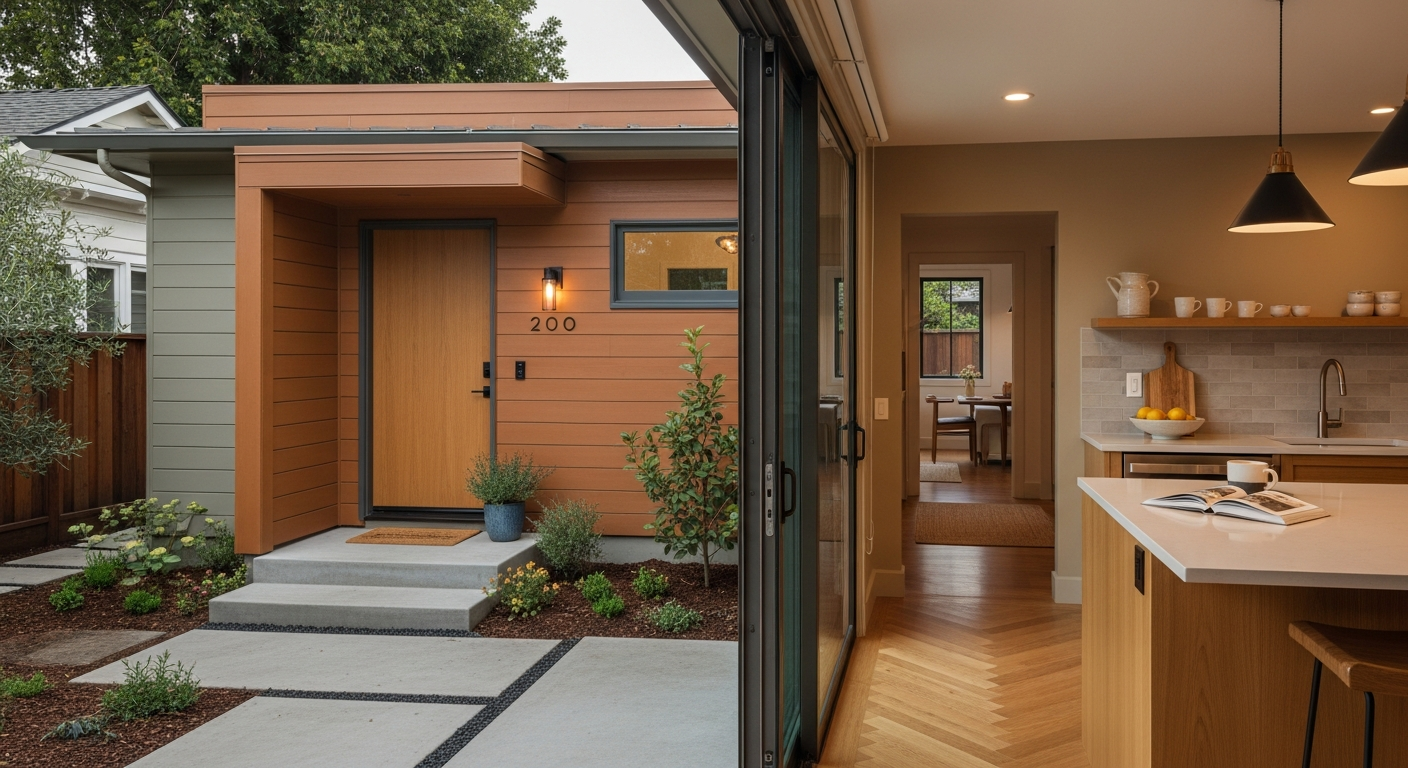
- Warm wood tones: Engineered white oak or European oak flooring in a herringbone or wide-plank pattern creates warmth that photographs beautifully and feels high-end. This is the single most impactful finish upgrade in an ADU.
- Fluted details: Fluted wood or plaster paneling on a kitchen island or bathroom vanity adds texture and visual interest at a modest cost.
- Zellige tile: Handmade zellige tile in a kitchen backsplash or shower niche adds artisanal character. It costs $15–$30/sq ft installed — a small premium over standard subway tile that elevates the entire space.
- Warm earthy tones: The sterile all-white aesthetic is over. Bay Area renters in 2026 respond to warm plaster walls in mushroom or greige tones, matte black or unlacquered brass fixtures, and natural material palettes.
- Induction cooktop: Increasingly required by new California building code and preferred by tenants. A 30" Bosch or Fisher & Paykel induction cooktop is efficient, safe, and modern.
Exterior Design That Adds Curb Appeal
- Cedar cladding or Shou Sugi Ban siding: Natural wood exteriors age beautifully and distinguish your ADU from generic stucco boxes.
- Natural stone veneer accents: A stone feature wall at the entry creates an immediate impression of quality.
- Standing seam metal roofing: Durable, modern, and attractive — a step above composition shingle at a reasonable cost premium.
- Integrated finger-pull cabinetry: Eliminating visible hardware throughout the kitchen and bath creates the clean, modern aesthetic Bay Area tenants expect.
Every design decision in an ADU should balance aesthetics, durability, and rental ROI. Our ADU design-build process starts with a market analysis of comparable rentals in your specific neighborhood so we can make data-informed decisions about where to invest in finishes and where to save.
California ADU Laws in 2026: What Bay Area Homeowners Need to Know
California's ADU regulations have become increasingly homeowner-friendly, and 2026 brings continued momentum. Here are the rules that directly impact your ability to build and earn rental income from an ADU in Santa Clara County and San Mateo County.
Key California ADU Regulations for 2026
- No owner-occupancy requirement: Thanks to AB 1033 and subsequent legislation, most California cities cannot require you to live on the property to rent out your ADU. This means you can rent both your primary home and your ADU — or live in the ADU and rent the main house.
- ADU sales (AB 1033): As of 2024, California allows cities to opt in to programs that let homeowners sell ADUs as separate condominiums. While adoption has been slow in the Bay Area, this is a game-changer for long-term ROI — potentially allowing you to sell a $350,000 ADU investment for $600,000+ as a standalone unit.
- No parking requirements: If your property is within half a mile of public transit (which covers most of Sunnyvale, Mountain View, Palo Alto, and San Jose), no additional parking is required for the ADU.
- Setback minimums: Side and rear setbacks are limited to 4 feet for ADUs, regardless of local zoning — a significant expansion of buildable area on most lots.
- No impact fees for ADUs under 750 sq ft: This saves homeowners $10,000–$30,000 in cities like San Jose and Palo Alto that charge school impact fees and park fees on larger units.
- Two ADUs allowed (SB 9 + ADU law): On qualifying single-family lots, you may be able to build both a JADU and a detached ADU, creating two additional income streams. Our team has completed several of these dual-unit projects in San Jose and Campbell.
Permit Requirements by County
Santa Clara County Planning and San Mateo County Building Department each have specific requirements for ADU applications. Both require a full set of construction drawings (architectural, structural, mechanical, electrical, plumbing), Title 24 energy compliance documentation, and a site plan showing setbacks, utility connections, and drainage. In our experience, working with a design-build contractor who prepares permit-ready drawings in-house — rather than a separate architect and builder — reduces the back-and-forth that leads to plan check corrections and delays.
One critical note on short-term rentals: most Bay Area cities restrict or prohibit Airbnb-style stays of fewer than 30 days in ADUs. Los Gatos, Palo Alto, Mountain View, and Saratoga all have short-term rental ordinances that effectively limit ADUs to monthly or longer leases. Before factoring Airbnb income into your projections, verify your city's current short-term rental policy.
Frequently Asked Questions
How much rental income can I make from an ADU in Los Gatos?
A Los Gatos ADU generates $2,800–$4,500 per month unfurnished in 2026, depending on size and configuration. A well-designed one-bedroom ADU of 600–750 square feet typically rents for $3,200–$3,800/month, while a furnished unit targeting corporate tenants can command $4,200–$5,500/month. Based on our completed projects in the Los Gatos area, annual gross rental income ranges from $33,600 to $54,000. Net income after expenses (insurance, maintenance reserve, property tax increase) is typically 75–85% of gross.
How much does it cost to build an ADU in the Bay Area in 2026?
What is the ROI on an ADU in Silicon Valley?
The cash-on-cash return on investment for a Silicon Valley ADU ranges from 8% to 14% annually based on rental income, with most homeowners recouping their full construction investment within 7 to 12 years. Garage conversions and JADUs offer the fastest payback at 4–9 years due to lower construction costs. Beyond rental income, ADUs typically increase Bay Area property values by $150,000–$350,000, meaning your total ROI (income + appreciation) often exceeds 15–20% annually in the first several years.
How long does it take to build an ADU in Santa Clara County?
From initial design to tenant move-in, an ADU project in Santa Clara County takes 8 to 14 months in 2026. This includes 6–10 weeks for design and engineering, 4–8 weeks for permit approval through Santa Clara County Planning or your city's building department, and 4–7 months for construction. Garage conversions are fastest at 3–4 months of construction time. Detached new-build ADUs typically require 5–7 months of construction. Working with a design-build firm that handles all phases under one contract can save 4–8 weeks compared to hiring a separate architect and contractor.
Do I need to live on my property to rent out an ADU in California?
No. As of 2025, California law prohibits most cities from requiring owner-occupancy as a condition of building or renting an ADU. This means you can rent out both your primary home and your ADU, or live in the ADU and rent the main house. This applies to ADUs permitted after January 1, 2020 in most jurisdictions. However, Junior ADUs (JADUs) do still require owner-occupancy of either the JADU or the primary residence. Always verify your specific city's ordinance, as some local rules may differ on JADUs.
Can I Airbnb my ADU in the Bay Area?
Most Bay Area cities restrict or prohibit short-term rentals (stays under 30 days) in ADUs. Los Gatos, Palo Alto, Saratoga, Mountain View, Cupertino, and Menlo Park all have short-term rental ordinances that effectively limit ADUs to monthly or longer lease terms. San Jose allows short-term rentals in ADUs with a permit and a 180-night annual cap in some zones. Before building an ADU with Airbnb income in mind, check your city's current short-term rental policy. Many of our clients find that 30-day minimum furnished rentals on platforms like Furnished Finder offer a strong middle ground — higher rents than annual leases without violating local ordinances.
What size ADU should I build to maximize rental income in the Bay Area?
Does building an ADU increase my property value in the Bay Area?
Yes. A well-built ADU increases Bay Area property values by $150,000 to $350,000+ in 2026, according to local appraisal data and our experience with clients who have sold or refinanced after ADU construction. The exact value increase depends on location, ADU quality, and rental income. Appraisers in Santa Clara County and San Mateo County increasingly use the income approach (valuing the ADU based on its rental income stream) in addition to comparable sales. A permitted ADU generating $40,000+ in annual rental income can justify $300,000+ in added property value at prevailing cap rates. California's AB 1033 may further increase ADU resale value by enabling separate ADU sales in cities that opt into the program.