ADU in Menlo Park 2026: What Homeowners Need to Know First
Building an ADU in Menlo Park in 2026 costs between $280,000 and $520,000 for a detached unit, depending on size, finishes, and site conditions. Garage conversions start lower - typically $180,000 to $280,000 - making them the most popular entry point for Menlo Park homeowners.
Menlo Park sits in San Mateo County, which means your ADU permit flows through the City of Menlo Park Building and Planning Department rather than Santa Clara County. That distinction matters - San Mateo County jurisdictions have their own fee schedules, design review thresholds, and processing timelines that differ meaningfully from what you might read in guides focused on Los Gatos, Saratoga, or Cupertino.
Based on our 116+ completed ADU and remodeling projects across the Bay Area, Menlo Park has some of the strongest ADU economics in the region. Median rents for a well-finished 1-bedroom ADU in Menlo Park run $3,200 to $4,400 per month in 2026, driven by proximity to Stanford, Sand Hill Road, and the downtown Caltrain corridor. That income profile gives most Menlo Park ADUs a 6-to-9-year payback period before the unit starts generating pure profit.
This guide covers everything: current permit rules, real cost ranges by ADU type, San Mateo County-specific requirements, 2026 design trends, and the questions I get most often from Menlo Park homeowners we've worked with.
ADU Types Allowed in Menlo Park 2026: Detached, Attached, Garage Conversion, and JADU
Menlo Park allows all four California-standard ADU types - detached, attached, garage conversion, and JADU (Junior ADU) - subject to state law minimums and local design standards.
Here's a breakdown of each type with 2026 Menlo Park-specific notes:
| ADU Type | Max Size (State Law) | Typical Menlo Park Size | 2026 Cost Range | Best For |
|---|---|---|---|---|
| Detached ADU | 1,200 sq ft | 600-1,000 sq ft | $280,000 - $520,000 | Rental income, guest house, multigenerational |
| Attached ADU | 50% of primary home or 1,200 sq ft | 400-800 sq ft | $220,000 - $420,000 | Aging parents, adult children |
| Garage Conversion | Up to existing garage footprint | 400-600 sq ft | $180,000 - $280,000 | Budget-conscious, fastest to permit |
| JADU | 500 sq ft | 300-500 sq ft | $80,000 - $160,000 | Attached within existing home, low cost |
Menlo Park follows California AB 68 and SB 9 provisions, which means the city cannot deny a by-right ADU application solely on zoning grounds in most single-family and multi-family zones. However, the city's Residential Design Guidelines still apply to new detached structures - meaning your ADU's exterior materials, window placement, and roofline should complement the primary residence.
One thing I tell every Menlo Park client: the city's design review staff pays close attention to massing and neighbor privacy screening. A well-prepared set of drawings that addresses privacy fencing, window placement relative to adjacent lots, and material compatibility will move through plan check significantly faster than a generic plan set.
ADU Cost in Menlo Park 2026: Real Numbers by Project Type
ADU construction costs in Menlo Park in 2026 run $450 to $620 per square foot for a turnkey detached unit with mid-to-high finishes - higher than the broader Bay Area average due to San Mateo County labor markets and Menlo Park's own permit fee structure.
Our 2026 project data shows the most common Menlo Park ADU request is a 700-to-850 square foot, 1-bedroom/1-bath detached unit aimed at rental. At that size and finish level, all-in budgets typically land between $340,000 and $470,000.
| Cost Category | Garage Conversion (450 sq ft) | Detached 1BR (700 sq ft) | Detached 2BR (1,000 sq ft) |
|---|---|---|---|
| Design + Engineering | $12,000 - $22,000 | $22,000 - $38,000 | $32,000 - $52,000 |
| Menlo Park Permit Fees | $8,000 - $16,000 | $18,000 - $32,000 | $26,000 - $44,000 |
| Site Work + Foundation | $0 - $25,000 | $30,000 - $70,000 | $45,000 - $90,000 |
| Framing + Structure | $20,000 - $40,000 | $60,000 - $100,000 | $90,000 - $140,000 |
| MEP (Mechanical/Electrical/Plumbing) | $30,000 - $55,000 | $55,000 - $85,000 | $75,000 - $110,000 |
| Finishes (cabinets, tile, fixtures) | $35,000 - $65,000 | $65,000 - $110,000 | $90,000 - $150,000 |
| Landscaping + Hardscape Repair | $8,000 - $20,000 | $15,000 - $35,000 | $20,000 - $45,000 |
| Total (Typical Range) | $180,000 - $280,000 | $300,000 - $440,000 | $410,000 - $580,000 |
A few cost drivers that are specific to Menlo Park and deserve special attention:
Utility connection fees. The City of Menlo Park charges a school impact fee on new ADUs (currently approximately $3.79 per square foot for residential) and a transportation impact fee. These add $4,000 to $12,000 to projects that might not face similar fees in Santa Clara County cities.
Soil conditions. Parts of Menlo Park - particularly west of El Camino Real near the Flood neighborhood and areas adjacent to San Francisquito Creek - sit on expansive clay soils. A soils report and engineered slab can add $15,000 to $35,000 to foundation costs versus a standard lot.
Old utility infrastructure. Many Menlo Park homes were built in the 1940s through 1960s. Electrical panels are often 100-amp and insufficient for a new ADU without an upgrade - budget $8,000 to $18,000 for a panel upgrade if your home has an older service.
Menlo Park ADU Permit Process 2026: Step-by-Step Through San Mateo County
The Menlo Park ADU permit process takes 4 to 9 months from first submission to permit issuance in 2026, with the wide range driven by project complexity, completeness of your initial submittal, and whether your plans trigger design review.
Step 1: Pre-Application Research (2-4 weeks). Pull your parcel data from the City of Menlo Park's online GIS portal. Confirm your zoning district, lot size, existing structure square footage, and any deed restrictions or HOA covenants. Menlo Park's R-1 zones allow ADUs on lots as small as 5,000 square feet under state law - but your specific lot dimensions affect placement options.
Step 2: Design and Engineering (6-12 weeks). Work with a licensed architect or design-build firm to produce a complete plan set. For Menlo Park, this means architectural drawings, a site plan showing setbacks and lot coverage, Title 24 energy compliance documentation, and structural calculations if you're building a new foundation. Menlo Park's Building Division offers a pre-application meeting - I strongly recommend booking one before submitting. It catches issues early and demonstrates good faith to the plan checker.
Step 3: Permit Application Submission. Submit online through the City of Menlo Park's permitting portal (currently eTRAKiT). For by-right ADUs (which meet all state law criteria), the city is required to approve or deny within 60 days of a complete application. If your plans require any discretionary review, that timeline extends.
Step 4: Plan Check and Corrections (4-14 weeks). First-round plan check comments typically take 3-6 weeks. The most common correction items in Menlo Park involve: egress window sizing, Title 24 compliance, fire sprinkler requirements (required for new detached ADUs over 750 sq ft per Menlo Park local amendments), and utility service documentation.
Step 5: Permit Issuance and Construction. Once approved, your contractor pulls the building permit. Inspections occur at framing, rough MEP, insulation, and final. Menlo Park's inspectors are generally responsive - scheduling windows are usually 1-3 business days in 2026.
Step 6: Certificate of Occupancy. After passing final inspection, the city issues a Certificate of Occupancy. You'll also need to update your property's record with San Mateo County Assessor to reflect the new ADU square footage.
"The single biggest mistake I see Menlo Park homeowners make is submitting an incomplete set of plans to save money on design fees. A plan check rejection adds 6 to 12 weeks to your timeline and usually costs more in holding costs than the design savings were worth. Do it right the first time." - Bar Benbenisty, Owner, Barcci Builders
ADU Setbacks, Height, and Lot Coverage Rules in Menlo Park
In Menlo Park in 2026, detached ADUs must maintain a 4-foot minimum setback from rear and side property lines under California state law - the city cannot require more. Height limits for detached ADUs are capped at 16 feet for single-story and up to 24 feet with two stories in most residential zones.
Here are the key dimensional standards for Menlo Park ADUs in 2026:
Rear setback: 4 feet minimum (state law floor; Menlo Park cannot impose more for standard ADUs).
Side setback: 4 feet minimum. Corner lots have additional street-facing setback requirements that vary by zone.
Height: 16 feet for a detached ADU within 4 feet of the property line. If your ADU is set back further from the property line, you may be able to build taller subject to standard zoning height limits for the zone.
Lot coverage: Menlo Park's standard R-1 lot coverage limits still apply to the aggregate of all structures on the lot. However, state law provides that an ADU of up to 800 square feet cannot be denied solely because it exceeds local lot coverage standards - a significant protection for smaller lots.
Owner occupancy: California eliminated owner-occupancy requirements for ADUs through 2025. As of 2026, Menlo Park cannot require you to live on-site as a condition of building an ADU. This makes ADUs viable for investment-focused homeowners as well.
Parking: No replacement parking is required when you convert an existing garage to an ADU - even if you lose the garage spaces. This is a state law protection that Menlo Park must follow.
One nuance worth flagging: Menlo Park has a design overlay district covering parts of the city near the downtown core and El Camino Real corridor. If your property falls in one of these overlays, you may face additional design compatibility review. Check your parcel's overlay status before finalizing your design.
ADU Design Trends in Menlo Park 2026: What Builds Strong Rental Appeal and Resale Value
The most sought-after ADU finishes in Menlo Park in 2026 are those that blur the line between a rental unit and a luxury guest house - because that positioning commands top rents and attracts the most reliable tenants in this market.
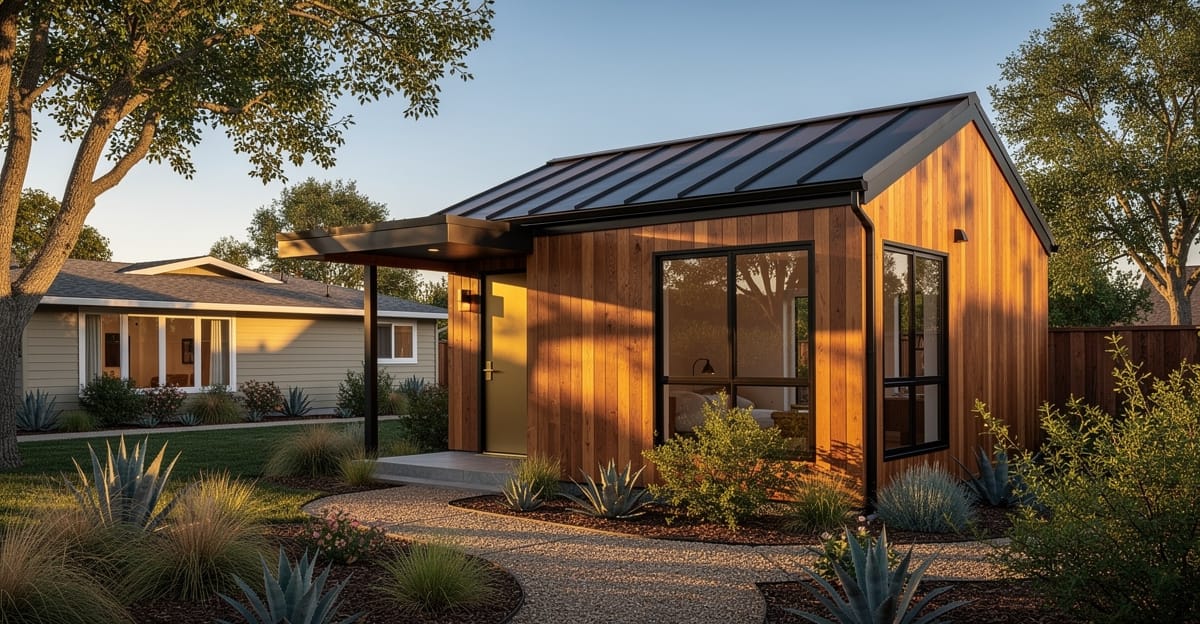
Exterior: Cedar cladding and warm materiality. The stark white box ADU is giving way to warmer palettes in 2026. Cedar cladding - either natural or thermally modified for longevity - paired with a dark standing seam metal roof reads as intentional architecture rather than an afterthought. This matters in Menlo Park because design-forward ADUs photograph better and attract higher-income tenants from the Stanford and tech communities.
Kitchens: Integrated finger-pull cabinetry and induction cooking. Compact ADU kitchens benefit enormously from slab-front cabinetry with integrated finger pulls - no hardware protruding into tight circulation paths. Induction cooktops (flush-mounted into Dekton or Caesarstone counters) are now standard in our Menlo Park ADU kitchens. They eliminate gas permitting complexity, reduce heat load in compact spaces, and align with California's long-term gas appliance phase-out trajectory.
Bathrooms: Zellige tile and microcement. For a 1-bathroom ADU to feel spa-like rather than cramped, material selection is everything. A full-height zellige tile feature wall in a walk-in shower - paired with a Kohler matte black rain head - transforms a 50-square-foot bathroom into a genuine selling point. Microcement on floors delivers a seamless, grout-free surface that is both low-maintenance and visually expansive.
Flooring: Rift-cut white oak. Engineered rift-cut white oak continues to be the floor of choice in our Menlo Park ADU projects in 2026. It reads as premium without the cost of solid hardwood, handles the humidity range of a Bay Area unit well, and photographs beautifully for rental listings.
Lighting and hardware: Unlacquered brass. Unlacquered brass fixtures and Kohler plumbing hardware age gracefully and signal quality to prospective tenants. Paired with warm LED pendants at 2700K, they create the ambiance that justifies $3,800+ monthly rents in Menlo Park.
Outdoor connection: Even a small covered porch or deck (as little as 80 square feet) measurably increases ADU rental velocity in Menlo Park. Tenants in this market expect outdoor space. If the lot allows, a concrete or Ipe wood deck off the main living area is among the highest-ROI finishes we add.
ADU Rental Income and ROI in Menlo Park 2026
A well-finished, 1-bedroom ADU in Menlo Park rents for $3,200 to $4,400 per month in 2026, putting annual gross income between $38,400 and $52,800. That income profile gives most Menlo Park ADUs a realistic payback period of 7 to 11 years on a fully-loaded project budget.
The Menlo Park rental market is driven by proximity to Stanford University (under 2 miles), Menlo Park's strong tech employer base (Meta's headquarters is in Menlo Park), and the city's location between Palo Alto and San Mateo along the Caltrain line. These demand drivers mean ADU vacancy rates in Menlo Park run exceptionally low - typically under 3% annually for well-maintained units.
Here's how the ROI math works on a typical Menlo Park project:
| Scenario | 700 sq ft Detached ADU | 450 sq ft Garage Conversion |
|---|---|---|
| Total Project Cost | $380,000 | $220,000 |
| Monthly Rent (2026) | $3,800 | $2,800 |
| Annual Gross Income | $45,600 | $33,600 |
| Operating Costs (est. 15%) | $6,840 | $5,040 |
| Annual Net Income | $38,760 | $28,560 |
| Simple Payback Period | 9.8 years | 7.7 years |
| Est. Home Value Increase | $300,000 - $420,000 | $200,000 - $300,000 |
Beyond rental income, Menlo Park ADUs add significant appraised value to the primary property. Our 2026 project data shows that finished detached ADUs in Menlo Park and neighboring Palo Alto are appraising at 80 to 110 cents on the dollar relative to construction cost - meaning a $380,000 ADU adds roughly $320,000 to $420,000 to the home's market value, depending on comparables and the appraiser's methodology.
"In Menlo Park, I've seen ADUs effectively pay for themselves twice over - once through rental income and once through property value appreciation when the homeowner eventually sells. It's the single highest-return renovation we build in San Mateo County." - Bar Benbenisty, Owner, Barcci Builders
If you're considering financing your Menlo Park ADU via a HELOC or cash-out refinance, note that Bay Area lenders are increasingly willing to underwrite against projected ADU rental income as part of your debt-service ratio calculation - a trend that has made ADU financing more accessible in 2026 compared to 2023-2024.
How to Choose the Right Contractor for Your Menlo Park ADU
Choosing the right contractor for a Menlo Park ADU comes down to three non-negotiable criteria: verified CSLB licensure, demonstrable San Mateo County permit experience, and a portfolio of completed ADUs - not just remodels - in the $250,000+ budget range.
Here's what I recommend Menlo Park homeowners verify before signing a contract with any ADU builder:
CSLB License verification. Confirm the license number is active at cslb.ca.gov. Barcci Builders holds CSLB #1086047. Any contractor who hesitates to share their license number or discourages you from verifying it online is a red flag.
San Mateo County permit pull history. Ask the contractor to name at least three ADU projects they've permitted and completed in Menlo Park, Palo Alto, or other San Mateo County cities. San Mateo County's building departments have distinct code interpretations - fire sprinkler thresholds, energy compliance pathways, and soils documentation requirements differ from Santa Clara County. A contractor whose entire portfolio is in San Jose or Sunnyvale will face a learning curve on your project.
Design-build vs. general contractor. A design-build firm handles design, permitting, and construction under one contract - which compresses your timeline and creates clear accountability. A separate architect-plus-general-contractor arrangement can work well but requires you to actively manage the coordination between two parties. For ADUs specifically, where the design and construction decisions are tightly interdependent, design-build with integrated 3D rendering typically delivers better cost control and fewer surprises.
Detailed written estimates. Any credible ADU contractor should provide a written scope of work and cost estimate itemized by trade - not a single lump sum. Ask for a breakdown that separates foundation, framing, MEP, finishes, and permit fees. If a contractor resists providing this level of detail before contract signing, that's worth noting.
Our ADU and home additions service covers the full Menlo Park area and surrounding San Mateo County communities including Atherton, Redwood City, and Portola Valley. We've completed ADU projects across both Santa Clara and San Mateo counties and understand the permitting nuances of each jurisdiction.
You can also explore our work in nearby areas: Palo Alto ADU projects, Los Altos ADU projects, and Mountain View ADU projects.
Frequently Asked Questions
How much does an ADU cost in Menlo Park in 2026?
ADU costs in Menlo Park in 2026 range from $180,000 to $280,000 for a garage conversion and $280,000 to $520,000+ for a new detached unit. The wide range reflects differences in size, finish level, soil conditions, and utility upgrade needs. A typical 700 sq ft detached 1-bedroom ADU with mid-to-high finishes runs $340,000 to $470,000 all-in.
How long does it take to get an ADU permit in Menlo Park?
The Menlo Park ADU permit process takes 4 to 9 months from first submission to permit issuance in 2026. By-right ADU applications must be approved or denied within 60 days of a complete application under California state law. Design complexity, plan check corrections, and completeness of your initial submittal are the biggest variables.
What are the setback requirements for an ADU in Menlo Park?
Detached ADUs in Menlo Park must maintain a minimum 4-foot setback from rear and side property lines under California state law. The city cannot require larger setbacks for ADUs that comply with state standards. Height limits are 16 feet for units within 4 feet of the property line, up to 24 feet for two-story units set back further.
Can I build an ADU in Menlo Park without owner-occupancy?
Yes. California eliminated owner-occupancy requirements for ADUs statewide through 2025, and as of 2026, Menlo Park cannot require you to live on the property as a condition of building an ADU. This means investors and homeowners who primarily live elsewhere can legally build and rent an ADU on a Menlo Park property they own.
How much rent can I charge for an ADU in Menlo Park?
Well-finished ADUs in Menlo Park rent for $2,800 to $4,400 per month in 2026, depending on size, layout, and finishes. A 700 sq ft 1-bedroom detached ADU near downtown Menlo Park or the Caltrain corridor typically commands $3,500 to $4,200 per month. Vacancy rates are very low - typically under 3% annually - due to proximity to Stanford and major tech employers.
Does a Menlo Park ADU require fire sprinklers?
Yes, under Menlo Park's local amendments to the California Residential Code, new detached ADUs over 750 square feet require a fire sprinkler system. This adds approximately $8,000 to $18,000 to the project budget but is non-negotiable for units above that threshold. Garage conversions may or may not require sprinklers depending on the existing structure - your plan checker will confirm.
What is a JADU and can I build one in Menlo Park?
A JADU (Junior ADU) is a unit up to 500 sq ft created entirely within the walls of an existing single-family home. JADUs are allowed in Menlo Park under California state law and cost significantly less than a detached ADU - typically $80,000 to $160,000 - because they use existing structure. They require a separate entrance but can share a bathroom with the main home. Owner-occupancy is required for JADUs in California.
Is it better to convert my Menlo Park garage to an ADU or build a new detached unit?
It depends on your budget, lot layout, and goals. A garage conversion is faster to permit (typically 3-5 months), costs 35-45% less than a comparable new detached ADU, and doesn't consume additional lot coverage. A new detached ADU offers more design flexibility, better sound separation from the main house, and higher rental rates. Most Menlo Park clients with budgets under $250,000 pursue conversions; those with budgets above $320,000 and suitable lot size typically choose detached.
What impact fees does Menlo Park charge for ADUs?
Menlo Park charges a school impact fee (currently approximately $3.79 per square foot for residential) and a transportation impact fee on new ADUs. Combined, these impact fees typically add $4,000 to $12,000 to a project budget, in addition to standard building permit fees which range from $18,000 to $32,000 for a 700 sq ft detached ADU.
Who are the best ADU builders in Menlo Park?
Look for CSLB-licensed contractors with documented permit and construction experience in Menlo Park and other San Mateo County jurisdictions. Barcci Builders (CSLB #1086047) has completed 116+ projects across the Bay Area including Menlo Park, Palo Alto, and surrounding communities. Verify any contractor's license at cslb.ca.gov and ask for references from completed Menlo Park ADU projects specifically.