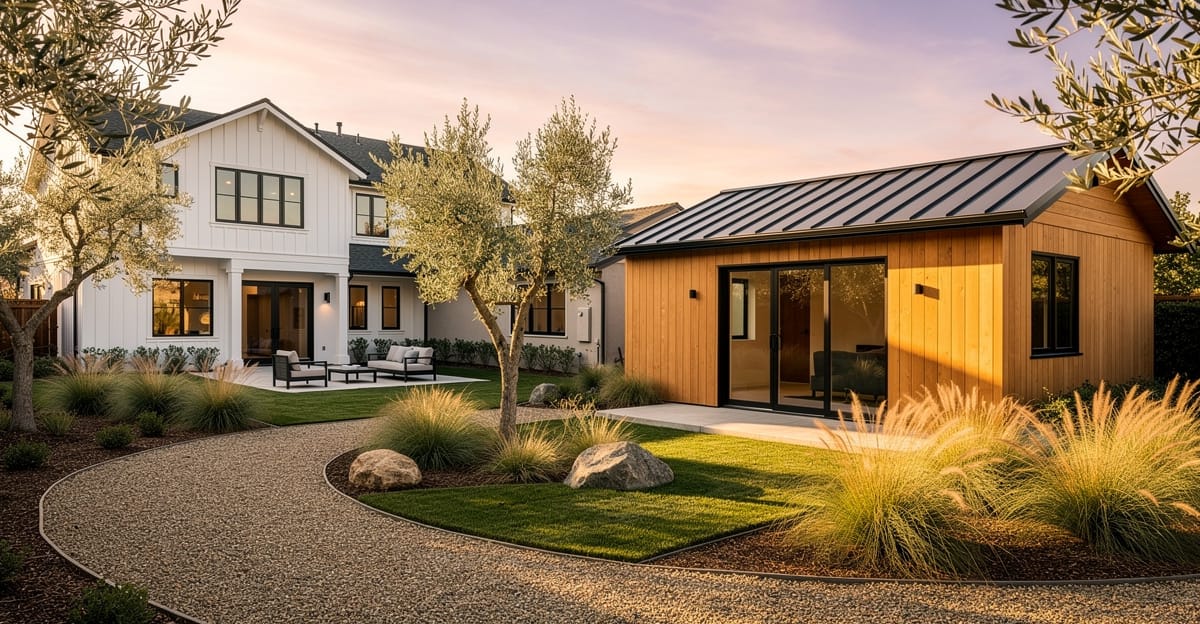
ADU Financing in California 2026: What Bay Area Homeowners Are Actually Using
"The financing decision is the first decision," says Bar Benbenisty, owner of Barcci Builders. "I've watched homeowners design an ADU they love, then discover their equity position or credit profile limits them to a product with different terms than they expected. Know your financing options before you pick your floor plan."
HELOC and Home Equity Loans: The Most Popular ADU Financing Tool in 2026
A HELOC is the dominant ADU financing vehicle for Bay Area homeowners in 2026 because it offers draw flexibility, relatively fast approval, and low origination costs compared to a full refinance. For a typical Los Gatos or Saratoga home valued between $2.2M and $3.5M with a mortgage balance under $1.2M, the available HELOC capacity at 80% combined loan-to-value (CLTV) runs $560,000 - $1,600,000 - far more than enough for even a high-end detached ADU.
Current HELOC rates in the Bay Area range from 7.25% to 8.75% variable (tied to prime rate, as of mid-2026). For a $300,000 HELOC draw, monthly interest-only payments during construction run approximately $1,812 - $2,188. Many of our clients offset this cost almost immediately: once the ADU is tenanted, Bay Area rental income of $2,800 - $4,500 per month for a 600-square-foot unit covers the financing payment with cash left over.
Key advantages of a HELOC for ADU construction:
- Draw only what you need, when you need it - no lump-sum interest starting day one
- Approval and funding typically within 30-45 days at most Bay Area lenders
- No prepayment penalties at most institutions
- Reusable credit line once principal is repaid
- Soft credit inquiry at many lenders for initial qualification
The primary risk is rate variability. HELOCs track the prime rate, so Fed rate increases translate directly to higher monthly payments. For homeowners who need payment certainty - particularly those close to retirement or with tight monthly cash flow - a home equity loan (fixed-rate lump sum at 7.5%-8.5% as of 2026) or a cash-out refinance often makes more strategic sense.
Our 2026 project data shows that clients financing detached ADUs in Palo Alto and Menlo Park favor HELOCs at roughly 2:1 over other products, largely because their existing low-rate mortgages make a cash-out refinance unattractive.
CalHFA ADU Grant and California State Loan Programs: What Qualifies in 2026
2026 CalHFA ADU Grant eligibility requirements:
- Owner-occupied primary residence in California
- Household income at or below 80% of Area Median Income (AMI). In Santa Clara County, that threshold is approximately $130,000 - $158,000 depending on household size. In San Mateo County, it is $135,000 - $165,000.
- Must use a CalHFA-approved lender and contractor
- ADU must carry a 3-year deed restriction limiting rental to below-market rates
- ADU must be tenant-occupied (not used as short-term rental)
The income ceiling rules out many homeowners in Los Gatos, Saratoga, and Los Altos Hills, but the program is highly relevant in San Jose's Willow Glen and East San Jose neighborhoods, in Campbell, and across Mountain View and Sunnyvale where median household incomes better align with AMI limits.
Beyond the grant, CalHFA partners with community lenders to offer below-market ADU construction financing at rates of 4.5% - 5.5% for income-qualifying borrowers. That spread vs. the 8%+ commercial HELOC rate translates to $7,500 - $12,000 in annual savings on a $250,000 loan - meaningful over a 10-year repayment horizon.
For homeowners who do not qualify for CalHFA, several Bay Area credit unions offer competitive ADU-specific loan products. Stanford Federal Credit Union, Patelco Credit Union, and Bay Federal Credit Union have all expanded ADU lending in 2025-2026, typically at rates 0.25% - 0.50% below comparable bank products.
"The CalHFA grant is one of the best-kept secrets in ADU financing. Homeowners who qualify should absolutely apply before funding anything out of pocket. We help our clients understand eligibility during the pre-design phase, not after permits are pulled." - Bar Benbenisty, Barcci Builders
Cash-Out Refinancing for an ADU: When the Math Actually Works
A cash-out refinance replaces your existing mortgage with a new, larger loan and delivers the difference as a lump sum for ADU construction. In 2026, 30-year fixed rates in the Bay Area run 6.75% - 7.50% for well-qualified borrowers (760+ FICO, documented income, 25%+ remaining equity). The calculus depends almost entirely on your current mortgage rate.
The cash-out refi makes sense when:
- Your existing mortgage rate is above 6.5% - making the new rate only marginally worse or equivalent
- You need a large lump sum ($300,000 or more) and want a single monthly payment with no draw complexity
- You have at least 25-30% equity remaining after the cash-out amount
- You plan to stay in the home 7+ years and the reduced cognitive overhead justifies the cost
When the math does not work: If your existing mortgage rate is below 5% - still the case for roughly 35-40% of Bay Area homeowners who bought or refinanced in 2020-2022 - a cash-out refi is almost never the right move. You would be replacing a below-market rate across your full loan balance with a 7%+ rate. On a $1.2M existing balance, that rate swap costs $24,000+ in additional annual interest. A HELOC or home equity loan preserves your low-rate protection and costs a fraction of that.
ADU Construction Loans and Fannie Mae HomeStyle: For Ground-Up Builds
Construction loans are short-term financing instruments (typically 6-18 months) that fund ADU construction through a series of milestone draws - foundation complete, framing complete, MEP rough-in, drywall, and final. Rates run 8.0% - 9.5% variable in the Bay Area in 2026, higher than most alternatives, but you pay interest only on amounts drawn rather than the full loan balance.
For a $360,000 ADU with draws spread over 12 months, you might pay interest on an average outstanding balance of $180,000 (midpoint estimate), totaling approximately $14,400 - $17,100 in construction-period interest - a manageable carrying cost for a project that will generate $3,000 - $4,500/month in rent. Most Bay Area lenders offer "one-time close" construction-to-permanent loans so you avoid paying closing costs twice.
Fannie Mae's HomeStyle Renovation loan is a compelling alternative for homeowners who are purchasing a property with ADU plans, or who want a single long-term fixed-rate product. The HomeStyle loan finances both the property (or existing mortgage) and renovation costs in one instrument, based on the after-renovation value (ARV) of the property - allowing up to 75% of ARV including the ADU. For a Cupertino home currently worth $1.8M where a completed ADU would bring value to $2.1M, HomeStyle could finance up to $1,575,000 - well above what a standard HELOC on the pre-ADU value might support.
One practical note from our experience: construction loans require more documentation, lender inspections at each draw milestone, and an approved contractor on file. For homeowners who want simplicity, a HELOC drawn at project milestones is functionally similar but with 60-70% less paperwork. For large, complex ground-up detached ADUs with $400,000+ budgets, a construction loan's structured draw schedule can actually be an asset - it creates natural checkpoints and keeps cash deployment disciplined.
How Much ADU Financing Do You Actually Need in the Bay Area?
Based on our 116+ completed ADU and home addition projects, here are the real all-in costs you should plan to finance in 2026. These figures include hard construction, soft costs (design, engineering, permits), utility connections, and landscaping restoration - the numbers homeowners are actually writing checks for, not the stripped-down estimates that cause budget shock mid-project.
| ADU Type | Typical Size | Hard Construction | Soft Costs (Permits, Design, Engineering) | All-In Budget Range |
|---|---|---|---|---|
| JADU (Junior ADU) | Up to 500 sq ft | $65,000 - $125,000 | $12,000 - $20,000 | $77,000 - $145,000 |
| Garage Conversion ADU | 400 - 640 sq ft | $145,000 - $250,000 | $20,000 - $38,000 | $165,000 - $290,000 |
| Attached ADU | 500 - 850 sq ft | $195,000 - $320,000 | $28,000 - $45,000 | $225,000 - $370,000 |
| Detached ADU (single-story) | 600 - 1,000 sq ft | $250,000 - $380,000 | $32,000 - $52,000 | $285,000 - $435,000 |
| Two-Story Detached ADU | 800 - 1,200 sq ft | $330,000 - $500,000 | $40,000 - $65,000 | $375,000 - $570,000 |
One finding that surprises nearly every client: permit fees alone in Santa Clara County for a detached ADU run $14,000 - $24,000, and the approval process takes 4-8 months. San Mateo County is similar at $16,000 - $28,000. These fees are due before construction begins and are typically not included in contractor bids. Budget for them explicitly in your financing plan.
Our 2026 project data shows that homeowners who add a 15% contingency buffer to their hard construction budget come out within $8,000 of final cost 80% of the time. Homeowners who skip the contingency overspend their planned budget by an average of 22%. For a $300,000 ADU, that is a $66,000 gap - large enough to require emergency financing.
Also factor in utility connection costs: in our projects, extending water, sewer, gas, and electrical service to a new detached ADU adds $18,000 - $45,000 depending on distance from the main house and whether the street requires trenching. This is a hard cost that surprises many clients who assumed utility connections were minor. Plan your financing envelope accordingly.
ADU Financing Options Compared: Rates, Terms, and Best Use Cases
No single financing vehicle is best for every homeowner. The right choice depends on your mortgage rate history, equity position, income, credit profile, and project timeline. Here is how the main options stack up in 2026 Bay Area conditions.
| Financing Option | 2026 Rate Range | Term | Typical Max | Best Use Case | Primary Drawback |
|---|---|---|---|---|---|
| HELOC | 7.25% - 8.75% variable | 10-yr draw / 20-yr repay | 80% CLTV | Phased funding; preserving low-rate 1st mortgage | Rate variability risk |
| Home Equity Loan | 7.50% - 8.50% fixed | 10 - 20 years | 80% CLTV | Single-stage projects needing rate certainty | Interest accrues day 1 on full amount |
| Cash-Out Refinance | 6.75% - 7.50% fixed | 30 years | 75 - 80% LTV | Existing rate above 6.5%; want single payment | Resets entire mortgage at current rate |
| ADU Construction Loan | 8.00% - 9.50% variable | 6 - 18 months + permanent | Varies by lender | Large ground-up builds with milestone draws | Highest rate; most lender oversight |
| Fannie Mae HomeStyle | 7.00% - 7.75% fixed | 30 years | 75% of ARV | Purchase + ADU; high ARV uplift scenarios | Complex underwriting; contractor approval required |
| CalHFA ADU Grant | 0% (grant, not loan) | N/A | $40,000 | Pre-development costs for income-qualifying owners | AMI income ceiling; 3-year deed restriction |
| Credit Union ADU Loan | 6.75% - 8.25% fixed/variable | 10 - 25 years | Varies | Homeowners who don't qualify for CalHFA but want competitive rates | Membership requirements; smaller loan limits |
How to Choose the Right ADU Financing Strategy for Your Bay Area Home
The right strategy comes down to four questions: What is your current mortgage rate? How much equity do you have? What is your income relative to AMI limits? And how quickly do you want to build?
Start with your current mortgage rate. If it is below 5.5%, protecting it is paramount - you should be looking at a HELOC, home equity loan, or credit union ADU product, not a cash-out refinance. If your rate is above 6.5%, the refinance option is worth modeling seriously.
Check your equity position. Bay Area home values have appreciated 18-24% over the past three years in cities like Los Gatos, Saratoga, and Los Altos. If you bought more than 5 years ago, your equity position is likely strong enough to support a substantial HELOC even for a $400,000+ ADU project.
Run the CalHFA eligibility check early. If your household income falls below the AMI threshold for your county, the $40,000 grant can eliminate your pre-development cost exposure entirely. That alone reduces your financing need by 10-15% on a typical project.
Finally, work backward from your ADU rental income projections. A 640-square-foot detached ADU in Saratoga or Los Gatos rents for $3,200 - $4,200/month in the current market. At $3,500/month, that is $42,000/year in gross rental income. If your HELOC interest cost is $22,000/year on a $300,000 draw, the net cash flow position in year one is approximately $20,000 - before accounting for long-term equity appreciation from the ADU's value-add to your property.
"Every ADU financing decision has to start with the rental income math," says Bar Benbenisty. "When clients see that a $350,000 investment generates $3,500/month in rent and adds $400,000+ to their appraised value, the financing conversation changes completely. The question stops being 'Can I afford this?' and starts being 'What's the most efficient capital structure for the highest return?'"
Barcci Builders works with homeowners across Los Gatos, Saratoga, Palo Alto, Menlo Park, San Jose, and the broader South Bay to design ADUs that are optimized for both livability and return on investment. Explore our ADU and home addition services or see our 3D design and rendering process to understand what your ADU project could look like before a single permit is pulled.
Frequently Asked Questions: ADU Financing in California 2026
How do I finance an ADU in California in 2026?
The most common ADU financing options in California in 2026 are: a HELOC (home equity line of credit) at 7.25%-8.75% variable, a cash-out refinance at 6.75%-7.50% fixed, a home equity loan at 7.5%-8.5% fixed, or a construction-to-permanent loan at 8%-9.5%. Income-qualifying homeowners should also explore the CalHFA ADU Grant, which provides up to $40,000 for pre-development costs at no cost. The best option depends on your existing mortgage rate, equity position, and project timeline.
Can I use a HELOC to build an ADU in the Bay Area?
Yes. A HELOC is the most popular ADU financing tool in the Bay Area in 2026, used by roughly 58% of homeowners who don't pay cash outright. Bay Area homeowners with strong equity positions - especially those who bought before 2020 at low mortgage rates - can typically access $300,000-$800,000 in HELOC capacity at 80% CLTV. The main risk is variable rate exposure; HELOC rates run 7.25%-8.75% in 2026.
What is the CalHFA ADU Grant and who qualifies in 2026?
The CalHFA ADU Grant provides up to $40,000 for pre-development costs (permits, architectural plans, engineering, title fees) for income-qualifying California homeowners. To qualify in 2026, household income must be at or below 80% of Area Median Income - approximately $130,000-$158,000 in Santa Clara County and $135,000-$165,000 in San Mateo County depending on household size. The ADU must also carry a 3-year affordable deed restriction. Apply through a CalHFA-approved lender before design costs are incurred.
How much equity do I need to finance an ADU?
Most lenders require at least 20% equity remaining in your home after the ADU loan is funded, meaning you can borrow up to 80% of your home's combined loan-to-value (CLTV). For a Bay Area home worth $1.8M with an $800,000 existing mortgage, your maximum HELOC capacity is approximately $640,000 ($1.44M at 80% CLTV minus $800,000 existing balance). That is more than enough for most ADU projects, which range from $165,000 to $570,000 all-in depending on type and size.
Is a cash-out refinance a good idea for ADU financing?
A cash-out refinance makes sense for ADU financing if your existing mortgage rate is above 6.5%, since the new rate (6.75%-7.50% in 2026) would be similar or only marginally higher. However, if your current rate is below 5% - still the case for many Bay Area homeowners who refinanced in 2020-2022 - a cash-out refi is almost never the right choice. You would be replacing a below-market rate on your full balance with a 7%+ rate, costing $24,000+ in additional annual interest on a $1.2M balance. In that scenario, a HELOC or home equity loan is almost always better.
What credit score do I need to get an ADU loan?
Most Bay Area lenders require a minimum FICO score of 680-700 for a HELOC or home equity loan for ADU financing, with better rates available at 740+. For Fannie Mae HomeStyle loans, the minimum is typically 620 but competitive rates require 680+. CalHFA programs have their own requirements; check with a CalHFA-approved lender. Construction loans tend to be more stringent, often requiring 700+ and documented reserves.
How long does it take to get financing approved for an ADU?
HELOC approval at a Bay Area bank or credit union typically takes 30-45 days. Home equity loans run 30-60 days. Cash-out refinances take 45-75 days due to full underwriting. Construction loans can take 60-90 days and require detailed project documentation, contractor bids, and plans. CalHFA programs involve additional review and typically take 60-90 days. Plan your financing application to close before your permit is ready so construction can start without delay.
Can rental income from an ADU help me qualify for a loan?
In most cases, yes. Fannie Mae HomeStyle loans and some portfolio lenders will include projected ADU rental income in your debt-to-income calculation for qualification purposes - typically at 75% of market rent to account for vacancy. For HELOCs and home equity loans, most lenders do not count projected rental income since the unit is not yet built; they underwrite based on your existing documented income. Once the ADU is completed and rented, that income can support a refinance into better terms.
What is the best loan for building an ADU in Los Gatos or Saratoga?
For most homeowners in Los Gatos and Saratoga - where home values run $2M-$4M and equity positions are strong - a HELOC is the best starting point for ADU financing in 2026. These homeowners typically have low-rate existing mortgages they do not want to disturb, and HELOC capacity of $600,000+ is common. The HELOC covers construction costs with draw flexibility, and the rental income from the completed ADU services the interest. Homeowners with higher existing mortgage rates (above 6.5%) should model a cash-out refinance as a competitive alternative.
Does a Fannie Mae HomeStyle loan work for ADU construction in California?
Yes. The Fannie Mae HomeStyle Renovation loan is a viable option for Bay Area ADU projects, particularly in high-appreciation markets where the after-renovation value (ARV) of the property - including the ADU - supports a larger loan than current value alone. HomeStyle finances up to 75% of ARV in one fixed-rate 30-year product, covering both existing mortgage and ADU construction costs. It requires an approved contractor and detailed scope, but it is one of the few products that can actually increase your loan availability based on the value the ADU adds.