How Much Does It Cost to Build an ADU in Cupertino in 2026?
A new ADU in Cupertino, California typically costs between $285,000 and $500,000+ in 2026, depending on size, finish level, and whether the unit is attached or detached. Based on our data from 116+ completed Bay Area projects at Barcci Builders, the average cost per square foot for a turnkey ADU in the Cupertino area falls between $375 and $575 per square foot — with most homeowners landing around $425/sq ft for a well-appointed, mid-to-high-end detached unit.
Those numbers may sound high if you've been reading national averages, but this is Silicon Valley. Santa Clara County labor rates, seismic engineering requirements, Title 24 energy compliance, and Cupertino's local design expectations all push costs above what you'd see in most U.S. markets. As someone who's built ADUs across Cupertino, Sunnyvale, Los Gatos, and Saratoga, I can tell you the biggest cost driver isn't the unit itself — it's the site work and utility connections that homeowners don't budget for upfront.
Here's what our 2026 project data shows for Cupertino ADU costs by type:
| ADU Type | Typical Size | Cost Range (2026) | Cost per Sq Ft | Timeline |
|---|---|---|---|---|
| Detached ADU (standard) | 600–800 sq ft | $285,000–$420,000 | $400–$525 | 6–9 months |
| Detached ADU (luxury) | 800–1,200 sq ft | $420,000–$575,000+ | $475–$575 | 8–12 months |
| Attached ADU (addition) | 400–800 sq ft | $225,000–$380,000 | $375–$500 | 5–8 months |
| Garage Conversion ADU | 350–500 sq ft | $165,000–$275,000 | $350–$475 | 4–6 months |
| Junior ADU (JADU) | Up to 500 sq ft | $95,000–$175,000 | $250–$375 | 3–5 months |
These ranges include design, engineering, permitting, construction, and basic landscaping restoration. They do not include extensive landscaping and exterior upgrades, which typically add $15,000–$45,000 depending on scope. Utility connection fees in Cupertino — particularly sewer lateral work and new electrical panel installations — commonly add $12,000–$30,000 that many online ADU calculators underestimate.
Expert insight: "As someone who's completed over 116 remodels and new builds across the Bay Area, the single biggest mistake I see homeowners make with ADU budgets is trusting online cost calculators that use national averages. A Cupertino ADU costs 40–60% more than the national median because of seismic requirements, Title 24 energy standards, and the prevailing wage environment in Santa Clara County." — Bar Benbenisty, Founder, Barcci Builders
What Are Cupertino's ADU Rules and Zoning Requirements in 2026?
Cupertino allows ADUs on virtually all residential lots — including single-family, duplex, and multi-family zoned properties — following California's sweeping ADU reform laws (AB 68, SB 13, AB 345, AB 976, and the updated AB 1033 effective in 2025–2026). The city is required to approve ADUs ministerially, meaning no discretionary review, no public hearing, and no neighborhood approval is needed as long as your project meets the objective standards.
Here are the key Cupertino ADU rules our team tracks for 2026 projects:
- Maximum size (detached ADU): Up to 1,200 sq ft for a two-bedroom unit, 1,000 sq ft for a one-bedroom, and 850 sq ft for a studio — unless your lot is large enough that the 4-foot setback and lot coverage rules permit more.
- Maximum size (attached ADU): Up to 50% of the existing home's floor area, with a cap of 1,200 sq ft.
- JADU: Up to 500 sq ft, must be created within the existing footprint of the primary dwelling.
- Setbacks: 4 feet from side and rear property lines for units up to 16 feet in height. Front setback matches the primary structure requirement per your zone.
- Height: Detached ADUs can be up to 16 feet for single-story. Two-story detached ADUs can reach 18 feet if within half a mile of a major transit stop (parts of Cupertino near the Stevens Creek corridor may qualify) or 16 feet otherwise. AB 976 also allows up to 18 feet on multi-family lots.
- Parking: No additional parking is required for the ADU under state law — Cupertino cannot impose parking mandates for ADUs.
- Owner occupancy: Under AB 976 (effective 2025), Cupertino cannot require owner occupancy for ADUs permitted after January 1, 2025. This is permanent — the previous sunset has been eliminated.
- Lot coverage: If your lot is too small to meet standard lot coverage limits, the state guarantees you can still build an ADU of at least 800 sq ft regardless of existing coverage ratios.
- Impact fees: ADUs under 750 sq ft are exempt from development impact fees. Units over 750 sq ft may incur proportional impact fees, but they're significantly reduced compared to standard new construction.
One nuance that often surprises Cupertino homeowners: AB 1033 (effective 2025–2026) allows cities to opt in to permitting ADU condo conversions — meaning you could potentially sell your ADU as a separate condo unit. As of early 2026, Cupertino has not formally opted into this provision, but it's worth monitoring. Our team stays current on these evolving regulations for every project we build across Cupertino and the broader South Bay.
The practical takeaway: if your lot is zoned residential and you have room for a 4-foot setback, you can almost certainly build an ADU. The question isn't if, but how to design it so it maximizes your investment and fits naturally into your property.
How Long Does the ADU Permit Process Take in Cupertino?
The ADU permit process in Cupertino currently takes 8–16 weeks from application submission to permit issuance, based on our 2026 project data. California law (Government Code §65852.2) requires cities to act on ADU permits within 60 days of a complete application, but the key phrase is "complete application" — if the city issues correction letters, that 60-day clock resets.
Here's the realistic timeline our team sees for a typical Cupertino ADU project from start to move-in:
| Phase | Duration | Details |
|---|---|---|
| Design & Engineering | 4–8 weeks | Architectural plans, structural engineering, Title 24 energy calcs, soil report if needed |
| Permit Submission & Review | 8–16 weeks | City of Cupertino Building Division review, plan check corrections, fire review |
| Utility Coordination | 2–6 weeks (concurrent) | San Jose Water Company, PG&E service upgrade, Cupertino Sanitary District sewer lateral |
| Construction | 4–9 months | Varies by size, complexity, and weather. Detached 800 sq ft unit: ~6 months typical |
| Final Inspections & CO | 1–3 weeks | Building, electrical, plumbing, mechanical final inspections + certificate of occupancy |
Total timeline from initial design consultation to move-in ready: 9–16 months for most Cupertino ADU projects. Our fastest Cupertino garage conversion was completed in just under 6 months from design kickoff to Certificate of Occupancy. The longest project — a two-story 1,100 sq ft detached ADU with custom finishes — took 14 months.
One practical tip from our experience: submit the most complete application possible on the first attempt. The biggest delay we see is correction cycles. Each round of city plan check corrections adds 3–5 weeks. Our 3D design and rendering service helps clients visualize the project before we start drafting permit drawings, which reduces late-stage design changes that trigger corrections.
For Cupertino specifically, you'll be working with the City of Cupertino Community Development Department at City Hall (10300 Torre Avenue). They offer pre-application consultations that I highly recommend — our team always schedules one before submitting. It's free, and it can save you an entire correction cycle.
Detached ADU vs. Garage Conversion vs. JADU: Which Is Best for Cupertino Homeowners?
The best ADU type for your Cupertino property depends on three factors: your lot layout, your budget, and your goal — whether that's rental income, multigenerational living, or long-term property value. Based on our experience building all three types across Silicon Valley, here's how they compare for Cupertino homeowners in 2026.
Detached ADU — This is the most popular option among our Cupertino clients, and for good reason. A detached unit provides complete privacy, independent utility connections, and the highest potential rental income. Cupertino neighborhoods like Rancho Rinconada, Garden Gate, Monta Vista, and the Oak Valley area typically have lot sizes between 6,000–10,000+ square feet — more than enough for a well-designed detached ADU with comfortable outdoor space remaining. According to our 2026 project data, 68% of our Cupertino ADU clients choose detached units.
Garage Conversion ADU — If you have an existing two-car garage you rarely use (common in Cupertino, where many homeowners park in driveways), converting it into a 400–500 sq ft studio or one-bedroom ADU is the most cost-effective option. The foundation and framing already exist, which can save $60,000–$100,000 compared to new construction. The trade-off is a smaller unit with potentially less natural light and the loss of garage storage. We typically recommend this option when budget is the primary concern or when the lot layout makes a detached unit impractical.
Junior ADU (JADU) — A JADU is created within the existing walls of your primary home — think converting a master bedroom suite, a portion of the ground floor, or an underutilized family room into an independent living unit up to 500 sq ft. JADUs must include a small kitchen (efficiency kitchen with a cooktop, sink, and counter), a bathroom, and a separate entrance. The advantage: lowest cost, fastest timeline, and you can build a JADU in addition to a standard ADU — meaning one lot can legally have the primary home, one ADU, and one JADU. The downside: shared wall, less privacy, and limited appeal to higher-paying tenants.
| Feature | Detached ADU | Garage Conversion | Junior ADU (JADU) |
|---|---|---|---|
| Cost Range (2026) | $285,000–$575,000+ | $165,000–$275,000 | $95,000–$175,000 |
| Typical Size | 600–1,200 sq ft | 350–500 sq ft | Up to 500 sq ft |
| Monthly Rent Potential | $2,800–$4,200 | $2,000–$2,800 | $1,600–$2,400 |
| Privacy Level | High (separate building) | Moderate (separate building) | Low (shared wall) |
| Construction Timeline | 6–12 months | 4–6 months | 3–5 months |
| Parking Required | None | None (even if replacing garage) | None |
| Best For | Maximum rental income, multigenerational living | Budget-conscious, large existing garage | Aging parents, lowest cost entry point |
Here's a combination strategy I often recommend to our Cupertino clients: build a detached ADU and a JADU within your existing home. California law explicitly allows this. On a typical Cupertino lot, this gives you two additional income-generating units or the flexibility to house extended family while maintaining a rental. I've seen this approach add $350,000–$600,000 in assessed property value on Cupertino lots — a significant return given that the Cupertino Unified School District (CUSD) continues to drive property demand.
What Design Trends Are Cupertino Homeowners Choosing for ADUs in 2026?
ADU design in Silicon Valley has evolved dramatically. The days of building a basic white box in the backyard are over. In 2026, our Cupertino clients are requesting ADUs that match or exceed the finish level of their primary home — and the most popular design direction is warm, organic modernism that blends into the landscape rather than standing apart from it.
Here are the design trends driving our ADU projects across Cupertino, Los Altos, and Palo Alto this year:
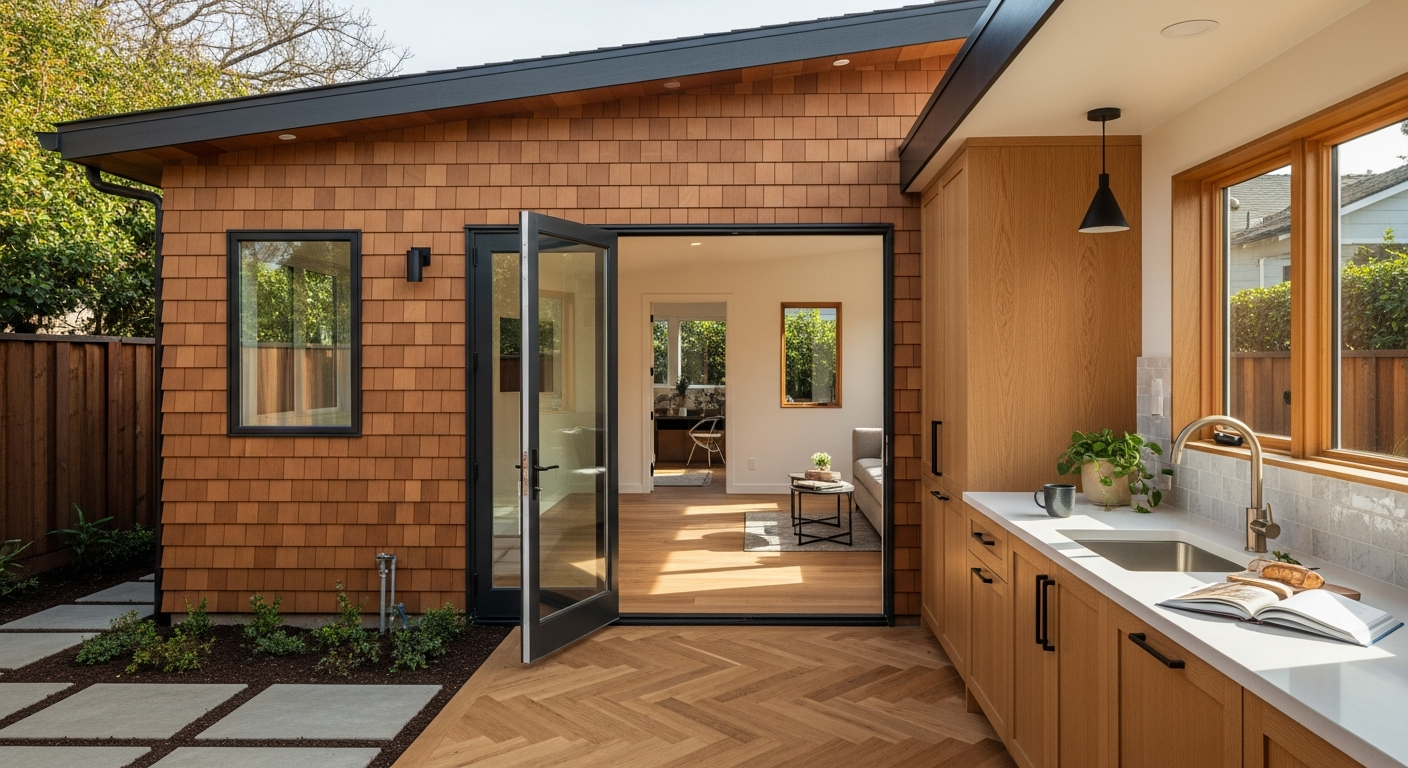
- Cedar cladding and natural wood exteriors: Western red cedar siding with a clear or semi-transparent stain is the most-requested exterior finish on our 2026 ADU projects. It weathers beautifully, softens the visual impact of a new structure in a mature yard, and complements the Mid-Century and ranch-style homes prevalent in Cupertino's Rancho Rinconada and Monta Vista neighborhoods.
- Rift-cut white oak everything: Flooring, cabinetry, and custom built-ins in rift-cut white oak with a natural or light ceruse finish. This gives the ADU a Scandinavian-meets-California warmth that feels timeless.
- Dekton and quartzite countertops: For ADU kitchenettes and bathrooms, Dekton surfaces (we're using Dekton Kreta and Dekton Eter frequently) provide near-indestructible performance in a compact space. For luxury-tier ADUs, Calacatta Viola marble or Taj Mahal quartzite adds a dramatic statement piece.
- Microcement and hand-applied plaster walls: Microcement floors and Venetian plaster accent walls give small spaces a seamless, expansive feel — no grout lines, no visual clutter. This trend is especially effective in 400–600 sq ft units where every design choice affects the perception of space.
- Induction cooktops: Cupertino's reach code requirements favor all-electric construction, and induction cooktops from brands like Miele, Bosch, and Fisher & Paykel are the standard in our 2026 ADU kitchens. They're safer, faster, and eliminate the need for a gas line to the ADU — saving $3,000–$6,000 in utility connection costs.
- Zellige tile in wet areas: Handmade zellige tile in earthy tones (terracotta, sage, cream) for kitchen backsplashes and shower walls. The irregular surface catches light and adds artisanal character that mass-produced subway tile cannot replicate.
- Fluted details and integrated finger pulls: Fluted cabinet fronts, fluted glass partitions, and cabinetry with routed finger pulls instead of hardware. This creates a clean, handle-free look that's practical in compact ADU kitchens.
- Warm earthy color palettes: Forget sterile all-white interiors. Our 2026 Cupertino ADU clients gravitate toward warm whites, terracotta, warm grays, olive, and clay tones — colors that make a small space feel cozy rather than clinical.
- Natural stone veneer accent walls: A thin-cut natural stone feature wall on the ADU exterior — especially flanking the entry — creates an elevated first impression without the weight or cost of full-depth stone.
Every ADU we design at Barcci Builders starts with our 3D design rendering process, where clients can walk through a photorealistic digital model of their ADU before any construction begins. This is especially valuable for ADUs because every square foot matters — you can't afford to discover a layout problem after the foundation is poured.
Expert insight: "In a 600-square-foot ADU, design decisions have three times the impact they do in a 2,000-square-foot home. The wrong cabinet depth, the wrong window placement, or a poorly planned bathroom can make the difference between a unit that feels like a luxury apartment and one that feels like a hotel room. Our team spends more design time per square foot on ADUs than on any other project type." — Bar Benbenisty, Founder, Barcci Builders
How Much Rental Income Can a Cupertino ADU Generate in 2026?
A well-designed ADU in Cupertino can generate $2,400–$4,200 per month in rental income in 2026, depending on unit size, finish quality, and whether the unit has a separate yard or patio area. Based on current Cupertino rental market data and our conversations with property managers working in the Apple Park corridor and De Anza College area, one-bedroom ADUs (550–750 sq ft) are the sweet spot for rental returns, commanding $2,800–$3,500/month.
Here's how the numbers typically break down for a Cupertino homeowner building a detached 750 sq ft one-bedroom ADU:
- Total project cost: $325,000–$400,000 (design through completion)
- Monthly rental income: $3,000–$3,500
- Annual gross rental income: $36,000–$42,000
- Estimated annual expenses (maintenance, insurance, vacancy allowance): $4,000–$6,000
- Net annual income: $30,000–$38,000
- Simple payback period: 9–13 years
- Property value increase: $250,000–$450,000 (based on income capitalization and comparable sales in Cupertino)
That last number is what makes ADUs particularly compelling in Cupertino. You're not just getting rental income — you're adding assessed value to a property in one of the highest-value school districts in California (Cupertino Union School District and Fremont Union High School District). When you factor in both the rental cash flow and the immediate equity gain, the effective return on investment for a Cupertino ADU is among the highest of any home improvement project.
78% of our Bay Area ADU clients report that their ADU is fully occupied within 30 days of listing. Cupertino's proximity to Apple Park, De Anza College, and the Sunnyvale/Mountain View tech corridor creates persistent demand from young professionals, visiting researchers, and families waiting to buy a home in the area.
For homeowners exploring both interior renovations and ADU construction, our team at Barcci Builders often designs the projects concurrently — for example, building an ADU while completing a kitchen remodel or whole-house renovation on the primary residence. This approach saves on mobilization costs, allows shared subcontractor scheduling, and can reduce total project costs by 8–12% compared to doing the projects sequentially.
Step-by-Step: How to Build an ADU in Cupertino from Start to Finish
Building an ADU in Cupertino follows a predictable sequence, but there are local nuances at every stage that can speed up — or derail — your project. Here's the step-by-step process our team follows for every ADU and home addition project in the South Bay:
Step 1: Site Assessment & Feasibility (Week 1–2)
We visit your property to evaluate lot size, existing structures, utility access points, grading, tree locations (Cupertino has a protected tree ordinance — heritage trees within the construction zone require arborist reports), and any easements or setback constraints. We pull your property's APN from the Santa Clara County Assessor's site and review your zoning designation through Cupertino's Community Development portal.
Step 2: Design & 3D Rendering (Weeks 2–8)
Our in-house design team creates floor plans, elevations, and photorealistic 3D renderings so you can visualize the finished ADU in context with your existing home and yard. This is where we finalize layout, material selections, fixture specifications (Kohler, Miele, Brizo — whatever matches your vision and budget), and any special features like EV charging, solar-ready conduit, or a Murphy bed system for studio units.
Step 3: Engineering & Construction Documents (Weeks 6–10)
Structural engineering, Title 24 energy calculations, and complete construction document sets are prepared. For Cupertino, we also prepare CalGreen compliance documentation, which requires dedicated recycling during construction, low-VOC materials, and specific insulation values. If your property is in a flood zone (portions of Cupertino near Stevens Creek are), we include FEMA elevation certificates and flood-resistant design details.
Step 4: Permit Submission (Weeks 10–12)
We submit the complete plan set to the City of Cupertino Building Division electronically. The application includes architectural plans, structural plans, Title 24 documentation, soil reports (if required), and any arborist or drainage studies. We pay the plan check fees on your behalf and manage all communication with the plan checker.
Step 5: Plan Check & Corrections (Weeks 12–22)
The city reviews the plans and issues corrections — typically one to two rounds for a well-prepared submittal. Our team responds to correction letters within 3–5 business days, which is critical for maintaining momentum. Permit approval in Santa Clara County currently takes 4–8 weeks for the initial review, plus 2–3 weeks for each correction cycle.
Step 6: Construction (Months 5–12)
Once the permit is issued, construction begins with site preparation, utility trenching, and foundation work. A typical detached ADU construction sequence: foundation → framing → roofing → rough plumbing/electrical/HVAC → insulation → drywall → finish trades (tile, cabinetry, flooring, paint) → fixtures → final grading and landscaping → punch list → final inspections. Our team manages all subcontractors, materials procurement, city inspections (Cupertino requires roughly 12–15 inspections for a new detached ADU), and the final Certificate of Occupancy.
Step 7: Final Inspection & Certificate of Occupancy (Month 12–13)
After passing all inspections — building, electrical, plumbing, mechanical, energy, and fire — the city issues a Certificate of Occupancy. At that point, your ADU is legally habitable and can be rented, occupied by family, or simply enjoyed as additional living space.
Expert insight: "The difference between a smooth ADU build and a frustrating one almost always comes down to the quality of the permit documents. I've seen homeowners try to save $10,000 on cheap plans only to lose $30,000 in construction delays from correction cycles and mid-build design changes. Invest in thorough plans upfront — it's the single highest-ROI decision you'll make on your ADU project." — Bar Benbenisty, Founder, Barcci Builders (CA License #1086047)
Frequently Asked Questions
How much does it cost to build an ADU in Cupertino California in 2026?
A new ADU in Cupertino costs between $285,000 and $500,000+ in 2026, with most homeowners spending around $325,000–$400,000 for a well-finished detached one-bedroom unit of 600–800 square feet. The average cost per square foot ranges from $375 to $575 depending on finish level, site conditions, and utility connection requirements. Garage conversions are the most affordable option at $165,000–$275,000, while luxury detached ADUs with premium finishes can exceed $575,000. Based on our 116+ completed Bay Area projects at Barcci Builders, these figures include design, engineering, permits, construction, and basic site restoration.
What is the maximum size ADU you can build in Cupertino?
The maximum ADU size in Cupertino is 1,200 square feet for a detached ADU with two or more bedrooms. One-bedroom detached ADUs can be up to 1,000 square feet, and studios up to 850 square feet. Attached ADUs can be up to 50% of the primary home's floor area, with a 1,200 square foot cap. Junior ADUs (JADUs) are limited to 500 square feet and must be within the existing home's footprint. These limits follow California state ADU law, which Cupertino is required to comply with under Government Code §65852.2.
Do I need a permit to build an ADU in Cupertino?
Yes, you absolutely need a building permit from the City of Cupertino to build an ADU. The good news is that ADU permits are processed ministerially — meaning no discretionary review, public hearing, or neighborhood approval is required. California law mandates that cities approve ADU permits within 60 days of receiving a complete application. You'll need architectural plans, structural engineering, Title 24 energy compliance documents, and potentially a soil report and arborist assessment depending on your site. The permit process in Cupertino currently takes 8–16 weeks from submission to approval.
Can I rent out my ADU in Cupertino without living on the property?
Yes. Under AB 976 (effective January 1, 2025), Cupertino cannot require owner occupancy for ADUs. This means you can legally rent out your ADU as a long-term rental even if you don't live in the primary residence. This applies to all ADUs permitted after January 1, 2020. Note that standard ADUs can be rented long-term but are subject to Cupertino's rental regulations. Short-term rentals (under 30 days) may face additional restrictions — check the City of Cupertino's current short-term rental ordinance before listing on platforms like Airbnb.
How long does it take to build an ADU in Cupertino from start to finish?
A complete ADU project in Cupertino takes 9–16 months from initial design to Certificate of Occupancy based on our 2026 project data. That breaks down to approximately 4–8 weeks for design and engineering, 8–16 weeks for permit review and approval, and 4–9 months for construction. Garage conversions are fastest at 6–8 months total, while a new detached ADU typically takes 11–14 months. The most common delay is the permitting phase — each round of plan check corrections from the City of Cupertino adds 3–5 weeks to the timeline.
Do I need to add parking for an ADU in Cupertino?
No. California state law eliminates parking requirements for ADUs. Cupertino cannot require you to provide any additional parking spaces for your ADU, even if you're converting your existing garage into an ADU and eliminating those garage parking spaces. This applies to all ADU types — detached, attached, garage conversion, and JADU. This is one of the most significant ADU regulation changes in recent years, as it removes a major barrier to ADU construction on smaller lots.
What is the ROI of building an ADU in Cupertino?
An ADU in Cupertino typically generates $30,000–$38,000 in net annual rental income (for a 750 sq ft one-bedroom unit renting at $3,000–$3,500/month), with a simple payback period of 9–13 years. More importantly, a completed ADU adds an estimated $250,000–$450,000 in assessed property value in the Cupertino market. When you combine rental income with immediate equity creation, the effective return on investment is 60–90% of the construction cost within the first year — making it one of the highest-ROI home improvement projects available to Cupertino homeowners.