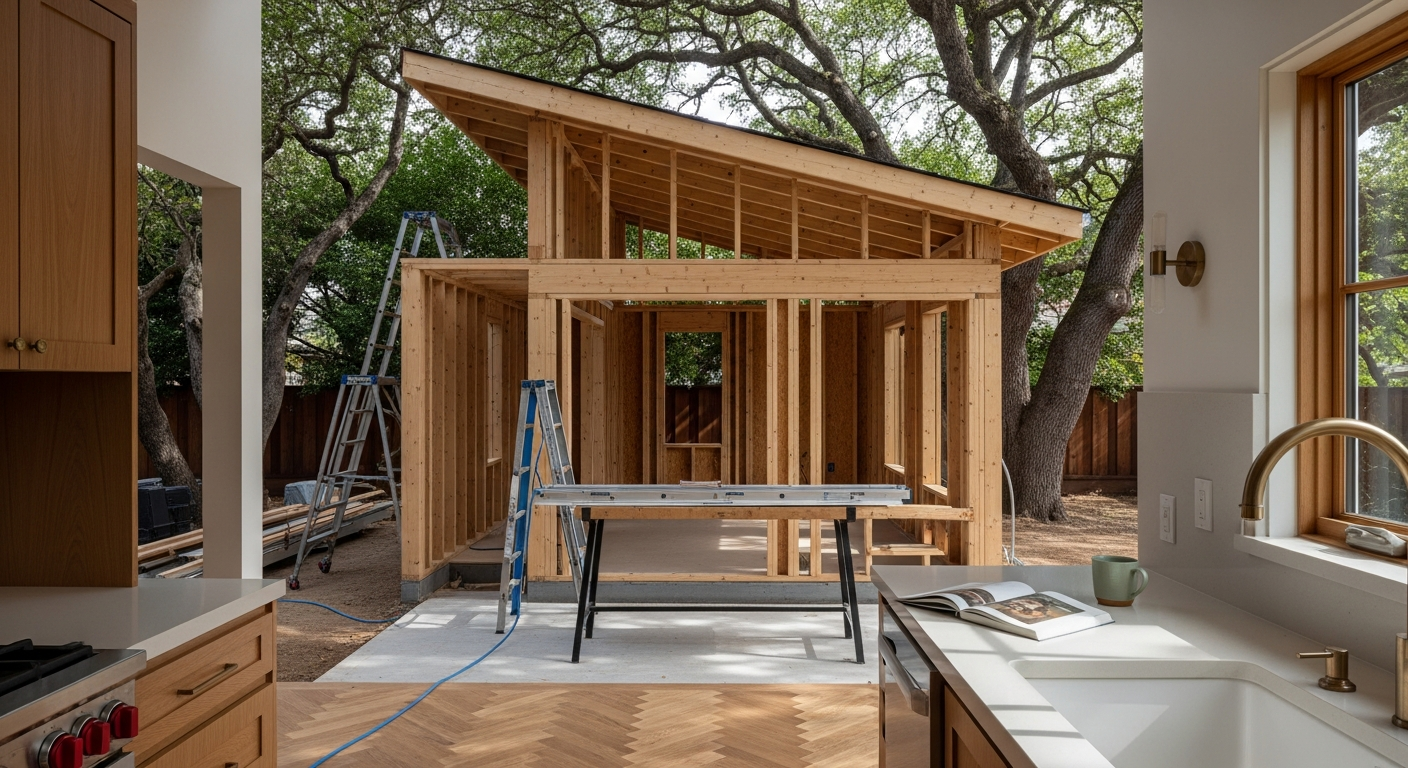
How Long Does It Take to Build an ADU in the Bay Area in 2026?
Those numbers might feel long, but here's the reality I share with every homeowner in Los Gatos, Saratoga, or Palo Alto who asks me this question: the projects that drag on for 18–24 months almost always stall during the planning phase, not the building phase. The homeowners who move fastest are the ones who understand each step before they begin.
That's exactly why I wrote this guide. Below, I'll walk you through every phase of the ADU construction process — with real durations, real costs, and the specific permit nuances we navigate in Santa Clara County and San Mateo County every week. Whether you're building a 400-square-foot junior ADU or an 1,100-square-foot detached unit, this is the roadmap.
Step 1: Feasibility Assessment and First Consultation (Week 1–2)
The ADU build timeline starts with a feasibility assessment — a site visit where we determine what's actually buildable on your property. This step takes 1–2 weeks and is the most important conversation you'll have in the entire process.
During this phase, our team evaluates:
- Lot size and setback requirements — California's ADU laws (effective January 2025) allow a minimum 4-foot rear and side setbacks for detached ADUs, but local overlay zones in cities like Los Gatos, Monte Sereno, and Hillsborough may impose additional design review requirements.
- Existing utility infrastructure — sewer lateral capacity, electrical panel amperage (most pre-1990 panels need a 200A upgrade), and water meter sizing.
- Site access for construction — Can we get a concrete truck into your backyard? Properties on narrow hillside lots in Woodside or Los Gatos sometimes require crane work or hand-carried materials, which adds cost.
- Soil and slope conditions — Hillside lots across the Santa Cruz Mountains foothills often require geotechnical reports ($3,500–$6,000), adding 2–3 weeks to the pre-design phase.
- Your goals — Rental income? Multigenerational living? Home office? An ADU for an aging parent has very different design priorities than a rental unit optimized for Airbnb income.
At Barcci Builders, this initial consultation is complimentary. By the end of week two, you'll have a clear yes-or-no on feasibility, a preliminary budget range, and a realistic timeline tailored to your specific property and city.
Step 2: ADU Design, Engineering, and 3D Renderings (Weeks 3–12)
The ADU design phase typically takes 6–10 weeks and is where your project transforms from an idea into a permit-ready plan set. This is the phase where most homeowners are surprised by the complexity — and where cutting corners creates expensive change orders down the road.
Architectural Design (Weeks 3–7)
Our in-house design team creates floor plans, elevations, and 3D renderings so you can visualize every detail before a single permit is filed. For ADUs, we typically go through 2–3 design revisions over 4–5 weeks. Key design decisions include:
- Layout optimization — In a 500-square-foot ADU, every inch matters. We use design techniques like pocket doors, built-in storage, and open-concept kitchenettes to make compact spaces feel significantly larger.
- Material selections — 2026 ADU design trends lean heavily toward warm, organic materials: rift-cut white oak cabinetry, microcement flooring, zellige tile backsplashes, and hand-applied plaster walls. Homeowners in Palo Alto's Professorville and Old Mountain View are choosing these finishes to ensure their ADU complements the character of their primary residence.
- Exterior cladding — Cedar cladding, natural stone veneer, and board-and-batten siding remain the most popular exterior finishes for Bay Area ADUs in 2026. Standing seam metal roofing pairs particularly well with modern designs.
- Energy efficiency — California's 2022 Title 24 energy code requires all new ADUs to be all-electric with solar-ready infrastructure. We specify high-efficiency mini-split HVAC systems, heat-pump water heaters, and induction cooktops as standard.
Structural Engineering and Title 24 (Weeks 6–12)
While design is being finalized, we run engineering and energy calculations in parallel. A structural engineer produces calculations and details ($4,000–$8,000), and our Title 24 energy consultant completes the required compliance documentation ($1,500–$2,500). For properties in Cupertino, Sunnyvale, and other Santa Clara County cities, we also coordinate fire sprinkler design if the ADU exceeds certain square footage thresholds or lot line proximity.
Our 2026 project data shows that the average design-and-engineering phase costs between $15,000 and $30,000, depending on ADU size and site complexity. This investment is included in our design-build contracts — you're never paying for plans that end up sitting on a shelf.
Step 3: How Long Does ADU Permitting Take in Santa Clara County?
Here's what the permitting phase actually looks like:
| Permitting Step | Duration | Notes |
|---|---|---|
| Plan submission to city | 1 day | Electronic submission in most Bay Area cities |
| First plan check review | 3–6 weeks | Building, planning, fire, and utility review |
| Corrections and resubmittal | 1–3 weeks | 85% of ADU applications receive at least one correction letter |
| Second review | 1–2 weeks | Faster turnaround on resubmittals |
| Permit issuance | 2–5 days | Pay fees, pull permit |
| Total typical range | 4–10 weeks | Santa Clara County average |
A few city-specific notes from our recent experience:
- Los Gatos — The Town of Los Gatos has been relatively efficient on ADU permits in 2026, averaging 5–7 weeks. However, properties in hillside residential zones trigger additional review by the Planning Commission, which can add 4–6 weeks.
- Palo Alto — Palo Alto's planning department requires an additional individual review for properties in certain single-family residential zones. Expect 6–8 weeks minimum.
- San Mateo and Burlingame — Cities in San Mateo County have been running 6–10 weeks, with fire department review often being the bottleneck.
- San Jose — The City of San Jose offers an expedited ADU permit track and has been averaging 4–6 weeks for standard applications in 2026.
ADU Permit Fees in the Bay Area (2026)
Permit and impact fees vary significantly by city. California law prohibits impact fees on ADUs under 750 square feet, which is a major cost advantage for smaller units. For larger ADUs:
| City | Permit Fees (750+ sq ft ADU) | School Impact Fees | Utility Connection Fees |
|---|---|---|---|
| Los Gatos | $8,000–$14,000 | Exempt under 750 sf | $5,000–$12,000 |
| Saratoga | $9,000–$16,000 | Exempt under 750 sf | $6,000–$15,000 |
| Palo Alto | $10,000–$18,000 | Exempt under 750 sf | $8,000–$18,000 |
| San Jose | $5,000–$10,000 | Exempt under 750 sf | $4,000–$9,000 |
| Cupertino | $7,000–$13,000 | Exempt under 750 sf | $5,000–$11,000 |
These fees are in addition to your construction costs and are paid at permit issuance. Our team handles the entire permit process — submission, plan check corrections, agency coordination, and fee payments — so you never have to stand in line at city hall.
Step 4: ADU Construction Timeline — What Happens During the Build (Months 5–12)
Here's the construction sequence we follow on every ADU project, with realistic durations for each phase:
Site Work and Foundation (Weeks 1–4)
Demolition or site clearing comes first, followed by trenching for utilities (sewer, water, electrical, gas stub if applicable). Foundation work includes forming and pouring a concrete slab or raised foundation. For Bay Area projects, we typically pour a post-tension slab, which performs better on our expansive clay soils. Concrete cures for a minimum of 7 days before framing begins.
Framing, Roofing, and Rough Systems (Weeks 4–10)
Framing a 600-square-foot ADU typically takes 2–3 weeks. After the framing inspection, roofing goes on immediately to protect the interior from rain (critical during Bay Area's November–March wet season). Rough plumbing, electrical, and HVAC are installed simultaneously by our coordinated trade teams. This is also when fire sprinkler rough-in occurs if required.
Insulation, Drywall, and Interior Finishes (Weeks 10–20)
After passing rough inspections, we install insulation (spray foam or batt, depending on the wall assembly), hang and finish drywall, and begin interior finishes. This is where your ADU truly comes to life:
- Cabinetry installation — Custom or semi-custom cabinets in rift-cut white oak or painted maple with integrated finger pulls are our most-specified option in 2026.
- Flooring — European white oak in herringbone pattern or wide-plank formats, microcement, or luxury vinyl plank (LVP) for budget-conscious builds.
- Tile work — Zellige tile in warm, earthy tones for kitchen backsplashes and bathroom walls. Hand-applied plaster walls in the living areas for that organic, textured look that's defining 2026 design.
- Fixtures — Unlacquered brass hardware and plumbing fixtures from brands like Kohler and Brizo are extremely popular. Miele and Bosch lead our appliance specifications for compact ADU kitchens.
Final Inspections, Punch List, and Certificate of Occupancy (Weeks 20–24)
The last 3–4 weeks involve final mechanical, electrical, plumbing, and building inspections, followed by a detailed punch list walkthrough. After all corrections are complete, we request the Certificate of Occupancy (C of O) from the city — this is the document that legally allows someone to live in the ADU. In Santa Clara County, final inspection to C of O issuance typically takes 1–2 weeks.
How Much Does It Cost to Build an ADU in the Bay Area in 2026?
| ADU Type | Typical Size | Cost Range (2026) | Cost Per Sq Ft | Timeline |
|---|---|---|---|---|
| Junior ADU (JADU) — internal conversion | 200–500 sf | $100,000–$200,000 | $350–$450/sf | 3–5 months |
| Garage Conversion ADU | 400–600 sf | $180,000–$320,000 | $380–$500/sf | 4–6 months |
| Detached ADU (standard) | 500–800 sf | $275,000–$425,000 | $420–$550/sf | 10–14 months |
| Detached ADU (premium) | 800–1,200 sf | $400,000–$600,000+ | $450–$550/sf | 12–16 months |
These numbers include design, engineering, permitting, and construction. They do not include landscaping, furnishing, or separate utility meter installations (which can add $5,000–$15,000).
A few cost factors unique to the Bay Area that national ADU cost guides miss:
- Prevailing labor rates — Skilled construction labor in Santa Clara and San Mateo counties commands $65–$95/hour in 2026, roughly 40–60% above the national average.
- Soils and seismic engineering — Bay Area seismic design requirements (Seismic Design Category D or E) add approximately 8–12% to structural costs compared to non-seismic regions.
- Material logistics — Tight lot access common in older neighborhoods like Campbell, Willow Glen, and Downtown Los Gatos increases delivery costs and extends framing timelines.
- Utility connection fees — As shown in the permitting section, utility fees alone can range from $4,000 to $18,000 depending on your city and whether a new sewer lateral or water service is required.
I always tell prospective clients: the cost-per-square-foot of a well-built ADU is higher than your main house addition, because you're packing an entire home — kitchen, bathroom, HVAC, plumbing, electrical — into a smaller footprint. The fixed costs of a kitchen and bathroom don't scale down just because the square footage is smaller.
What Are the Most Common ADU Build Delays (and How to Avoid Them)?
The most common ADU build delays in the Bay Area are permit correction cycles, utility coordination, and material lead times — not the construction itself. Over 116+ projects, here are the delays we've learned to prevent or minimize:
- Sewer lateral issues (adds 2–4 weeks) — Many Bay Area homes built before 1970 have clay or Orangeburg sewer laterals that can't support an additional dwelling unit. We scope the sewer line during feasibility to identify problems early. Replacement costs $8,000–$18,000.
- PG&E electrical panel upgrades (adds 3–6 weeks) — If your main panel needs a 200A upgrade, PG&E coordination can take weeks. California AB 68 prohibits cities from requiring panel upgrades as a condition of ADU approval, but practical electrical demand may still necessitate one.
- Custom material lead times — European fixtures (Duravit, Fantini), custom cabinetry, and specialty tile (handmade zellige, Calacatta Viola marble slabs) can have 8–14 week lead times. We place material orders during the permitting phase so deliveries align with construction milestones.
- Weather (November–March) — Foundation and framing work can be delayed by extended rain events. We build weather contingency into every schedule — typically 1–2 weeks during winter months.
- Neighbor disputes and HOA complications — While California law limits HOA restrictions on ADUs, neighbor concerns about privacy, views, and parking can slow projects politically. Proactive neighbor communication during the design phase prevents most issues.
The single best way to shorten your ADU build timeline is to hire a design-build firm that manages architecture, engineering, permitting, and construction under one contract. When design and construction teams work separately, you lose weeks (sometimes months) to miscommunication, redesigns, and finger-pointing. At Barcci Builders, every ADU project moves through a single point of accountability — from first sketch to final walkthrough.
ADU Build Timeline Summary: A Month-by-Month Roadmap for Bay Area Homeowners
Here's the complete ADU build timeline condensed into a month-by-month overview, based on a typical 600-square-foot detached ADU in a Bay Area city like Los Altos, Menlo Park, or Mountain View:
| Month | Phase | Key Milestones |
|---|---|---|
| Month 1 | Feasibility + Design Kickoff | Site visit, property research, preliminary budget, design contract signed |
| Month 2–3 | Architectural Design + 3D Renderings | Floor plans finalized, exterior elevations, material selections begin, 3D walkthroughs approved |
| Month 3–4 | Engineering + Plan Set Completion | Structural engineering, Title 24 energy calcs, fire sprinkler design, plan set assembled for permit |
| Month 4–6 | Permitting | Plans submitted, first review, corrections addressed, permit issued, material orders placed |
| Month 6–7 | Site Work + Foundation | Demo/clearing, utility trenching, foundation pour, slab cure |
| Month 7–9 | Framing + Roof + Rough Systems | Wood framing, sheathing, roofing, rough plumbing/electrical/HVAC, insulation |
| Month 9–11 | Interior Finishes | Drywall, cabinetry, countertops, tile, flooring, paint, fixtures, appliances |
| Month 11–13 | Final Inspections + Move-In | Final inspections, punch list, Certificate of Occupancy, landscaping, move-in |
Total: 10–14 months for a straightforward detached ADU. Garage conversions compress this to roughly 7–10 months. Complex hillside or two-story projects may extend to 14–16 months.
If you're considering building an ADU in the South Bay or Peninsula, I'd encourage you to start the conversation early — even if you're 6 months away from wanting to break ground. The design and permitting phases are where we have the most flexibility to refine your budget, and getting a head start on these steps is the single most effective way to stay on schedule. Reach out to our team to discuss your property's specific feasibility and get a realistic, personalized timeline for your ADU project.
Frequently Asked Questions
How long does it take to build an ADU in California in 2026?
In 2026, building an ADU in California takes 10–16 months from initial design through move-in, based on project data from Barcci Builders' 116+ completed Bay Area projects. This includes 2–4 months for design and engineering, 2–4 months for permitting (California law mandates 60-day permit review for compliant applications), and 5–7 months of construction. Garage conversions are faster at 7–10 months total, while hillside or two-story ADUs can take up to 16 months.
How much does it cost to build an ADU in the Bay Area in 2026?
Bay Area ADU construction costs range from $250,000 to $550,000+ in 2026, depending on type and finishes. Garage conversions typically cost $180,000–$320,000, standard detached ADUs (500–800 sf) cost $275,000–$425,000, and premium detached ADUs (800–1,200 sf) cost $400,000–$600,000+. Cost per square foot ranges from $350–$550, which is higher than the national average due to Bay Area labor rates, seismic engineering requirements, and permit fees. These figures include design, engineering, permitting, and construction.
How long does it take to get an ADU permit in Santa Clara County?
ADU permit approval in Santa Clara County takes 4–10 weeks in 2026, depending on the city and project complexity. San Jose has been the fastest at 4–6 weeks, while Los Gatos averages 5–7 weeks and Palo Alto runs 6–8 weeks. Approximately 85% of ADU applications receive at least one correction letter, which adds 1–3 weeks for resubmittal and second review. California law (Government Code Section 65852.2) requires cities to approve compliant ADU permits within 60 days.
What is the cost per square foot to build an ADU in Silicon Valley?
The cost per square foot for ADU construction in Silicon Valley ranges from $350 to $550 per square foot in 2026. Junior ADUs and garage conversions fall on the lower end ($350–$500/sf), while new detached ADUs with premium finishes like rift-cut white oak cabinetry, Dekton countertops, and custom tile work are $450–$550/sf. These rates are 40–60% above the national average due to Bay Area labor costs ($65–$95/hour for skilled trades), seismic engineering requirements, and high permit and utility connection fees.
Do I need a permit to build an ADU in Los Gatos, CA?
Yes, a building permit is required for any ADU construction in Los Gatos, California. The Town of Los Gatos processes ADU permits through its Community Development Department. Standard applications are reviewed within 5–7 weeks in 2026. Properties in hillside residential zones may require additional Planning Commission review, adding 4–6 weeks. Permit and impact fees for ADUs over 750 square feet in Los Gatos range from $8,000 to $14,000, plus utility connection fees of $5,000–$12,000. ADUs under 750 square feet are exempt from impact fees per California state law.
Garage conversion ADU vs. detached ADU — which is faster and cheaper?
Garage conversions are both faster and cheaper than detached ADUs. A garage conversion typically takes 7–10 months total (3–5 months construction) and costs $180,000–$320,000, while a detached ADU takes 10–14 months (5–7 months construction) and costs $275,000–$425,000. However, garage conversions are limited by the existing garage footprint (typically 400–600 sf) and may require foundation reinforcement. Detached ADUs offer more design flexibility, can be up to 1,200 square feet, and often achieve higher rental income — $3,000–$5,500/month for a well-designed detached unit in cities like Palo Alto, Los Gatos, or Menlo Park.
What are the biggest delays when building an ADU in the Bay Area?
The three most common ADU build delays in the Bay Area are: (1) permit correction cycles, which add 3–6 weeks when plan submissions are incomplete or don't meet city-specific requirements; (2) utility coordination, especially PG&E electrical panel upgrades (3–6 weeks) and sewer lateral replacements (2–4 weeks); and (3) custom material lead times — European fixtures and handmade tile can take 8–14 weeks to arrive. Weather adds 1–2 weeks during the November–March rainy season. Working with a design-build firm that manages the entire process under one contract is the most effective way to minimize these delays.
Can I build a two-story ADU in California in 2026?
Yes, California law allows two-story ADUs in many situations as of 2025 (AB 1033 and related legislation). Two-story ADUs can be built up to 16 feet in height in most single-family zones, and some cities allow up to 18–24 feet depending on lot size and primary home height. However, individual city zoning codes may still impose additional restrictions. In Los Gatos and Saratoga, two-story ADUs typically require design review to assess neighborhood compatibility. A two-story detached ADU costs approximately 15–25% more than a single-story unit of the same square footage due to additional structural engineering, staircase construction, and increased framing complexity.